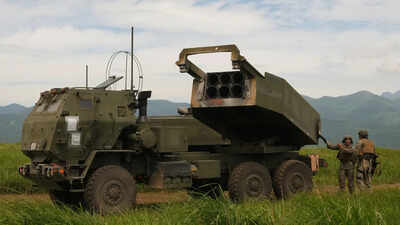
The United States has stepped up its use of mobile missile launchers in the Indo-Pacific, with US Marines conducting a live-fire HIMARS exercise this week at Camp Fuji in Japan to demonstrate how, where, why, and with what capability Washington plans to deter potential Chinese aggression against Taiwan.
The short but high-impact drill, carried out in the foothills of Mount Fuji with Japanese observers present, showcased rapid “shoot-and-scoot” tactics designed to counter evolving battlefield threats and reinforce allied defence coordination.
The exercise saw two HIMARS units fire a total of 12 rockets in quick succession before retreating to concealed positions, underscoring a tactical shift towards mobility and survivability. The demonstration comes as the Pentagon prioritises “deterrence through strength, not confrontation” in response to China’s growing military capabilities and the rising risk of conflict in the Taiwan Strait.
Zelensky 'Hides In Bunker' | On Cam:Biblical Fireball In Kyiv After Russia's Oreshnik Missile Strike
Military planners increasingly view truck-mounted systems like HIMARS as central to future warfare in the region, particularly in scenarios where fixed assets and large platforms such as aircraft carriers could be vulnerable.
“The US does not want China to invade Taiwan, but it would not be relying on the traditional aircraft carrier-based attack wings of the past,” said Euan Graham, a senior defence analyst with the Australian Strategic Policy Institute. “In Iran, with the US conflict there, there were over 40 US aircraft, manned and unmanned, either destroyed or damaged against a much less capable adversary, so in the case of conflict with China, that vulnerability would be much greater,” he said. “That’s why we’re seeing the US emphasising these smaller units.”
The HIMARS, or High Mobility Artillery Rocket System, allows forces to deploy rapidly, fire GPS-guided missiles, and relocate within minutes to avoid detection by drones or satellites. “It depends on the crew, but it can get as fast as four minutes, [even] two minutes sometimes,” said Sergeant Kevin Alvarez, section chief of one of the units involved in the drill.
Recent conflicts, particularly in Ukraine and the Middle East, have reinforced the importance of mobility as drone surveillance and precision strikes make static positions increasingly vulnerable. Lt Col Ryan Anness, commander of the 3rd Battalion, highlighted the advantage of such systems.
“They’re much quicker, much faster, and much easier to hide than, say, traditional cannon artillery, and obviously having the precision fire weapons and having the ability to hide easier is why so many countries, and why it’s important for us, to have the HIMARS,” he said.
The system’s expanding strike range further enhances its strategic value. HIMARS can now fire precision strike missiles capable of hitting targets more than 310 miles away, in addition to ATACMS missiles with a range of about 180 miles. These capabilities were recently demonstrated in combat during US operations against Iran, where such systems were used to strike maritime targets.
Defence analysts note that, when combined with other mobile platforms such as the Army’s Typhon missile system, HIMARS could effectively cover key flashpoints, including the Taiwan Strait and the Luzon Strait. These waterways are considered critical in any potential Chinese attempt to blockade or invade Taiwan.
“In advance of a conflict around Taiwan, there would likely be a large-scale outflux of US assets within the envelope of China’s missile capabilities,” Graham said. “All that would be left is submarines, which are more survivable, and small units based on rugged survivability — mobile systems like the HIMARS.”
The Camp Fuji exercise, conducted with dummy rounds under strict safety protocols, also served to reinforce coordination with Japan, a key US ally in the region. Local infrastructure was temporarily restricted during the drill to ensure safety, reflecting the controlled but realistic nature of the training.
US officials emphasise that such exercises are intended not as provocation but as a signal of readiness and partnership. “Being able to have long-range precision-fire weapons provides deterrence here in the Pacific, and we train with our Japanese partners as much as we can to make sure we’re ready,” Anness said.
Poll
What do you consider the most important factor for US military strategy in the Taiwan Strait?