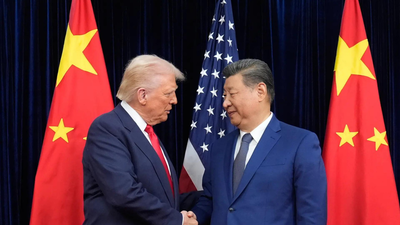
US President Donald Trump’s visit to Beijing ended without any major breakthrough from his talks with Chinese President
Xi Jinping. The visit instead highlighted the widening gap in core interests between the two major powers. Both sides projected warmth and stability but the meetings showed how difficult it has become to turn high-level engagements into meaningful cooperation on major issues such as truce in Iran with focus on reopening the Strait of Hormuz, Taiwan, and technology. The low hanging fruit seemed to be only trade. Ahead of the talks, in an article I had stated that while stakes from the summit seemed high the outcomes were likely to be low. These low expectations have now been met as the Summit was short on major concrete deliverables but long on protocol and pomp. Both leaders left able to claim a measure of victory, being now locked in a delicate détente. For Trump, that meant a fresh round of commercial deliverables China’s commitment to purchase more planes, agriculture, and energy products. For Xi, it was an opportunity to lay down red lines on Taiwan and to offer up a new framework for the bilateral relationship.
As Xi announced at the Great Hall, “I have agreed with President Trump on a new vision of building a constructive China-US relationship of strategic stability. This will provide strategic guidance for China-US relations over the next three years and beyond.”
The fact is that US–China ties have entered a more transactional phase, where both sides focus on leverage rather than compromise. The meetings in Beijing appear to support that view. Iran the Heart Of Global Strategic Anxiety Iran emerged as one of the most immediate and visible points of discussion. Reports in US media suggested that Washington hoped Beijing would use its significant economic leverage over Tehran to encourage de-escalation. Given China’s position as one of Iran’s largest oil buyers and a key economic partner, the US expected Beijing to exert indirect pressure on Tehran to moderate its stance, thereby helping to reduce risks in a region already marked by instability. However, Chinese responses remained deliberately cautious and non-committal. Chinese statements after the talks included only general calls for restraint, ceasefire, and regional stability, without any indication that China intended to apply pressure on Tehran or adjust its economic engagement. The absence of concrete commitments underscored the limits of US expectations regarding China’s willingness to align with Washington on Middle Eastern security concerns. As per the White House readout, the two leaders reached a mutual understanding that “Iran can never have a nuclear weapon” and that the Strait of Hormuz “must remain open,” with Xi voicing opposition to the militarization of the strait and to any effort to “charge a toll for its use.” No country has a greater interest in seeing oil flow freely through the strait than China. Trump reported that Xi promised to be helpful with Iran and suggested he might lift sanctions on Chinese companies buying Iranian oil. In an interview with Fox News, he also claimed that Xi had assured him China would not supply Iran with military equipment. Speaking after returning from Beijing, Trump stated that he was “not asking for any favours”, while suggesting that China would “automatically” pressure Iran. However, he did not provide any explanation of how such pressure would materialise or what mechanisms might drive it. His remarks appeared to rely more on assumption than on negotiated agreement, reflecting the broader ambiguity surrounding the Iran discussions.
At the same time, Trump noted Xi’s emphasis on maintaining China’s access to Iranian oil and the importance of reopening maritime routes such as the Strait of Hormuz. These statements, while significant in tone, were not accompanied by any formal agreement or jointly issued framework. China’s foreign ministry, for its part, reiterated its longstanding position that a ceasefire in Iran was necessary and stressed the importance of ensuring that the Strait of Hormuz remains open “as soon as possible”. Yet again, these remarks reflected continuity rather than policy change, reinforcing the impression that the summit did not alter Beijing’s strategic posture in the region. But the fact is that that for Iran geography remains its biggest asset and it has realized that the Strait of Hormuz has far greater strategic value than even their nuclear programme and even greater than their proxies. Ghalibaf its Parliament Speaker has publicly stated that” the Strait of Hormuz situation won’t return to its pre-war status”. China Draws the Red Line Taiwan remained the most sensitive issue on the agenda as far as China was concerned. President Xi stated that mishandling the Taiwan question could push bilateral relations into a “dangerous place”, reaffirming Beijing’s long-standing position that Taiwan constitutes a core national interest. His remarks that; “The Taiwan question is the most important issue in China-US relations. If it is handled properly, the bilateral relationship will enjoy overall stability. Otherwise, the two countries will have clashes and even conflicts, putting the entire relationship in great jeopardy.” This reflects China’s view that the issue is central to its sovereignty and cannot be subject to compromise in the same way as economic or diplomatic disputes. On the American side, officials reiterated that the US policy toward Taiwan remained unchanged. Marco Rubio emphasised that Washington continues to oppose any use of force and warned that military escalation would represent a “terrible mistake.” However, on his return journey, Trump told reporters that he and Xi “talked a lot about Taiwan” and discussed “in great detail” the pending $14 billion weapons sale to Taiwan. He added, “I think the last thing we need right now is a war that’s
9,500 miles away.” Trump said that “on Taiwan [Xi] feels very strongly, I made no commitment either way.” Whether Trump ultimately approves the package, puts it on a back burner or uses it as a bargaining chip in broader negotiations will be one of the summit’s most consequential outcomes. By declining to confirm whether such support would proceed, he introduced additional unpredictability into an already fragile strategic balance. But it also underscores his ‘America First’ policy. Trade and Technology Beyond Iran and Taiwan, the summit did little to advance cooperation in trade or technology, despite public references to “fantastic trade deals” and resolve issues. President Trump’s entourage had a commercial focus as he was accompanied by a CEO delegation. Among his aims were Chinese purchases of American products like soybeans, LNG and Boeing aircraft. However, such purchases, even if fulfilled, are unlikely to compensate for the damage to US businesses from the 2025 trade war, when the US sought to use tariffs as a tool to extract concessions from China, but it was ultimately thrown off balance by China’s countermeasures – e.g., leverage over rare earths after identifying the US vulnerability. But the optics are necessary for a politically vulnerable administration. Trump announced that Chinese firms agreed to purchase two hundred Boeing aircraft the first major state-linked order from China since 2017. American farmers may also benefit from President Xi’s commitment to honor the 25-million-metric-ton soybean pledge made at Busan last October. There were also promises regarding additional purchases of US oil, liquefied natural gas, and other energy and agricultural products to come. Semiconductor exports and cooperation on artificial intelligence (AI) safety may also benefit. Shortly after the meeting, it was reported that the US had agreed to the sale of Nvidia’s H200 AI chips to roughly ten major Chinese technology firms including Alibaba, Tencent, ByteDance, and JD.com.
The two countries also appeared to open a new track on AI safety, by a protocol framed to ensure that “nonstate actors don’t get a hold of these models. President Xi attempted to frame the broader relationship in historical and ideological terms, suggesting that China’s “great rejuvenation” and the concept of making America great again could proceed in parallel. This rhetorical framing was intended to signal compatibility rather than confrontation. However, in practice, it did little to bridge the widening gap between the two countries’ strategic priorities. Implications for India As far as India is concerned the growing thaw in the US – China relations reinforces the point that India stands alone as far as its land threat is concerned along the Line of Actual Control with China. The US had used India to balance China in its pivot towards Asia but that did not deter China from initiating hostilities in Galwan in 2020. Trump 2.0 has already seen improvements in US relations with Pakistan with General Asim Munir being termed as ‘the favourite Field Marshal’. The maritime domain is an area which is significant to the US policy regarding India. For more than two decades, consecutive administrations have deepened ties with India as a measure to counterbalance China’s influence in the Indo-Pacific. A potential China-US reset could result in India questioning where it stands in the Quad's strategic framework. As per Ronak D Desai, visiting fellow at the Hoover Institution, Stanford University; ‘If Trump prioritizes a bilateral grand bargain with Beijing, India will have “reasonable concerns that the US will treat China as the central negotiating partner in Asia rather than as the central strategic challenge.” He goes on to state; “India will need to make its strategic value harder to overlook,” adding this would mean the US -India relationship must lead to more tangible outcomes in sectors like defence, maritime security, critical minerals, energy, and manufacturing.
On the surface, both sides continue to value high-level engagement as a tool for signaling stability and preventing escalation. Behind the scenes, however, the scope for compromise appears increasingly limited. Each side remains committed to core interests that are fundamentally incompatible in key areas, particularly regarding Taiwan. The fact is that China has asserted itself as a global strategic competitor to the US. With a growing military that rivals the United States, the world’s second-largest economy, and steadfast soft-power campaigns throughout third countries, China has never been more important. No wonder President Xi remarked; “Can China and the United States overcome the ‘Thucydides Trap’ and establish a new paradigm for relations between great powers?” The theory that a rising power's bid to displace an established great power inevitably raises the risk of conflict posing the question of whether China and the United States could transcend it. Implicit in Xi’s invocation of ‘Destined for War ‘by Graham Alison is the premise that China’s rise is unstoppable, and that the US must accommodate it, lest the two head into a Peloponnesian War but this time it will be with nuclear characteristics. The broader implication of the summit is not that diplomacy has changed. Rather than producing significant agreements, summit meetings now serve primarily to manage expectations, reduce immediate tensions, and maintain channels of communication in an increasingly competitive environment. But the fact is that the US is today embroiled in the ongoing conflicts including Iran while China has used this time to build its strength and sees the US as a declining power hence Trump appears to have visited China at a time when his leverage is reduced. There is a long list of issues between the two nations who are engaged in a multidimensional competition but the visit reveals that while there is a shift towards rapprochement both share a preference for managing their rivalry rather than resolving issues. This was visible in the calibration between economic cooperation and strategic warning.