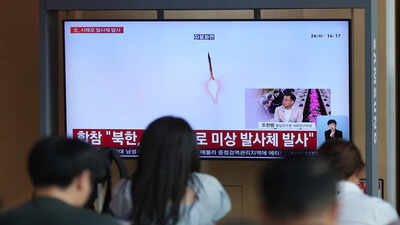
North Korea fired several projectiles, including a suspected short-range ballistic missile, into the Yellow Sea on Tuesday, according to South Korea’s military, marking Pyongyang’s first missile launch in 37 days and its eighth weapons test this year amid rising regional tensions.
South Korea’s Joint Chiefs of Staff said the launches were detected from the North Korean city of Chongju at around 1:00 pm local time (0400 GMT). The projectiles reportedly travelled around 80 kilometres before falling into the Yellow Sea, the body of water separating the Korean peninsula from China.
North Korea Fires Multiple Ballistic Missiles After Trump Announces Ceasefire With Iran
The launch has triggered renewed scrutiny over North Korea’s rapidly modernising short-range missile programme, particularly its efforts to improve precision, survivability and the ability to evade missile defence systems.
South Korea’s military said it had “strengthened surveillance and vigilance in preparation for possible additional launches” and added that Seoul, the United States and Japan were maintaining “a state of full readiness” while closely sharing intelligence.
If confirmed as a ballistic missile launch, it would be North Korea’s first such test since April 19, when Pyongyang fired several short-range ballistic missiles reportedly equipped with cluster bomb warheads.
Missile launch comes amid renewed weapons push
The latest launch followed a series of missile and weapons tests conducted by Pyongyang in recent months as North Korean leader
Kim Jong Un continues pushing military modernisation efforts.
In April, North Korea claimed it had tested a new cluster bomb warhead as well as an electromagnetic weapon, moves analysts viewed as part of broader attempts to demonstrate the country’s ability to wage what it describes as a “modern war”.
North Korea has also repeatedly rejected reconciliation efforts by South Korea, calling Seoul its most “hostile” adversary.
Kim Jong Un declared earlier this year that North Korea’s nuclear weapons status was “irreversible” and stressed that expanding a “self-defensive nuclear deterrent” remained essential for national security.
Growing focus on short-range missile systems
Defence analysts say Pyongyang’s recent missile activity highlights an increasingly important shift in focus towards advanced short-range strike systems capable of overwhelming missile defence networks on the Korean peninsula.
According to a January 2023 study published by The European Network of Independent Non-Proliferation Think Tanks, North Korea has significantly modernised its short-range missile arsenal through systems such as the KN-23, KN-24 and KN-25.
The report by Stéphane Delory, Antoine Bondaz and Christian Maire noted that Pyongyang was replacing older Soviet-era Scud-derived systems with more accurate and survivable missiles capable of penetrating South Korean and US missile defence systems.
The study said North Korea’s short-range arsenal was evolving through two major developments: solid-fuel propulsion and quasi-ballistic missile technology designed to evade interception.
“Pyongyang probably sought to increase the ability of the arsenal to overcome missile defence in order to ensure its capability to strike in every circumstances,” the report stated.
KN-23, KN-24 and KN-25 seen as key upgrades
Among the systems attracting particular attention are the KN-23, KN-24 and KN-25 missile families, which analysts believe significantly expand North Korea’s conventional and strategic strike options.
The KN-23 is considered visually similar to Russia’s Iskander missile system and has reportedly undergone multiple upgrades, including heavier variants displayed since 2021.
The KN-24, meanwhile, is viewed as a North Korean analogue of the US ATACMS tactical missile system and is believed to be intended for battlefield support and long-range artillery operations.
The KN-25 has attracted growing concern because of its unusually flat flight trajectory and ability to overwhelm missile defence systems through mass launches.
According to the study, the KN-25 “may represent a real breakthrough” because it demonstrates North Korea’s growing ability to produce highly advanced weapons systems domestically.
Missile upgrades may widen military options
Experts believe the growing accuracy and survivability of North Korea’s short-range systems could substantially alter military calculations on the Korean peninsula.
The study argued that improved missile precision may allow North Korea to target military, industrial and economic sites more selectively during limited conflicts while maintaining escalation control.
“Assuming that the defences currently deployed in South Korea would be significantly less effective against North Korea’s quasi-ballistic systems, the increased accuracy of its missiles substantially improves North Korea’s strike options,” the report said.