
- News
- City News
- visakhapatnam News
- ‘India is equipped to withstand foreign threat’
Trending
This story is from December 5, 2016
‘India is equipped to withstand foreign threat’
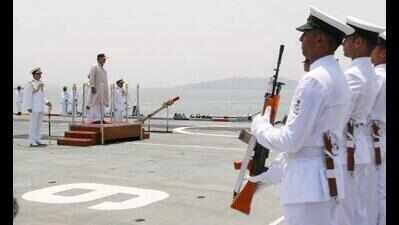
<p><br> Representative image</p>

We have heard that Russia and Reliance Industries have shown interest in setting up ship-building manufacturing and other facilities in Vizag. What’s the Navy's take on this?
I have heard this in passing and not received any concrete news about their interest. But I feel being self-reliant and indigenously manufacturing is the best. Though we are manufacturing ammunitions, missiles and rocket launchers, we are still importing certain weapons. Effort should be on ‘Make in India’, which is the best rather than depending on foreign nations.
To counter the Chinese in the Eastern Sea Board, what is the Indian Navy’s stand on a maritime quadrilateral as suggested by foreign delegates visiting India from US, Japan and Australia?
Maritime quadrilateral or maritime cooperation on sea and joint naval exercises is just one part of it. It has to be extended to socio-cultural bonhomie within the nations. Engagement with Indian Ocean Region (IOR) countries is very important and ships are deployed accordingly. ENC is very serious about it and benign naval operations and surveillance missions will continue in 2017 too.
As China forays into the IOR, India’s Look East Act East Policy is important. How far is ENC braced up for Chinese activities? Also, what about threats from Pakistan?
Since India and China are both fastest growing economies, both have certain common interest in sea links protection. Threat is a combination of intention and capability. We both have the capacities and intention is economic development. As for Pakistan, which doesn’t come under ENC’s domain, but as an independent observer I can say that they are grappling with their own issues. It’s not so easy for them to undertake full-fledged hostile attacks. Economic development is the common issue for all now. However, with one of the largest fleets in the world, India is equipped and capable enough to withstand any threat from them.
How are the preparations of the Indian Navy’s Everest Expedition going on?
There is a plan to scale the Mount Everest in 2017 by navy men from the different commands situated in Visakhapatnam, Mumbai and Kochi. It’s being organised by the headquarters in Delhi. Some women officers are also joining. However, the team has not yet been finalised. Pre-Everest expeditions have been continuing since last year during which our people have been summiting different peaks including Mt Saser Kangri, Mt Kun and Mt Kamet. Though lower in height than Mt Everest, these peaks are extremely challenging and provide a tough training for those aiming to summit the world’s highest peak Mt Everest. Those who successfully scale these lower peaks, will make it to the final expedition team.
What other expeditions are on the cards?
Another interesting expedition would be that of circumnavigation by the sailing boat Mhadei’s sister ship Tarini with an all-women crew. Already, training is going on and the women are going on successful sailing expeditions and competitions or participating in races for instance from Cape Town to Rio on board Mhadei. We are looking forward to their sagar parikrama or circumnavigation round the globe on that sailing vessel in the near future. Trained by Commander Dilip Donde, the six women crew includes naval ATC officer Lt P Swathi from Vizag too.
When will women officials be deployed in the sea as their male counterparts?
This is a subject very close to our heart and we are looking forward to deploy them into the sea on board ships in the future. Already, women are an integral part of the Indian Navy and are doing very well. Most of them are working with the Air Traffic Control (ATC) or as sensor operators. However, to send them to the sea, certain women-friendly environment has to be created so that they don’t feel aloof or uncomfortable when they are at sea for long time deployment.
What are the hardships or challenges faced by ENC?
Operating in the maritime domain is a challenging task as the crew members face vagaries of weather and rough sea life, which causes damage to the equipment as well besides sea sickness especially among the newly joined seamen. Pollution from the open coal dumps in the dockyard is also another major problem in Vizag as along with the wind, all the coal dust blow into our ships.
Where are we deficient as a naval force?
We don’t lack anything as such. But we need to keep upgrading ourselves through training and up- gradation of technologies, which should be a continuous and ongoing process. Learning, new ideas and incorporation of advanced technologies should continue and we should not sit satisfied at what we have already achieved.
End of Article
FOLLOW US ON SOCIAL MEDIA








Hot Picks
TOP TRENDING
Trending Stories
In City
Entire Website
- Mysuru-based woman’s startup bags top honour
- Unni Vavavo a hit again, thanks to Alia Bhatt’s kid
- 'Don’t drag us into your agenda’: SC dismisses NCPCR plea seeking SIT probe into Jharkhand shelter homes
- 'Opened multiple bank accounts': Rs 382 crore tax notice leads to Aadhaar, PAN misuse scam in Thane
- Flyers denied airport lounge access, issue sorted in evening
- 10 most stressed states in the U.S. in 2024; check out the list
- Delhi's maximum temperature soars to 37°C, rain likely to return tomorrow
- "We Have Decided To Part Ways Respectfully": WWE Hall of Famer Announces Separation from Wife Wendy Barlow
- This is what Damian Priest said about Jey Uso’s Intercontinental Championship win
- 49ers’ Christian McCaffrey Travels to Germany for Achilles Treatment: What It Means for His Season
- Delhi roots, Colombo heights: New Sri Lankan PM Amarasuriya's link to India
- Kangana in dock again, BJP condemns MP's remarks on farm laws
- Why renaming Port Blair as Sri Vijaya Puram is a mockery of history
- Urmila Matondkar files for divorce from husband Mohsin Akhtar Mir
- How Israel sent warning texts? By hacking Lebanon telecom
- After a 'brat summer', Gen Z is celebrating a 'Strega Nona fall' this September
- After flirting with China, is Maldives back to loving India?
- Apple cuts price of iPhone 15 & iPhone 14 models, here's new price list
- Former academic Anura Kumara Dissanayake becomes Sri Lanka's third woman PM
- Israeli strike kills Hezbollah's top missile commander; toll hits 569

Popular Categories
Hot on the Web
Top Trends
Trending Topics
Living and entertainment
Latest News
'Virat shuru hoga Australia se': Basit Ali says Kohli's low scores vs Bangladesh not an issueAstrology-Inspired Characters in Movies: A Cosmic Connection on the Big ScreenTest | War 2: Hrithik Roshan, Kiara Advani's romantic chemistry grabs attention in viral picsAstrology-Infused Plotlines: The Cosmic Connection in Bollywood and HollywoodEC to have 'zero tolerance' towards use of money power in Jharkhand assembly pollsThrowback: When Parineeti Chopra shined in yellow during her joyful haldi ceremony celebrationsICAI CA Final Exam for Nov 2024 postponed due to Diwali, new exam date announced: Check official notice hereWhy you should avoid falling for your best friendEpic Last 'Monster' Standing match and more exciting matches announced for WWE RAW (9/30)Alia Bhatt reveals she and Ranbir Kapoor chose Raha's name at Jr NTR's house: 'He wished to pick the same name for his daughter'Donald Trump shares 'nail salon gossip' that Kamala Harris paying $700 for...Astrological Themes in Popular Film FranchisesBiden acknowledges he's running out of time as violence escalates in Middle-East: Aides‘My brother is critical but stable’; Veteran actor Manoj Mitra’s brother debunks death hoaxTirupati Laddu controversy: Prakash Raj vows to meet Pawan Kalyan for one-on-one discussionSocial media owners, generative AI biggest threats to online news: Experts warnSean 'Diddy' Combs predicted his arrest for 'freak offs' in 1999 video: They're gonna probably be arresting me doing all types of crazy thingsWhy there are growing cases of respiratory disease in India
Copyright © 2024 Bennett, Coleman & Co. Ltd. All rights reserved. For reprint rights: Times Syndication Service