
- News
- City News
- thane News
- Thane kids create gadgets based on daily life observations
Trending
This story is from August 13, 2016
Thane kids create gadgets based on daily life observations
Four 13-year-olds from AK Joshi High School have taken inspiration from a few observations in their daily life and created two gadgets that use the basic principles of physics to help the society at large.
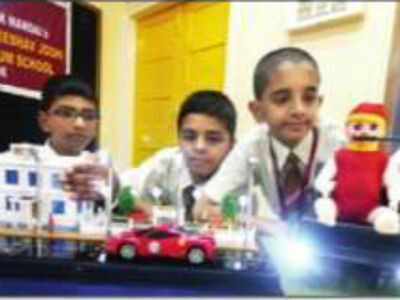
Students from AK Joshi Hish School with their projects has been invite to represent India at a contest in China this month
While class VIII students Varad Lele and Chaitanya Paranjpe have created a tech savvy infrared sensor equipped wheelchair that will enable the physically challenged to move independently by only moving their tongue, their classmates Shubham Karampure and Aashutosh Sathe have innovated a method of generating electricity through vehicular movement using simple physics.

These young innovators have now been invited to showcase their technology and represent India at an adolescent science and technology innovation contest in China from August 15 to 19.
Speaking about the revolutionary ways to generate electricity, Aashutosh said, “Shubham and I were discussing what made the popular children's shoes glow. We found out that it was the mechanical stress generated by the act of walking that converted into the charge that lit the shoes up.” He added, “After research and guidance from teachers, we found that Piezo plates can be used for generating electricity in the same way as their particles produce mechanical energy when under pressure. We created a prototype of this, which if put under pavements or roads will create electricity with the movement of every vehicle or person over it. The excess energy can be stored or added to the power grid.”
Regarding the other project of an infrared sensor equipped wheelchair for the physically challenged Varad said, “We were taken aback by the complete dependency of the disabled community on others even for basic requirements. We realised that if they had a wheelchair like Stephen Hawking's, then they would regain their sense of independence. We created a chair wherein one handle is at the face level and uses infrared sensors to detect tongue movements of the disabled person. This circuit has three sensors which monitor the leftward, rightward and frontal movement of the person's tongue respectively.”
End of Article
FOLLOW US ON SOCIAL MEDIA









Photostories

Hot Picks
TOP TRENDING
Popular Categories
Hot on the Web
Top Trends
Ratan TataRatan Tata HospitalisedIND vs BAN Live ScoreRatan Tata DiesNew UPI Transaction LimitWorld First Top 10 TrillionairesStock Market TodayKerala Lottery ResultElection Results 2024Tom BradyIsrael Hezbollah WarSuryakumar YadavManagement Colleges of IndiaTop Medical Colleges of IndiaTop Engineering Colleges of IndiaTop Pharmacy Colleges of IndiaLive Cricket Score
Trending Topics
Diwali WishesBigg Boss Tamil 8 Contestants ListBhool Bhulaiyaa 3 TrailerDurga Puja WishesSanjay Leela BhansaliVettaiyan ReviewBigg Boss 18 House PhotoDevara CollectionBigg Boss 18Deepika PadukoneShailesh LodhaDevaraColdplayNational Film Awards 2024Swatantrya Veer SavarkarColdplay India tour 2025Watch NFL Live StreamDress To ImpressRatan Tata DeathWordle Answer
Living and entertainment
Latest News
Ratan Naval Tata: The inspiring journey of Padma Vibhushan laureate and golden-hearted business tycoonSamantha Ruth Prabhu shares playtime with Chinmayi Sripaada's daughter, says 'It took her 4.5 seconds to disown her parents'Mohanlal remembers late TP Madhavan: ‘His love and affection were akin to that of a father towards me'Buy only from Sanatanis, says Akhara ParishadIshan Kishan named Jharkhand captain for Ranji TrophyPadma Vibhushan industrialist Ratan Tata dies at 86Ratan Tata: The industry titan with a golden heartManifesting with the 10/10 Portal: Zodiac-based guide for 20249 proven techniques for fastest weight lossOnly a true creative genius can spot the odd unicorn in 12 seconds!India vs Bangladesh 2nd T20: Nitish Kumar Reddy smacks seven sixes as hosts shatter multiple recordsTurkey's navy starts to evacuate its citizens from Beirut as Israel battles Hezbollah'Inspired this entire nation', 'remembered for invaluable contribution': Sports stars pay tribute to Ratan TataAnanya Panday REVEALS influencer cousin Alanna and her husband Ivor inspired her role in ‘CTRL’Producer Vijay Kiragandur reveals major updates on Yash starrer 'KGF 3' and Rishab Shetty starrer 'Kantara 2'Can simple lifestyle changes really keep the flu at bay?Watch: Hardik Pandya pulls off a stunning running catchBehind the NFL's Facade: Can Jim Trotter's Allegations Force Change or Will It All Be Swept Under the Rug?
Copyright © 2024 Bennett, Coleman & Co. Ltd. All rights reserved. For reprint rights: Times Syndication Service