
- News
- City News
- shimla News
- 'Double-engine' fails, Himachal Pradesh sticks to 'riwaz'
Trending
This story is from December 9, 2022
'Double-engine' fails, Himachal Pradesh sticks to 'riwaz'
Having tasted victory in Uttarakhand and Uttar Pradesh, the BJP was confident of retaining power in Himachal Pradesh, but the party's "double-engine" plank was derailed by the electorate in the hill state.
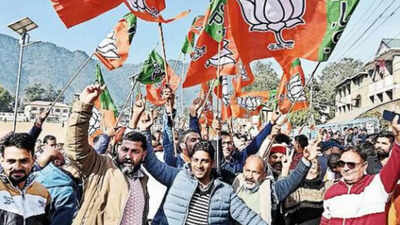
BJP supporters celebrate as the party wins in Mandi
In the last five years, chief minister Jai Ram Thakur-led government might have taken several decisions for the development of the state and welfare of the public, but it was often accused of focusing on select assembly constituencies at the cost of others.

Confident of repeating the government in Himachal, the BJP had come up with the slogan 'Riwaz badlega' (the tradition will change) but voters of the state preferred to go with the "riwaz" of changing the government after every five years. A lot was at stake for BJP national president J P Nadda, who hails from Himachal. He was leading the campaign from the front, but failed to woo the electorate.
In the 2017 assembly election, former chief minister Prem Kumar Dhumal had campaigned for the party in the entire state but this time, he was restricted to a certain pocket despite knowing it well that he enjoys public support in all the 68 assembly seats.
Before the elections, the central government accorded approval to the scheduled tribe (ST) status for the Hattee community of the trans-Giri area of Sirmaur district, which has five assembly seats. The announcement was seen as a masterstroke by Prime Minister Narendra Modi-led government at the Centre. However, the results show that the move had a little impact as the Congress managed to wrest the Shillai seat, where Hattees dominate the numbers.
The announcement of the bulk drug park for the state at Haroli in Una district also did not help the BJP as leader of the opposition Mukesh Agnihotri managed to win the seat by a good margin.
Wrong selection of nominees
Wrong selection of candidates, relying on candidates inducted from the Congress, failure to curb rebellion and pacifying rebels to withdraw their candidature are seen as some of the reasons for the party's poor show. While local leaders remained disconnected, the BJP relied heavily on the charisma of Modi to woo the voters and organised his rallies in all the four parliamentary constituencies of state.
BJP's defeat has also put a question mark on Jai Ram Thakur's capability to lead the party in the state. He was given the responsibility to lead the government in 2017 following the unexpected defeat of former chief minister Prem Kumar Dhumal.
The BJP at that time had claimed that the party would seize the trend of changing government after every five years and would ensure that it rules the state for 15 years. But now with the Congress bouncing back to power, many believe that the saffron party would have to find another chief minister face for the next assembly elections in 2027.
A section of the BJP was also not happy with the inclusion of some Congress leaders in the party and giving tickets to them. Workers were also not happy with the way Prem Kumar Dhumal had been sidelined. All these factors, apart from the presence of rebels, complicated the things for the party. The BJP ministers and MLAs also failed to remain connected with the voters in their respective constituencies.
To address anti-incumbency and people's anger against some of its MLAs, the BJP had even changed constituencies of two ministers, but even this could not help the party much.
Tough time for ministers
Mahender Singh Thakur, who was enjoying No. 2 position in the Thakur cabinet, managed the ticket for his son Rajat Thakur from Dharampur seat but he could not ensure his victory. Urban development minister Suresh Bhardwaj was shifted to Kasumpti from Shimla seat, but he too lost.
Social justice and empowerment minister Sarveen Chaudhary lost from the Shahpur assembly seat, while technical education minister Ram Lal Markanda faced defeat in the Lahaul-Spiti seat. Rural development minister Virender Kanwar, health minister Rajiv Saizal and food and civil supplies minister Rajender Garg lost their respective seats of Kutlehar, Kasauli and Ghumarwin.
From the entire cabinet, only three ministers - CM Thakur, power minister Sukh Ram and industries minister Bikram Singh - managed to win the elections, while nine ministers suffered defeat.

About the Author
Anand BodhEnd of Article
FOLLOW US ON SOCIAL MEDIA










Photostories
Hot Picks
TOP TRENDING
Popular Categories
Hot on the Web
Top Trends
Vinesh Phogat Election ResultHisar Election Result 2024Election Results 2024Haryana Election ResultJason KelceJammu Kashmir Election Result 2024Israel Hezbollah WarHardik SinghAakash ChopraAssembly ElectionHaryana Assembly Constituencies 2024Jammu Kashmir Election Winners ListGurgaon Election ResultHaryana Election Winners ListLive Election ResultFaridabad Election ResultLive Cricket Score
Trending Topics
Tulsi KumarBigg Boss Tamil 8 Contestants ListAjay DevgnNavratri Colours 2024Sanjay Leela BhansaliDurga Puja 2024Bigg Boss 18 House PhotoDevara CollectionBigg Boss 18Deepika PadukoneShailesh LodhaDevaraGovinda NewsNational Film Awards 2024Swatantrya Veer SavarkarColdplay India tour 2025Watch NFL Live StreamDress To ImpressCall Of Duty Black Ops 6Wordle Answer
Living and entertainment
Latest News
Ambala Cantt Assembly Election Result 2024: BJP's big gun Anil Vij leading in early trendsAquarius, Daily Horoscope Today, October 08, 2024: . You are likely to receive recognitionNavratri as Spiritual Detox: 9 days to cleanse your mind, body and soul5 must follow rules of Ayurveda to lose 5kg in 30 daysUniversity of East Anglia Introduces £4,000 Scholarship for Indian Students: Explore Courses, Eligibility, and BenefitsTodd Phillips explains SHOCKING CLIMAX of 'Joker: Folie à Deux', reveals Arthur Fleck acceptance of his true identityThe Power of Navratri: Honoring Goddess Durga and Manifesting DesiresAlia Bhatt just cannot keep calm on watching 'Singham Again' trailer, says 'all the dynamite in one frame' for the big multi-starrer led by Ajay DevgnNCERT to triple textbook production, aims to print 150 million books this year: Edu ministerMonetary policy committee meet: RBI moving closer to rate cutIndian branded pharma sector to see a decline in growth: ReportFrom spending habits to hiding reality: What each zodiac sign is likely to lie about'I own a Glock and yes, I’ve fired It,' says Kamala on 60 Minutes; rules out solo talks with Putin2024 Haryana assembly election result: 5 reasons why BJP's victory is significantKathua (SC) Assembly Election Result 2024: BJP's Dr Bharat Bhushan wins by 12,177 votesHappy Durga Puja 2024: Best Messages, Quotes, Wishes, and Images to Share on Durga Puja'Hopeful assembly elections results will be in our favour': Union Minister Chirag Paswan3 killed after an Air Evacuation helicopter crashes in Owen County
Copyright © 2024 Bennett, Coleman & Co. Ltd. All rights reserved. For reprint rights: Times Syndication Service