
Trending
This story is from April 12, 2020
Silence draws out birds & wild animals in Pune rural areas
The unusual quiet in the wake of the lockdown has brought back many winged creatures to the rural parts of Pune, a joint study by state forest department and Pune-based Ela Foundation said.
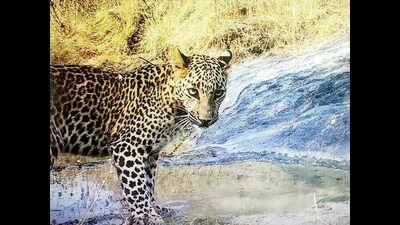
A leopard stands near a water body, porcupines captured on a trap camera drinking from a waterhole at night
“After lockdown, the urban areas usually occupied by pigeons, crows, kites and mynas witnessed new visitors. Interesting instances of parakeets entering homes, hornbills coming near windows, great tits, coucals and koels visiting terrace gardens, paradise flycatchers and fantails dancing in empty gardens, babblers making commotions, tailor birds, sunbirds, prinias, mynas, starlings, black drongos and bee-eaters coming close and owls perching on roof tops at night are being witnessed and reported,” Satish Pande, ornithologist and founder of Ela Foundation, said.

To study if a similar effect is witnessed in the rural regions adjacent to the city, a scientific study was launched in Purandar taluka, around Ela Habitat in Pingori village, near Jejuri.“We used camera traps and deployed them at waterholes. The trap cameras take photographs after a movement occurs in the field of view. The pictures are taken automatically by day and night (using IR light). Once deployed it takes up to seventy thousand photos,” Pande said.
Ela Foundation and the forest department are studying animal behaviour for the past five years using trap cameras deployed at several localities in Purandar taluka.
“For the lockdown study, we selected waterholes near human habitation for the present study from where we also had observations from past five years. One of the waterholes is artificially made by us at Ela Habitat in our premises. These sites were studied to find the effect on mammals and other wildlife after human absence due to the lockdown,” he said.
In the previous studies the observers had commonly seen mainly birds like
house sparrow, coucal, babblers, an occasional peafowl, chinkara and mongoose visiting the waterholes.
“When trap camera data was obtained after the first two weeks of lockdown, we were amazed. We had increased populations of all previous birds and additional species like rufous tree-pie, grey francolin, quails, buntings, pipits, flycatchers and also hawks and eagles at the waterholes. The mammals included mongoose, Asian palm civet, small Indian civet, Indian gazelle (chinkara), barking deer, four-horned antelope, black-naped hare, Indian fox, jungle cat, golden jackal, hyena, wolf, wild boar, porcupine and leopard. The visitors often came with their families,” Pande said.
Among reptiles there were snakes, chameleons, lizards and monitor lizard visiting the waterhole. “These waterholes which are close to human habitation and a reliable source of water are otherwise avoided by wild animals. They are now increasingly visited by wildlife. These very animals were otherwise forced to search for distant water bodies in the hot summer,” he added.
However, on the flip side, researchers have also found nooses, traps and snares to catch peafowl, hare and wild boar. They are promptly destroyed and reported to forest department, Pande said.

About the Author
Manjiri DamleEnd of Article
FOLLOW US ON SOCIAL MEDIA










Photostories
Hot Picks
TOP TRENDING
Popular Categories
Hot on the Web
Top Trends
Hurricane MiltonRatan Tata NewsNew UPI Transaction LimitRatan Tata DiesPM ModiRafael NadalShantanu NaiduTom BradyStock Market TodayNarayana MurthyEngland Cricket Team New RecordRatan Tata Inspiring QuotesManagement Colleges of IndiaTop Medical Colleges of IndiaTop Engineering Colleges of IndiaTop Pharmacy Colleges of IndiaLive Cricket Score
Trending Topics
Diwali WishesBigg Boss Tamil 8 Contestants ListBhool Bhulaiyaa 3 TrailerVettaiyan Twitter ReviewSanjay Leela BhansaliVettaiyan ReviewSalman KhanDevara CollectionBigg Boss 18Deepika PadukoneShraddha KapoorRatan Tata Passed AwayColdplayVettaiyan Movie ReviewSwatantrya Veer SavarkarDussehra 2024Watch NFL Live StreamDress To ImpressRatan Tata DeathWordle Answer
Living and entertainment
Latest News
How Chennai Night Race swerved past challenges to zoom toward a brighter motorsports futureAll-Star Tower Defense (ASTD) Codes October 2024Ranveer Singh: I have a man crush on Tiger ShroffWho is Noel Tata? Meet Ratan Tata’s half-brother, who could be successor at Tata TrustsHow to make Ginger Turmeric Shots for seasonal changeWhen Amitabh Bachchan slept on Marine Drive with rats as neighbours: I didn’t have a place to stayEthel Kennedy, widow of Senator Robert F Kennedy Sr suffers stroke in sleep, hospitalised'Stree 2' hits OTT after record-breaking box office success: Here’s where to watch!Da Hood Codes October 2024: Unlock new weapons to elevate your gameplay'Thalapathy 69': Here's how much Vijay will be earning in his last film!How The Tarot Suit Can Be Associated With The Elements'You're drunk': Britons stunned by BBC app's shocking 18,995 mph wind forecast!Hanging Lights For Living Room: Transform and Illuminate Your SpaceICC Women's T20 World Cup: Harmanpreet Kaur, Smriti Mandhana, bowlers demolish Sri Lanka as India get NRR boostArko: The reach of Bollywood is greater than single albumsLeaders of 24 countries, UN chief to attend BRICS summit: KremlinOnly a true creative genius can spot the odd unicorn in 12 seconds!Ratan Tata no more: When his throwback pic had netizens saying he looked like a Hollywood star
Copyright © 2024 Bennett, Coleman & Co. Ltd. All rights reserved. For reprint rights: Times Syndication Service