
Trending
This story is from July 14, 2018
Pu La's words of praise were my biggest award
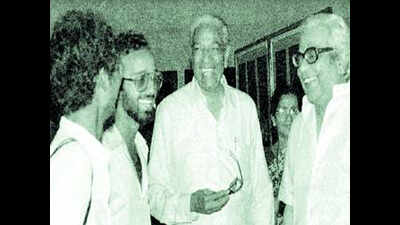
Pu La Deshpande (extreme right) with the writer (second from left)

At the time of the inauguration, the hall was full of music lovers and photography enthusiasts. At the auditorium were Ustad Saiduddin Dagar, Guru Rohinitai Bhate, Ashatai Gadgil, Madhukar Parundekar and Dattopant Deshpande. On the four adjacent walls of the exhibition hall were music maestros such as Mogubai Kurdikar, Bhimsen Joshi, Ravi Shankar, Vilayat Khan, Amjad Ali Khan, Zakir Hussain.
On June 16, the final day of the event, my eyes were fixed at the gallery door. I was eagerly waiting for a person I had invited personally. Will he come? It was almost half-past-four in the evening. I went to the cafeteria for tea. My friend, Pramod, suddenly ran towards me, saying, "Come on, hurry up. Pu La Deshpande and his friend are ar the gallery. He is asking for you."
I left the cup and ran to the gallery. Both of them were looking at the photographs with a crowd around. I went slowly and stood beside Pu La Deshpande. After some time, he said, "Hey, where were you? I was looking for you ? Meet my friend Nanda Naralkar."
I greeted both of them. I could not believe my eyes. Both were in front of me - Pu La Deshpande with his best friend. And both were applauding my work. For the next one hour or so, they enjoyed watching the exhibition and were nostalgic about the memories of various concerts they attended. After watching the entire exhibition, Pu La wrote in a remark book, "These excellent photographs create melodies in the minds." This was certainly one of the biggest awards for me at the beginning of my career.
Then Pu La asked me how much money have been spent on the exhibition. On knowing that all the expense was borne by me, he said, "We at National Centre of the Performing Arts (NCPA) are preserving the sound recordings of all these artists. Give us a copy of each artist's photo as a cover for that collection. Give me a letter of how much it will cost."
The following week, I and my friend, Pramod Deshpande, went to Mumbai by Sinhagad Express. A BEST bus dropped us at NCPA. Those days, there was no skyscraper in front of NCPA. On the sidewalk, we entered a gate on the side of the Tata Theatre.
"What do you want?" the watchman asked. "We are called by Pu La Deshpande Saheb," I replied. The watchman asked us to follow him and took us to the guest house. He rang the door bell, a house help opened the door and went inside with the message, "There is someone from Pune."
We were standing. After five minutes, Pu La entered the room . He was wearing a 'pista' colour kurta and a pair of 'pajamas'. After a causal conversation about our journey, Pu La asked, " Have you visited NCPA. before?" I said, "No".
In the meantime, I gave him the estimate letter for the photoprints. He looked at it and said it was okay. While having tea, Pu La asked the house help to get the keys and open the Piramal Gallery and Library.
As we reached the library, we saw various books, reference material, newspapers and treasures of cultural details. Pu La showed us the music section for which he had asked me to give the prints. Then we reached the Piramal Art Gallery. There were some prints of earlier exhibitions.
"All exhibitions here are on invitations. Photographers work on any theme and send their portfolio. The experts choose the ones to be displayed. The photographer has to give only prints. The work on display will be taken care of by the NCPA staff. All costs are borne by NCPA," he said. Then I realized why Pu La had asked me the expenses during my exhibition.
We then reached a fairly large hall in the middle. On one side was a curtain from roof to floor. There was a huge organ gifted by a Parsi family. From there we reached a restaurant called Rangoli with an experimental theater on its left
Finally we reached the stage of the Tata Theater. It was a semi-circular stage with a similar semi-sitting arrangement for 1,010 spectators and excellent acoustics. Pu La said, "An architect called Philip Johnson had designed it."
NCPA was the dream of JRD Tata and Jamshed Bhabha. The man who had worked hard to realize the dream was the honorary director and master of Marathi literature Pu La Deshpande. And he himself was showing us everything spread over 32,000sqm. What could have been more fascinating?
End of Article
FOLLOW US ON SOCIAL MEDIA


Hot Picks
TOP TRENDING
Trending Stories
In City
Entire Website
- UPS vs NPS Calculator: Is A Switch From National Pension Scheme to Unified Pension Scheme Really A No-Brainer? Check Calculations, Benefits - Top Points
- Monster vs Monster: WWE announced massive match for this week's Monday Night Raw
- UPI transaction limit to change from September 16! Here are the new limits for various UPI payments
- File movement linked to weight of money: Nitin Gadkari
- Apple's biggest 'iPhone update' for year 2024, iOS 18, rollout starts today - September 16: India time and how to prepare your iPhone for iOS 18 download
- Arvind Kejriwal's resignation: Who will be next Delhi CM? Atishi seen as top choice
- UP medical aspirants converting religion to secure MBBS seats: A look at NEET UG admission criteria around minority reservation rules
- Protests against students wearing hijab in school play, principal forced to apologize for promoting religious harmony
- Pitru Paksha 2024 Date and Time: Know Significance of Shradh Paksha
- Andhra suspends 3 IPS officers for 'framing', arresting Mumbai actress
- Second assassination attempt on Trump triggers outrage, suspicion on all sides
- Kolkata police commissioner removed after CM Mamata Banerjee's meeting with docs
- Rs 15cr gold crown from the Ambanis: Meet Mumbai’s richest Ganeshas
- BAPS swaminarayan temple vandalised in New York; 'unacceptable', says Indian consulate
- Modi govt will bury bid to revive 90s-like terrorism in J&K: Amit Shah
- 'Look at own record': India condemns remarks by Iran's Supreme Leader Khamenei
- Will Kejriwal pass the agni pariksha like Indira did in 1971?
- Apple's biggest 'iPhone update' for year 2024 rollout starts today
- Attempt to derail Delhi bound Swatantrata Senani Express
- UPS vs NPS Calculator: Switch a no-brainer? Not really! Check top points

Popular Categories
Hot on the Web
Top Trends
Prince HarryWho is Ryan RouthUPI Transaction LimitArvind Kejriwal ResignationNEET UG Admission CriteriaKolkata Doctor Rape CaseUS Presidential ElectionsRohit SharmaSports Stars Turned Power CouplesIBPS RRB Clark PO ResultDonald TrumpCristiano RonaldoIndia vs Korea HighlightsBMW Accident Madhya PradeshUPS vs NPS CalculatorMiami Dolphins OwnerLive Cricket Score
Trending Topics
Living and entertainment
Latest News
Vempalle Shareef's story is now a lesson for degree students in Andhra PradeshGovt launches programme to tackle glacial lake outburst flood threat in Himalayas, all 190 high-risk lakes to be monitoredKhatron Ke Khiladi 14: Shalin Bhanot hosts a fun party for his co-contestants Krishna Shroff, Abhishek Kumar, KaranVeer Mehra and othersAstrological Influence on Zodiac Signs' Career ChoicesBike rally held to raise voter awareness in Jammu and Kashmir's Doda ahead of assembly electionsFalcons' Predictable Offense and Cousins' Prime-Time Woes Spell Trouble in PhiladelphiaTaurus, Daily Horoscope Today, September 17, 2024: Anxiety and stress diminishLiza Colon becomes 1st Latina to win Best Supporting Emmy Award'Oh no!': Hilarious goof-up leads to missed catch, leaves bowler in smile. WatchTop NFL Superstars Who Are Vegan: Derrick Morgan, David Carter, Theo Riddick and moreKSCA Invitational: Arjun Tendulkar takes match haul of 9 wickets in big Goa CA XI winSohum Shah says 'Tumbbad 2' will be different from 'Munjya' and 'Stree 2': 'They are not making dadi-nani ki kahaniyaan'1031 candidates to contest Haryana Assembly Elections to be held on October 5: CEO J AgarwalSathiyan set to partner Sreeja in mixed doublesHere's why multiple WWE Hall of Famers refused to team up with Kevin Owens on SmackDownCarlito's Net Worth 2024, Current WWE Salary and MoreDirector Shailesh Patel and Atul Soni start shooting for an untitled project with Muhurat pujaEid Milad Un Nabi 2024: Date, Rituals and Significance of Eid e Milad
Copyright © 2024 Bennett, Coleman & Co. Ltd. All rights reserved. For reprint rights: Times Syndication Service