
- News
- City News
- patna News
- Call to revive Buddha’s path
Trending
This story is from April 30, 2023
Call to revive Buddha’s path
The landscape of Bihar is dotted with places associated with im - portant events in the life of Buddha and those of his disciples. For more than 1,500 years after the demise of the Buddha (6th BCE), devotees from China, Japan, Korea, south east and cen tral Asia travelled for up to thousand miles to reach the exact places where Buddha had set foot.
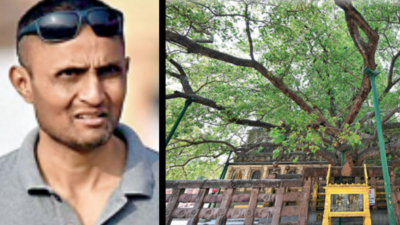
Deepak Anand; The Bodhi tree at Mahabodhi Mahavihara
For more than 1,500 years after the demise of the Buddha (6th BCE), devotees from China, Japan, Korea, south east and cen tral Asia travelled for up to thousand miles to reach the exact places where Buddha had set foot.
There is a need to revive the ancient walking trails and sacred places with the help of information from Buddhist literature and accounts of Buddhist monk scholars like Xuanzang (7th CE, Hie - un Tsang), so that devotees can once again undertake pilgrimages on these routes and offer homage at the sa - cred sites.

As mentioned in the Buddhist literature, two months after the enlightenment on the full-moon day of asalha (June-July), the Buddha preached the Dhammacakkappavattana Sutta (the first turning of the eheel) at Sarnath and then returned to Uruvela (now Bodh Gaya) with the objective to transform Uruvela Kassapa.
After the successful transformation of Kassapa brothers, the Buddha, along with the newly ordained jatila (matted hair) left Uruvela and reached Gayqsisa hill (Brahmayoni), about 10km north of Uruvela. Jatilas were fire worshipers and the Buddha used a metaphor of fire so that the teachings quickly pen - etrated the hearts of his audience. The Buddha referred to our existence as being filled with a type of ‘burn - ing,’ metaphorically linking craving to fire, spreading from one object to the next on an insatiable destructive path.
Kassapa along with a thousand jatilas listened as the Buddha explained the concept of consciousness and that for most humans caught up in their own needs and desires, constant - ly unaware of their sur - roundings, their senses and sensa - tions are on fire. As long as there is anger, greed, ignorance and lust fueling the fire, the cycle of birth and death along with despair and sorrow continue infinitely, he said.
The precious words of Buddha are recited today as the Aditta-Pariyaya Sutta (fire sermon). Upon hearing this sermon, thousands of jatilas practiced over time with the Buddha at Gayasisa hill and became arahats. Xuanzang saw a 100ft stupa on the top of the Hill built by King Ashoka to mark the historic event.
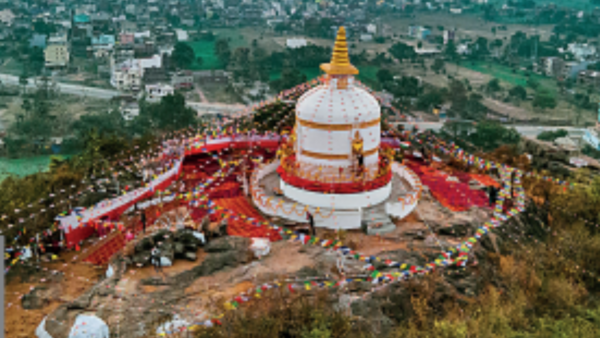
The new political climate at the turn of 1st millennia was not conducive for suste - nance of Buddhist monas - teries and Buddhist pilgrim - age. The Ashokan stupa on the Brahmayoni hill was prob - ably lost due to brick robbing and vandalization. The places related with the Buddha are very sacred. A stupa was recently inaugurated by Asian Buddhist Cultural Centre, Bodh Gaya to facilitate Bra - hamayoni hill becoming a living heritage as it used to be in ancient times.
True tribute to this very sacred site will be the revival of the 10km walking pilgrim - age trail from Bodh Gaya to Brahmayoni.
(The author is a Buddhist pilgrimage scholar and interpreter)
End of Article
FOLLOW US ON SOCIAL MEDIA





Hot Picks
TOP TRENDING
Trending Stories
In City
Entire Website
- Mysuru-based woman’s startup bags top honour
- Unni Vavavo a hit again, thanks to Alia Bhatt’s kid
- 'Don’t drag us into your agenda’: SC dismisses NCPCR plea seeking SIT probe into Jharkhand shelter homes
- 'Opened multiple bank accounts': Rs 382 crore tax notice leads to Aadhaar, PAN misuse scam in Thane
- Flyers denied airport lounge access, issue sorted in evening
- 10 most stressed states in the U.S. in 2024; check out the list
- Delhi's maximum temperature soars to 37°C, rain likely to return tomorrow
- "We Have Decided To Part Ways Respectfully": WWE Hall of Famer Announces Separation from Wife Wendy Barlow
- This is what Damian Priest said about Jey Uso’s Intercontinental Championship win
- 49ers’ Christian McCaffrey Travels to Germany for Achilles Treatment: What It Means for His Season
- 'Don't drag us into your agenda': SC slams NCPCR over plea for probe into J'khand shelter homes
- 'Bring back farm laws': BJP MP Kangana stirs row again
- After flirting with China, is Maldives back to loving India?
- New Sri Lankan PM's fascinating link to India
- Badlapur case: Akshay Shinde's father seeks probe into 'fake encounter'
- OTD! When Pele brought Kolkata to a standstill
- Why US surgeon-general just declared parental stress a serious public health issue
- Apple cuts price of iPhone 15 & iPhone 14 models, here's new price list
- Odisha govt to test ghee used for 'prasad' at Jagannath temple
- Bangladesh border force returns 'abducted' BSF jawan

Popular Categories
Hot on the Web
Top Trends
Trending Topics
Living and entertainment
Latest News
'Virat shuru hoga Australia se': Basit Ali says Kohli's low scores vs Bangladesh not an issueAstrology-Inspired Characters in Movies: A Cosmic Connection on the Big ScreenTest | War 2: Hrithik Roshan, Kiara Advani's romantic chemistry grabs attention in viral picsEC to have 'zero tolerance' towards use of money power in Jharkhand assembly pollsThrowback: When Parineeti Chopra shined in yellow during her joyful haldi ceremony celebrationsAPPG pushes for Ayurveda integration in UK’s healthcare systemBorder Gavaskar Trophy: When Steve Smith had a 'brain fade' moment against IndiaICAI CA Final Exam for Nov 2024 postponed due to Diwali, new exam date announced: Check official notice hereEpic Last 'Monster' Standing match and more exciting matches announced for WWE RAW (9/30)Essential tips for building and maintaining a happy marriageWhen and where to watch England vs Australia 3rd ODI: Date, time, venue, squad, broadcast detailsDonald Trump shares 'nail salon gossip' that Kamala Harris paying $700 for...BJP plans protests over reopening of ‘old cases’When Remo D'Souza opened up about his heart attack and revealed how Salman Khan stayed in constant touch with his wife over the phoneWB ANM, GNM result 2024 out: Direct link to download rank card hereAstrological Themes in Popular Film FranchisesBiden acknowledges he's running out of time as violence escalates in Middle-East: Aides‘My brother is critical but stable’; Veteran actor Manoj Mitra’s brother debunks death hoax
Copyright © 2024 Bennett, Coleman & Co. Ltd. All rights reserved. For reprint rights: Times Syndication Service