
- News
- City News
- noida News
- YEIDA meets NHAI regarding land for EPE
Trending
This story is from May 22, 2017
YEIDA meets NHAI regarding land for EPE
Yamuna Expressway Industrial Development Authority (YEIDA) maintained its stand of not providing National Highway Authority of India (NHAI) with free land for an interchange for the Eastern Peripheral Expressway (EPE).
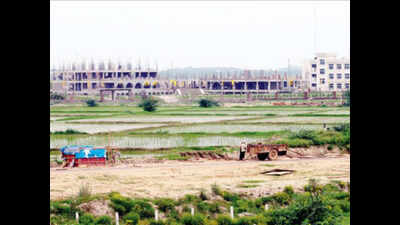
FILE: A general view of the area falling under YEIDA. TOI photo

According to officials, talks between YEIDA and the NHAI monitoring committee for the 20 hectares of land required for the EPE in the YEIDA area failed to reach a conclusion. “A meeting will be held in Lucknow next week with the Uttar Pradesh government to decide on the issue,” Arunvir Singh, Chief Executive Officer (CEO), YEIDA told TOI. “The said land falls in the Jaganpur-Afzalpur area of YEIDA,” he explained.
YEIDA officials further said that it was not possible to agree to the terms of NHAI as they had acquired the land from farmers and had to pay them an additional compensation of 64.7%. Giving the land free to NHAI would not be a viable proposition for YEIDA, officials said.
In August 2015 too, talks had failed to reach a conclusion when NHAI had demanded that the YEIDA land—about 72 hectares at the time—which was estimated to cost about Rs 161 crore be given free of cost for the EPE. The NHAI had also wanted that YEIDA should bear the cost of the construction of the EPE falling in the YEIDA area. A 13-km stretch of the EPE falls in the GB Nagar area.
The EPE project, which is about 62% complete, is envisaged to provide a smooth ride between the cities of Ghaziabad, Greater Noida, Sonipat, Faridabad and Palwal, as well as to de-congest Delhi roads. Once completed by August 2017, it is likely to take at least 70,000-80,000 vehicles off Delhi roads. The NHAI needed land from 39 villages in GB Nagar for the expressway, which was proposed in 2005. It is also likely to benefit UP and Haryana as it would open up hinterlands for developing commercial areas and townships along the expressway.
In Greater Noida, the EPE will connect near the Yamuna Expressway and near the integrated township of the Delhi-Mumbai Industrial Corridor while on NH-91 (Grand Trunk road) it will connect near Beel Akbarpur. Noida, Greater Noida, Dadri, GT Road, Ghaziabad, Dholana, Hapur will be decongested once the e-way is in place. Expected vehicular movement on the e-way is about one lakh per day by 2021.

About the Author
Vandana KeelorEnd of Article
FOLLOW US ON SOCIAL MEDIA



Photostories
Hot Picks
TOP TRENDING
Popular Categories
Hot on the Web
Top Trends
Israel Hezbollah WarKerala Lottery ResultsRohit SharmaBrittany MahomesHarbhajan SinghLionel MessiTaylor SwiftUGC NET Result 2024PPF CalculatorTirupati Laddu CaseIndia T20 WC ScheduleIND vs PAK T20 WC MatchDiddyTop Management Colleges of IndiaWomen T20 World Cup ScheduleWomen T20 World Cup Points TableLive Cricket Score
Trending Topics
GovindaNavratri Colours 2024Navratri WishesHappy Navratri 2024 WishesGandhi Jayanti WishesDevara CollectionGOAT OTT ReleaseGandhi Jayanti 2024Rajinikanth Health UpdateNavratri HistoryDevaraGovinda NewsDevara Movie ReviewHealthy RaitasSwatantrya Veer SavarkarColdplay India tour 2025Upcoming Smartphones In OctoberAmazon SaleSony Bravia 55 inch 4k Ultra HD TVWordle Answer
Living and entertainment
Latest News
Minister Konda Surekha apologizes to Samantha Ruth Prabhu after divorce remarks with her ex-husband Naga ChaitanyaWhen Govinda called off his engagement with Sunita and would've probably married Neelam Kothari; admitted to have played dirty with his 'Khudgarz' co-starKaun Banega Crorepati 16: Host Amitabh Bachchan recalls his young days in Allahabad; says 'Ganga nadi mein jaate the nahaane toh Gharial nikalta tha wahan'WBJEEB JELET counselling 2024 notification out, registration begins today at wbjeeb.nic.inIsrael-Hezbollah conflict: How hard liners influence Netanyahu govtPower outages, water shortages emerge as Hurricane Helene smashes US' Southeast'Was screaming, hitting him': 5-year-old Florida boy suffers cardiac arrest on Disney rollercoaster rideThe Amazing Spider-Man films starring Andrew Garfield now streaming for freeTwo youths held captive in Manipur’s Kangpokpi released after week-long abductionWho is S Iswaran? Former Singapore minister of Indian origin sentenced to one year in prisonMahima Chaudhry reveals she begged Ajay Devgn and Prakash Jha to keep her near-fatal car accident secret: 'I feared industry boycott'Can mosquitoes spread HIV? Here’s what you need to knowVijay's 'GOAT' gets an OTT release; official date announced!Navratri Day 1 colour: How to style the shade of OrangeAquarius, Daily Horoscope Today, October 03, 2024: Romantic life may experience a few bumpsPopulation of Hindus & tribals declining in Jharkhand, says PM ModiChange Begins Here, as TOI shines a spotlight on hope and impactKTR reason for Naga-Samantha divorce, says Telangana minister; sparks row
Copyright © 2024 Bennett, Coleman & Co. Ltd. All rights reserved. For reprint rights: Times Syndication Service