
- News
- City News
- noida News
- Noida set to finally cover its drains
Trending
This story is from May 25, 2022
Noida set to finally cover its drains
The Noida Authority has decided to cover 10 drains across the city under a pilot project, responding to years of complaints from residents living in their vicinity about pungent smell and toxic gases emanating from them.
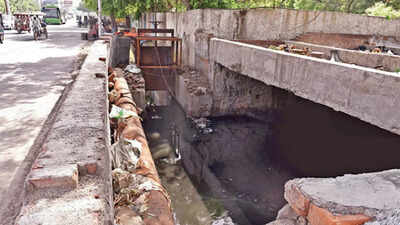
Citing health hazards, residents across sectors have long been demanding that drains passing near houses should be covered
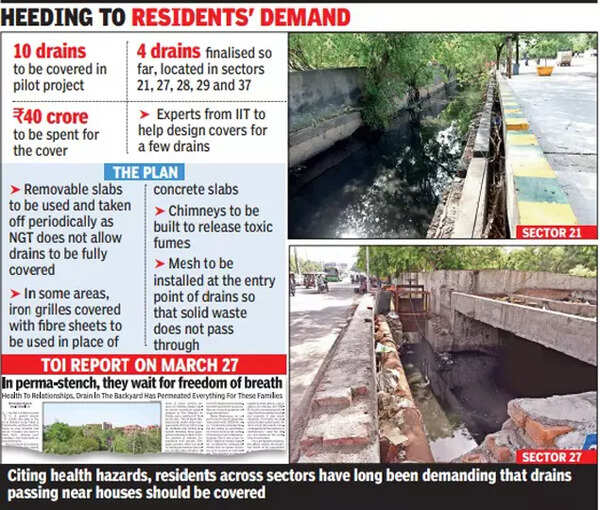
Officials said one drain in each of the city’s 10 work circles would be covered in this phase. If the response is good, the move would be replicated in other areas as well.

Over the next few weeks, four drains will be covered. Among them is the main drain in Arun Vihar, which has permeated the lives of the families living there and raised concerns about health problems — an issue TOI had highlighted in an article in March. About Rs 40 crore would be spent on repairing and covering the four drains, which pass through several populated areas of sectors 21, 27, 28, 29 and 37.
A 2014 directive of the National Green Tribunal (NGT), however, bans the covering of drains fully. The NGT had pointed out that these drains needed to be cleaned and de-silted regularly and covering them fully could affect the exercise.
The authority, however, said they had reached a middle path and would cover the drains with iron grilles and concrete slabs with gaps between them so that they could be removed for cleaning. Outlets would also be created in isolated places if hazardous gases accumulated — a concern the NGT had raised in 2014.
At the starting points of each drain, multiple layers of mesh would be installed so that solid waste does not pass through. In some places, iron grilles would be used in place of concrete slabs, which would then be covered with fibre sheets. The authority has taken the help of IIT-Delhi on how to cover the drains in a scientific manner.
“We are taking this step keeping in mind the repeated complaints of residents. They have been seeking a solution to stench in the areas from the open drains. We are also considering the NGT norms. If this pilot project is successful, it can be replicated in other areas,” said Ritu Maheshwari, the Noida Authority CEO.
For long, residents living in societies around the drains had raised concerns about lung ailments and other health problems. Their social life was also thrown out of gear as no relative would visit them. Selling a flat near a drain proved to be a difficult task too.
Col IP Singh (retired), the chairperson of the Arun Vihar RWA, said, “We have been raising the issue of an open drain in our area for several years now. The drains passing through sectors 28, 29 and 37 are also posing health hazards for around 5,000 families living in their vicinity. NGT norms do not allow covering of drains fully. But there are multiple ways to solve the issue. Creating outlets and leaving gaps in between concrete slabs are some of them, besides regular cleaning.”
Environmentalists, however, raised questions about Noida’s plans. “There are several alternatives, but the authority is taking the easy way out. Covering of drains will further deteriorate the water quality because of the anaerobic conditions. There is nothing like temporary or permanent cover. Over time, it would become a permanent feature in violation of the NGT order. This is nothing but a cover-up. Bio-remediation efforts could be done to curb the smell, probably at a much lower cost,” said Manu Bhatnagar, the principal director in the natural heritage division of INTACH.
End of Article
FOLLOW US ON SOCIAL MEDIA










Photostories

Hot Picks
TOP TRENDING
Popular Categories
Hot on the Web
Top Trends
Hurricane MiltonRatan Tata NewsNew UPI Transaction LimitRatan Tata DiesPM ModiRafael NadalShantanu NaiduTom BradyStock Market TodayNarayana MurthyEngland Cricket Team New RecordRatan Tata Inspiring QuotesManagement Colleges of IndiaTop Medical Colleges of IndiaTop Engineering Colleges of IndiaTop Pharmacy Colleges of IndiaLive Cricket Score
Trending Topics
Diwali WishesBigg Boss Tamil 8 Contestants ListDussehra WishesVettaiyan Twitter ReviewSanjay Leela BhansaliVettaiyan ReviewSalman KhanDevara CollectionBigg Boss 18Deepika PadukoneShraddha KapoorRatan Tata Passed AwayColdplayVettaiyan Movie ReviewSwatantrya Veer SavarkarDussehra 2024Watch NFL Live StreamDress To ImpressRatan Tata DeathWordle Answer
Living and entertainment
Latest News
All-Star Tower Defense (ASTD) Codes October 2024Ranveer Singh: I have a man crush on Tiger ShroffWho is Noel Tata? Meet Ratan Tata’s half-brother, who could be successor at Tata TrustsHow to make Ginger Turmeric Shots for seasonal changeWhen Amitabh Bachchan slept on Marine Drive with rats as neighbours: I didn’t have a place to stayEthel Kennedy, widow of Senator Robert F Kennedy Sr suffers stroke in sleep, hospitalised'Stree 2' hits OTT after record-breaking box office success: Here’s where to watch!Da Hood Codes October 2024: Unlock new weapons to elevate your gameplayTriple centurion Harry Brook happy to break Dad's club record'Thalapathy 69': Here's how much Vijay will be earning in his last film!Happy Dussehra 2024: Top 50 Wishes, Messages, and Quotes to Share with Your Loved OnesHow The Tarot Suit Can Be Associated With The Elements'You're drunk': Britons stunned by BBC app's shocking 18,995 mph wind forecast!Hanging Lights For Living Room: Transform and Illuminate Your SpaceArko: The reach of Bollywood is greater than single albumsExclusive- Iss Ishq Ka Rab Rakha fame Shalini Kapoor Sagar on celebrating Navratri festivities says, "We will be shooting the Durga Puja track soon"Leaders of 24 countries, UN chief to attend BRICS summit: KremlinOnly a true creative genius can spot the odd unicorn in 12 seconds!
Copyright © 2024 Bennett, Coleman & Co. Ltd. All rights reserved. For reprint rights: Times Syndication Service