
- News
- City News
- nashik News
- Maharashtra: Focus on jabs for women in rural belt to fight hesitancy
Trending
This story is from June 11, 2021
Maharashtra: Focus on jabs for women in rural belt to fight hesitancy
Vaccination camps in remote villages — like in the Akkalkuwa taluka of Nandurbar — are turning the tide. Preparations start 3-4 days prior to the camps and ASHA and Anganwadi workers, along with local Unicef members and ZP teachers, go door to door to spread awareness.
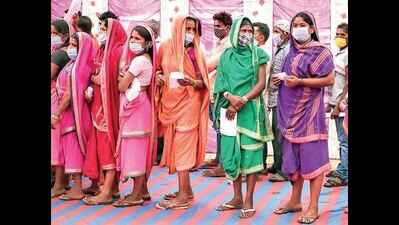
Tribal women wait in a queue for vaccination with copies of their Aadhaar cards in Nandurbar district
The officials are now trying to spread awareness, recruit local Unicef workers and convince women in the tribal areas to get inoculated, so that they can then encourage their family members and associates to get the jabs.

Vaccination camps in remote villages — like in the Akkalkuwa taluka of Nandurbar — are turning the tide. Preparations start 3-4 days prior to the camps and ASHA and Anganwadi workers, along with local Unicef members and ZP teachers, go door to door to spread awareness.
“We started coordinating with Unicef members who are from tribal communities and things then started turning around,” Akkalkuwa tehsildar. Ramji Rathore said.
“Real awareness started when we went off the road and reached isolated houses,” said Jitendra Valvi, Unicef coordinator from Kathi village. Valvi, along with three other members, has helped health officials conduct 16 camps in hamlets in the Satpura region, where 5,342 people have been vaccinated so far. Some of these villages are over 300km from Nashik.
Leena Bansod, Nashik Zilla ZP chief executive officer, said the emphasis would now be on vaccination of the women members of the self-help groups in the tribal areas.
End of Article
FOLLOW US ON SOCIAL MEDIA










Hot Picks
TOP TRENDING
Trending Stories
In City
Entire Website
- 7 Must-Watch Films to Inspire Students
- Florida woman who sold all her possessions for a 3-year luxury cruise banned for WhatsApp messages
- Animal fat in Tirupati laddu: Centre intervenes, temple trust blacklists supplier - Top developments
- Indian Embassy official found dead at Washington DC office under mysterious circumstances
- Rohit Sharma gets angry at team-mate: 'Soye hue hain sab log'
- PM Modi on 3-day US visit for Quad summit: Key agendas, full schedule
- 10 Daily Habits for Students to Keep Their Minds Young and Sharp
- 'When temples are being attacked ... ': Andhra deputy CM Pawan Kalyan on Tirupati laddu row
- NIA conduct raids at several locations across Punjab in terror-conspiracy case linked to Gurpatwant Singh Pannun
- To challenge Ola and Uber, Chennai auto drivers rebuild ride-booking app after crippling hack
- 'Quad is here to stay,' says PM Modi as India prepares to host 2025 summit
- PM Modi attends 6th Quad summit in US hosted by Biden: Key takeaways
- How Israel killed most wanted terrorist with a phone call in 1996
- Amritpal & aides pose serious threat to Punjab CM Mann's life: Police
- 1st Test Live: Ashwin breaks Shanto - Shakib stand
- TikTok Ploy: Pakistan cricketer’s clever attempt
- There is a speed bump in bulldozer raj’s way
- How India prices of iPhone 16 compare with US, Canada, Singapore, Dubai
- Struggling Virat Kohli advised to 'move with the times'
- PM Modi arrives in New York after Quad meeting, set to address UN summit

Popular Categories
Hot on the Web
Top Trends
Trending Topics
Daughter's Day WishesDaughter's Day 2024 WishesAbdu RozikMukesh KhannaJayamSana Khan HusbandTirupati Laddoo ControversyGOAT CollectionVaazha OTT ReviewKozhipannai Chelladurai ReviewCheetahsKangana RanautAditi Rao HydariDalljiet KaurHoliday DestinationVikas SethiBest Selling Earbuds Under 1000Apple iPhone 16 ProVirat KohliWordle Answer
Living and entertainment
Latest News
Delhi CM’s statement highlights loyalty dilemma in Indian partiesHrithik Roshan SPOTTED filming intense action sequences for 'WAR 2' in Italy - WATCHKarnataka CM Siddaramaiah warns of legal action against those spreading fake newsThe truth about sugar substitutes: Safe alternative or hidden health risk?Lucky numbers for September 22 to September 28: Your weekly fortunate number revealedUP: Muslim 'healer' arrested for sexually assaulting teen girlMalaysian police arrest hundreds in child abuse probeAryan Khan or dad Shah Rukh Khan, who wore this lather jacket better?No rain likely for three days, temperature to go up; AQI turns worse in Delhi18-year-old woman arrested after crushing man under wheels of his own Porsche, see videoTapCoin daily bounty cards for September 22, 2024: Earn tokens, exclusive rewards and more'Trump made Robinson...': Harris' campaign aims to shift voters in NC amid scandalOh no to ONOE but we do need electoral reformGemini, Daily Horoscope Today, September 22, 2024: Be mindful of diet and mental well-beingAuto driver to juice shop owner, they’re taking on bulldozer rajMan thought he had runny nose; actually his brain was leakingPalanpur tea seller's son gets into IIM RanchiUP couple sleeping on roadside crushed to death by reversing car
Copyright © 2024 Bennett, Coleman & Co. Ltd. All rights reserved. For reprint rights: Times Syndication Service