
- News
- City News
- nagpur News
- Post Diwali, pollution higher in 9 of 11 capital cities this year
Trending
This story is from November 14, 2023
Post Diwali, pollution higher in 9 of 11 capital cities this year
Air pollution in Indian capital cities during Diwali was worse than the previous year, with Patna recording the highest average level of particulate matter 2.5 (PM2.5), 13 times higher than the safe limit set by the WHO. Analysis of data from monitoring stations in 11 capital cities found that eight cities had lower PM2.5 levels compared to the previous year, while Gandhinagar, Kolkata, and Patna had higher levels. Delhi recorded the highest average PM2.5 levels the day after Diwali. Bengaluru had lower PM2.5 levels this year compared to last, but widespread firecracker use reversed the gains made due to rainfall.
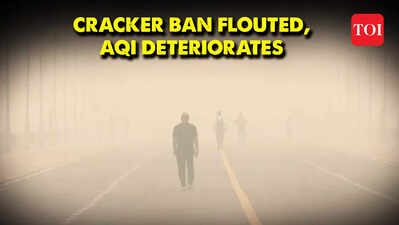
Representative Image
An analysis of data sourced from Continuous Ambient Air Quality Monitoring Stations installed by Central Pollution Control Board (CPCB) revealed the highest average level of particulate matter (PM) 2.5 was recorded in Patna on November 12. At 206.1 micrograms per cubic meter (mpcm), pollution levels were 13 times more than the safe limit set by the World Health Organization (WHO).
The data of 11 capital cities — Bengaluru, Bhopal, Chandigarh, Chennai, Delhi, Gandhinagar, Hyderabad, Lucknow, Mumbai and Patna — was analysed by NCAP Tracker, a joint project by Climate Trends and Respirer Living Sciences that tracks the country’s progress towards achieving targets set under National Clean Air Programme (NCAP).
On November 11, a day before Diwali this year, eight of 11 capital cities — Bengaluru, Bhopal, Chandigarh, Chennai, Delhi, Hyderabad, Lucknow and Mumbai — had lower PM 2.5 levels as compared to the day before Diwali last year (October 23). For the same days, Gandhinagar, Kolkata and Patna had levels higher this year compared to last.
Bandra-Worli sea link barely visible as AQI deteriorates in Mumbai
Analysts further found that on Monday, a day after Diwali, Delhi recorded the highest PM2.5 average of around 396 mpcm between midnight to 12noon. Among the 11 capitals, highest spike (recorded at an interval of 15 minutes) was also seen in the national capital. “The pollutant level reached 999.5 mpcm at Pusa around 1.30am,” the analysis added.
Bengaluru recorded lower PM 2.5 averages in 2023 as compared to 2022 for the day before Diwali, Diwali day and day after. Additionally, on the day after Diwali 2023, it clocked the lowest PM 2.5 average among 11 cities analysed in this report.
Bengaluru recorded lower averages this year for the day before Diwali, on the festive day and the day after.
Aarti Khosla, director at Climate Trends said, “Data shows widespread bursting of crackers took away gains made due to rains, thereby decimating useful impact of regulation for at least a 2-3 day period till the hazardous levels settle.”
Full report on www.toi.in
We also published the following articles recently
Pollution lens on major cities before, during & after Diwali
The Pollution Control Board of Assam (PCBA) will monitor air and sound quality in the state before, during, and after Diwali to measure pollution caused by firecrackers. The air and sound quality of major cities will be monitored for 7 days before, 2 days during, and 7 days after Diwali. Other districts will be assessed only during Diwali. The PCBA will also check for heavy metals like aluminum in the air due to firecrackers. The board has designated three zones for sound pollution assessment: silent, residential, and commercial. The PCBA is urging people not to burst crackers to avoid health hazards.
The Pollution Control Board of Assam (PCBA) will monitor air and sound quality in the state before, during, and after Diwali to measure pollution caused by firecrackers. The air and sound quality of major cities will be monitored for 7 days before, 2 days during, and 7 days after Diwali. Other districts will be assessed only during Diwali. The PCBA will also check for heavy metals like aluminum in the air due to firecrackers. The board has designated three zones for sound pollution assessment: silent, residential, and commercial. The PCBA is urging people not to burst crackers to avoid health hazards.
Delhi records best air quality in eight years on Diwali
On Diwali, Delhi recorded its best air quality in eight years, with an AQI of 218, attributed to intermittent rainfall and favorable wind speeds. Concerns remain over potential pollution from firecrackers and low night temperatures. The recent improvement is a result of rain and reduced stubble burning. Delhi has enforced a ban on firecrackers, but sporadic incidents were reported. Doctors warn of severe health risks associated with Delhi's polluted air, equivalent to smoking 10 cigarettes a day. Stringent restrictions have been implemented, and the odd-even car rationing scheme may be considered if pollution levels rise.
On Diwali, Delhi recorded its best air quality in eight years, with an AQI of 218, attributed to intermittent rainfall and favorable wind speeds. Concerns remain over potential pollution from firecrackers and low night temperatures. The recent improvement is a result of rain and reduced stubble burning. Delhi has enforced a ban on firecrackers, but sporadic incidents were reported. Doctors warn of severe health risks associated with Delhi's polluted air, equivalent to smoking 10 cigarettes a day. Stringent restrictions have been implemented, and the odd-even car rationing scheme may be considered if pollution levels rise.
Delhi Air Pollution: An unexpected bonus this Chhoti Diwali
Delhi's air quality is expected to be in the "poor" category on Diwali, resulting in potentially cleaner celebrations. Weather analysts predict that the wind speed will increase in the coming days, reducing pollution levels. In 2022, Delhi experienced its cleanest Chhoti Diwali in seven years with an AQI of 259. Typically, the AQI on Diwali eve has been in the "severe" or "very poor" categories, except in 2019. Although Friday's AQI was 274, mainly due to rain, pollution levels are expected to worsen to the "very poor" and "severe" categories on November 12 and 13.
Delhi's air quality is expected to be in the "poor" category on Diwali, resulting in potentially cleaner celebrations. Weather analysts predict that the wind speed will increase in the coming days, reducing pollution levels. In 2022, Delhi experienced its cleanest Chhoti Diwali in seven years with an AQI of 259. Typically, the AQI on Diwali eve has been in the "severe" or "very poor" categories, except in 2019. Although Friday's AQI was 274, mainly due to rain, pollution levels are expected to worsen to the "very poor" and "severe" categories on November 12 and 13.
End of Article
FOLLOW US ON SOCIAL MEDIA








Photostories

Hot Picks
TOP TRENDING
Popular Categories
Hot on the Web
Top Trends
Trending Topics
Diwali WishesSalman KhanDiwali 2024 WishesTeri Garr Death NewsShamita ShettyPriyanka ChopraKaun Banega Crorepati 16Diwali Pooja TimingDevara OTT ReleaseVicky Vidya Ka Woh Wala Video CollectionAbhishek BachchanAnanya PandayRishad Yusuf Death NewsSmriti MandhanaOptical illusionDiwali Bank HolidaysChoti Diwali Whatsapp StatusWordle Answer
Living and entertainment
Latest News
Best Vacuum Cleaner Under 10000 With Powerful Suction And Advanced FeaturesNawab Malik back on NCP ticket against Mahayuti pickNBFC stock up 66,926x to India's most expensivePaw-sitively peaceful: Prateik Patil Babbar and Priya Banerjee celebrate a pet-friendly Diwali with their dogsJeff Bezos defends decision to end Washington Post's presidential endorsementsHappy Diwali 2024: Best SMS, Images, Wishes, Facebook, and WhatsApp messages to send as Happy Diwali greetingsSai Pallavi to reportedly earn THIS much for her role in upcoming war drama 'Amaran''India, China pull back troops to pre-2020 positions as part of LAC pact, coordinated patrolling to resume soon'Royal Enfield Bear 650 vs Royal Enfield Interceptor 650: Dimensions, engine, features, and specs comparedIs ‘Kill’ actor Raghav Juyal teaming up with Mohanlal for a Malayalam film?Saif Ali Khan, Kareena Kapoor Khan, Taimur and Jeh jet off for a vacay on Diwali, Jeh gets all the attention yet again! - WATCH VideoMiddle East crisis: Satellite photos suggest Israeli strike damaged Iran's major missile baseThe benefits of getting a personal loan during festival seasonLaxmi, the most loved South Asian Food Brand Illuminates Times Square with Heartwarming Diwali CampaignHappy Diwali 2024: 10 amazing quotes and saying that perfectly depicts the festival of lightsDiwali 2024: Wishes, Messages, images and greetings to share on Facebook, WhatsApp and messagesHappy Choti Diwali 2024: Images, Wishes, Messages, Greetings, Quotes, Rangoli Designs, Photos, WhatsApp and Facebook StatusBigg Boss 18: Karan Veer Mehra slams Vivian Dsena in the Time God task; says 'Ek ladki ki toilet habits ke baare mein batana national TV pe..'
Copyright © 2024 Bennett, Coleman & Co. Ltd. All rights reserved. For reprint rights: Times Syndication Service