
- News
- City News
- nagpur News
- Nanoparticles pose mega risk to Delhi
Trending
This story is from October 4, 2023
Nanoparticles pose mega risk to Delhi

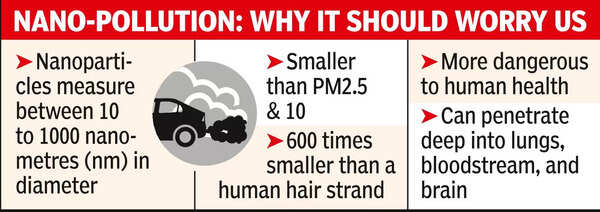
According to climate researchers, nanoparticles are minuscule particles measuring between 10 to 1000 nanometres (nm) in diameter, making them invisible to the naked eye. Believed to be more dangerous to human health, these toxic particles are 600 times smaller than a human hair strand and can penetrate deep into the lungs, bloodstream, and the brain.
The study was conducted on Bawana road in the northwest part of the national capital, which connects Delhi to Rohtak in Haryana.

The research was carried out by Rajeev Kumar Mishra, assistant professor at department of environmental engineering, Delhi Technological University; S Ramachandran from the Physical Research Laboratory, Ahmedabad; and Kanagaraj Rajagopal, a research scholar from Advanced Air and Acoustics Research Laboratory, Delhi Technological University.
Bawana road, which has a vehicular density of around 1,300 per hour, and an average of 40,000 vehicles per day, was divided into two periods during the research. The first period was from April 1, 2021 to June 30, 2021, while the second was from October 3, 2021 to November 30, 2021. Researchers found that nanoparticles directly related to vehicular exhausts were found more in the roadside areas. “When the wind speed is high, they get dispersed to the surrounding regions of the road, which may increase the exposure to the residents living nearby,” they stated.
Highlighting that the ultra-fine particles can contribute up to 90% to the total nanoparticle concentrations in urban areas, Mishra said, “People working near the road, such as police, street vendors, drivers, motorcyclists, delivery personnel, and the urban poor living around it are more susceptible.”
During the first period, which also saw Covid lockdown, the recorded vehicle fleet was 49% lower than the normal period. Due to this, the nanoparticle concentration was lower by 31% (from the baseline). In the second phase which was post Diwali, the concentration of particles went up by 35%.
“The outcomes of this study can be used to initiate mitigation measures for pollution events with implications to climate change, and help move towards a sustainable future,” added Mishra.
We also published the following articles recently
Nanoparticles pose mega risk to Delhi
Air quality monitoring data in Delhi has shown an increase in levels of nanoparticles, which are tiny particles that can penetrate deep into the lungs, bloodstream, and brain. The research, conducted on Bawana road, a highly polluted area with high vehicular density, found that nanoparticles related to vehicular exhaust were more concentrated in roadside areas. During the Covid lockdown, when vehicle movement was restricted, nanoparticle concentrations decreased, but post-Diwali, they increased due to vehicular and firecracker emissions. The study suggests policy building based on nanoparticle concentrations to mitigate pollution and protect human health.
Air quality monitoring data in Delhi has shown an increase in levels of nanoparticles, which are tiny particles that can penetrate deep into the lungs, bloodstream, and brain. The research, conducted on Bawana road, a highly polluted area with high vehicular density, found that nanoparticles related to vehicular exhaust were more concentrated in roadside areas. During the Covid lockdown, when vehicle movement was restricted, nanoparticle concentrations decreased, but post-Diwali, they increased due to vehicular and firecracker emissions. The study suggests policy building based on nanoparticle concentrations to mitigate pollution and protect human health.
Author workshop at MDU Rohtak promotes quality research and scientific writing
An Author Workshop was organized at Maharshi Dayanand University in collaboration with Springer Nature to highlight the importance of quality research publication. The Vice Chancellor emphasized the credibility that quality research publication brings to the university. The keynote speaker discussed the key factors for publication in quality research journals and explained the nuances of scientific writing and publishing. The workshop also covered topics such as academic writing, utilization of e-resources, and the impact of Springer Nature on the university community.
An Author Workshop was organized at Maharshi Dayanand University in collaboration with Springer Nature to highlight the importance of quality research publication. The Vice Chancellor emphasized the credibility that quality research publication brings to the university. The keynote speaker discussed the key factors for publication in quality research journals and explained the nuances of scientific writing and publishing. The workshop also covered topics such as academic writing, utilization of e-resources, and the impact of Springer Nature on the university community.
Walking five flights of stairs can reduce risk of heart disease by 20 per cent: Research
A new study from Tulane University suggests that climbing stairs and taking at least 50 steps per day can significantly reduce the risk of heart disease. The study found that climbing more than five flights of stairs daily could reduce the risk of cardiovascular disease by 20%. The research, which used data from 450,000 adults, concluded that stair climbing is an effective and accessible way to incorporate exercise into daily routines and prevent heart disease.
A new study from Tulane University suggests that climbing stairs and taking at least 50 steps per day can significantly reduce the risk of heart disease. The study found that climbing more than five flights of stairs daily could reduce the risk of cardiovascular disease by 20%. The research, which used data from 450,000 adults, concluded that stair climbing is an effective and accessible way to incorporate exercise into daily routines and prevent heart disease.
End of Article
FOLLOW US ON SOCIAL MEDIA










Photostories

Hot Picks
TOP TRENDING
Popular Categories
Hot on the Web
Top Trends
Mohamed Muizzu India VisitIsrael Hezbollah WarAssembly Election Result 2024Travis KelceBiju GeorgeGautam GambhirKayla NicoleBasit AliInd vs China Stock MarketLalu Prasad YadavUGC NET ResultDiddyWomen's T20 World CupTop MBA Colleges of IndiaT20 WC ScheduleWomen T20 World Cup Points TableLive Cricket Score
Trending Topics
Bigg Boss 18 Launch LIVE UpdatesBigg Boss Tamil 8 Contestants ListBigg Boss Tamil 8 Launch LIVE UpdatesNavratri Colours 2024Navratri Day 2 ColourDurga Puja 2024Bigg Boss 18 House PhotoDevara CollectionNita AmbaniDeepika PadukoneGovindaDevaraGovinda NewsDevara Movie ReviewSwatantrya Veer SavarkarColdplay India tour 2025Watch NFL Live StreamDress To ImpressCall Of Duty Black Ops 6Wordle Answer
Living and entertainment
Latest News
1st T20I: Dominant India make quick work of BangladeshWorld famous Corpus Clock: A time piece and a haunting work of artRanveer Singh: I have a man crush on Tiger ShroffGhum Hai Kisikey Pyaar Meiin: Savi accuses Jigar of misbehaviourYouTube Shorts extends duration to 3 minutes5 must follow rules of Ayurveda to lose 5kg in 30 daysONGC Apprenticeship Recruitment 2024 registration begins: Check direct link hereWWE Hall of Famer Diamond Dallas Page signs new WWE Legends deal'Like a ghost': Manish Sisodia says Arvind Kejriwal has become PM Narendra Modi's 'sole obsession''Singham Again' Trailer: Ranveer Singh kisses wife Deepika Padukone's poster as she skips grand launch eventMy effort in internationalising Shatatantri Veena among the next generation seemingly paying dividends says Tarun Bhattacharya on his return from US TourOptical Illusion: Can you find who's the boss in this picture?'All teams will come to Pakistan for Champions Trophy': PCB chairman on India's participation'Nervous Nineties': Sachin Tendulkar’s 'unwanted' record in international cricketCoin Master free spins and coins for 7 October, 2024: Earn million of coins using today’s linkIndustry upbeat on policy continuity as business confidence index rises to 2-quarter high: CIISeized vehicles, weapons used by Hamas in October 7 attack on display in IsraelCleveland Browns coach Kevin Stefanski said the team is “not changing quarterbacks” after Deshaun Watson's poor performance
Copyright © 2024 Bennett, Coleman & Co. Ltd. All rights reserved. For reprint rights: Times Syndication Service