
- News
- City News
- nagpur News
- For 7 & 13 Voters, Poll Officials Brave Hills & Forests In Melghat
Trending
This story is from April 25, 2024
For 7 & 13 Voters, Poll Officials Brave Hills & Forests In Melghat

Normally, the election team reaches voting centres a day before the polling. However, there are 136 remote stations in Melghat, a tribal pocket amid the Satpura hill ranges and large tracts of tiger reserve, where they are leaving no chance for a delay.










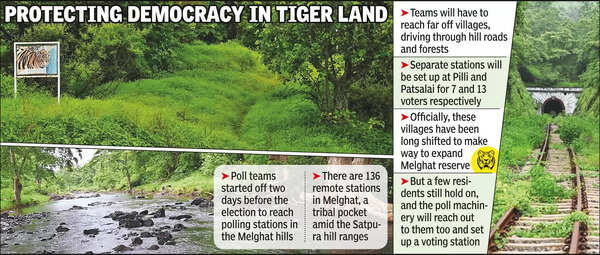
The staff will have to reach far off villages, driving through hill roads and forests, hoping there are no road blocks or any other hurdles.
Among the sparsely populated villages, separate stations will be set up at Pilli and Patsalai for 7 and 13 voters respectively. Officially, the villages have been long shifted to make way to expand Melghat Tiger reserve. But a handful residents still hold on, resisting land acquisition, and the poll machinery will reach out to them too and set up a voting station.
As the region is cut-off from mobile connectivity or internet in some pockets, reporting on voting turnout will have to be done by wireless or even motorcycle riders carrying messages.
Part of Chikhaldara tehsil, the two villages are more than 50km from the dispatch centre at Achalpur in the foothills. It takes nearly double the time to reach there as compared to the plains, said an election official.
There are a number of sparsely populated villages in Melghat, however, Pilli and Patsalai have the least number of voters, said the officer.
Once infamous for malnutrition deaths, Melghat has 2.86 lakh voters, which account for 15% of the voter base in Amravati Lok Sabha constituency. With a high turnout rate, Melghat remains a crucial area for candidates.
Since installation of mobile towers is restricted due to the tiger reserve, a number of villages remain cut off from mobile services.
As details of election turnout have to be uploaded in the Election Commission portal every two hours, the district administration has tied up with the forest department to relay data through wireless sets.
However, in some places even the wireless network may fail at times. In that case runners from the forest department will take over. The runners will take off on their motorbikes to reach the nearest spot where mobile connectivity is available, or the radio sets can work, said the government source.
There are 52 such villages but special arrangements have been made in 72 villages due to the local conditions. Trial runs were held in each of the villages by conducting a mock poll.
The runners have been kept as standby arrangement in most cases, but in Marti village, the turnout reporting will solely depend on the motorcycle men, said a senior official. The village has little over 400 voters.
Some of the remote villages also don’t have power connections. But officials have promised to provide the minimum facilities in each polling station. The area has 316 polling centres in all.
End of Article
FOLLOW US ON SOCIAL MEDIA









Photostories

Hot Picks
TOP TRENDING
Explore Every Corner
Across The Globe
Popular Categories
Hot on the Web
Top Trends
Trending Topics
Rakesh RoshanEmergency Box Office CollectionGame Changer Box Office CollectionCareer PredictionsBeetroot Chickpea KebabsValentines Day Week ListBaba VangaBasan Panchami WishesMamta KulkarniDeva ReviewKruger National ParkFebruary 2025 Health PredictionsFebruary 2025 Wealth PredictionsFebruary 2025 Career PredictionsFebruary 2025 Love PredictionsRapper Raftaar WeddingRohan KhaunteGujarat School RapeRajasthan High CourtHarpreet Kaur Babla
Living and entertainment
Latest News
'How can an out and out bowler replace a batter': Harshit Rana's concussion substitution sparks controversyGovernment made President read out BJP pamphlet: KhargeJason Kelce Rejects Travis’ Idea of a Split Eagles-Chiefs Jersey, Unlike Their Mom Donna at the Super Bowl'Deva' box office collection day 1: Shahid Kapoor starter opens with Rs. 5 crore, beats 'Sky Force' on FridayDesi companies seek access to states' electronics tendersSocial media affects kids' well beingWHO's 1 doctor per 1,000 people reality by 2030“Would be a heck of a football coach”: Andy Reid is highly recommending Travis Kelce to pursue coaching after his NFL career endsHollywood eyes Josh Allen as its next A-list star after shifting focus from Travis Kelce and Taylor SwiftNorth Korean troops fighting alongside Russia's army in Kursk 'withdrawn' after suffering heavy losses: Ukrainian officialInside the explosive Diddy's documentary: 7 Shocking revelations that will leave you speechlessSA20: Run-fest at Centurion as MI Cape Town defeat Pretoria Capitals by 27 runsUnmet vows & 'reworking' of climate goals'Emergency' box office collection day 14: Kangana Ranaut starrer inches towards Rs. 18 crore by the end of week twoMade for each other: Rural women & self-help groups a match for growth"It’s time for me to soar on my own": Shedeur Sanders jokes about dad Deion Sanders struggling with ‘Separation Anxiety’ during NFL draft processIn 5 years, 'bye to toll barriers on high-speed highwaysILT20: Pooran leads MI Emirates to thrilling victory over Gulf Giants
Copyright © 2025 Bennett, Coleman & Co. Ltd. All rights reserved. For reprint rights: Times Syndication Service