
- News
- City News
- nagpur News
- Felling city’s lungs will hit human lungs
Trending
This story is from February 26, 2022
Felling city’s lungs will hit human lungs
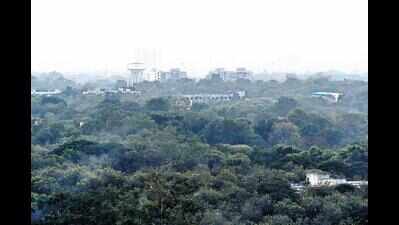
To cut or not to cut? Amid the growing row over proposed felling of heritage trees at Ajni Vann for an inter-modal station (IMS), experts from various fields have come together to make the masses aware of the repercussions that the destruction of this urban forest will cause. While doctors have warned of a rise in health ailments, specifically respiratory problems, environment experts assert that felling thousands of age-old trees will prove to be catastrophic and will lead to air pollution, global warming, soil erosion and a climate crisis
Nagpur: Over 40,000 citizens and various NGOs have joined hands to oppose the proposed felling of thousands of age-old trees at Ajni for construction of an inter-modal station.
In a press conference held on Friday, medical and environment experts presented various facts and evidences indicating towards the irregularities and violation of norms that loom over the project.

Highlighting that environmental clearances and other compliances were not taken for the project, experts stated that the economic cost of trees that are to be felled will be much higher than the financial benefits of the project. “These trees have been sequestering atmospheric carbon dioxide for almost 40-50 years,” they said.
Clarifying that they are not against the project and that it is a matter of pride that IMS is coming in Nagpur, the experts on the panel said that development should be sustainable. “We are willing to sit with the policy-makers and find sustainable solutions. This campaign is not against development but the location where it is coming. People who are saying that Ajni is not an urban forest or that other alternatives are not available are either misleading the public or are not well-informed,” added experts.
Recently, a group of trade and industries associations held a press conference asserting that IMS should come at Ajni for the sake of city’s economic growth and development. Union Minister Nitin Gadkari also said that IMS will be limited to 40-47 hectares land along the railway line.
Earlier, Gadkari had stated that his ministry would drop the IMS project if citizens did not want it. He also said that the contractor had already cancelled the project and sent a termination letter to NHAI due to legal tangles.
While the case is sub-judice, the objection letters filed by citizens against tree felling have been submitted to the newly-formed state tree authority. The committee has asked NHAI, which is the proposer of the project, to submit a detailed analysis of alternate sites that were explored.
During his recent city visit, state environment minster Aaditya Thackeray made an unscheduled halt at Ajni Vann after green crusaders presented him memorandums. The minister assured to find a way to ensure that the IMS comes in Nagpur along with the city’s Ajni Vann being protected and remaining green.
While interacting with TOI, Thackeray had said wherever trees could be saved, efforts must be made to save them, especially for green patches like Ajni Vann.
Green crusaders say it loud and clear
Development should not happen at the cost of human health. Trees play a very crucial role when it comes to protecting public health, especially our lungs. Last year during the pandemic, Union minister Nitin Gadkari inaugurated oxygen plant in the city. What we need to realize is that these plants are set up using natural oxygen. There is no point in destroying natural sources of oxygen and creating artificial ones. The large-scale destruction of trees will also lead to air pollution which will result in various respiratory ailments, lung diseases etc. I know so many families based in polluted cities like New Delhi are now shifting to cities like Nagpur and Pune for better quality of air. But if we keep destroying our green cover like this, a time will come when our city would also get highly polluted.
Dr Vasant Khalatkar | paediatrician & neonatologist
The city saw numerous deaths during the pandemic due to lack of oxygen. That time, saplings were distributed and citizens were encouraged to plant trees. On one hand, the government talks of plantations and on the other hand, it plans for such massive deforestation. Ajni is one of the biggest green pockets and has age-old trees which are the biggest source of natural oxygen. These trees are protecting us from harmful UV rays and maintaining air, water and soil balance. If these trees are felled, the water will turn turbid and this will give rise to vector-borne diseases. The deforestation will also lead to other health issues like asthma, bronchitis, lungs cancer and other ailments. Also, it has been scientifically proven that trees are stress-busters and boost mental health.
Dr Harsha Chhangani | dental surgeon
Our survey revealed that there are about 82 species at Ajni Vann, out of which 54 are native. Some species are also rare and a lot of trees are heritage. This aside, a tree cannot be perceived as a single entity — it controls air and noise pollution, maintains groundwater level, prevents soil erosion and is a habitat of biodiversity. Ajni Vann is home to various birds and animals. So, the question is not just about felling trees but destroying a complete ecosystem. Nagpur is already reeling under the effect of climate change, temperatures are rising and monsoon patterns are changing. We cannot afford losing this urban forest.
Prachi Mahurkar | tree expert, member of city’s tree committee
We have never been against the inter-modal station (IMS) project. And we are not environment mafias or anti-development and have no vested interest in opposing the project. All we are saying is we need to protect environment and urban health. And for those who argue that Ajni is not an urban forest, we would like to say that the definition of it as per the Forest Survey of India is a cover which includes more than 1 hectare and have tree canopy density of 10%. The definition further states that these patches of trees play a significant role in socio-economic and ecological status of economy. For our minister’s dream project, we cannot lose this urban forest. Our only demand is to shift it to an alternate location.
Anasuya Kale Chhabrani | president of swacch association
There have been various contentions about the project area and its phases. We have now come out with all the evidence to prove how policy-makers have been misleading public. The Memorandum of Understanding (MoU) signed between the Railway Land Development Authority (RLDA) and National Highways Authority of India (NHAI) clearly states that the project is planned over 446 acres land. Also, while some trade associations recently denied the project having any commercial phases, the MoU as well as internal presentations of NHAI show that the next phases are to be commercial, comprising of shopping complexes, offices, hotels etc. The master plan of the actual IMS project was kept hidden from the public.
Wasudev Mishra | rti activist
While authorities are claiming that most of the trees that will be felled at Ajni Vann are of subabul, the ground reality is that only 10-15% of the trees belong to this specie. Authorities should also note that subabul and babul are two different species; the latter is native to our region and is very useful. While subabul was introduced by the government as a fast-growing specie for fodder, later research proved that it contains toxins and is now banned as a fodder specie for livestock. Nevertheless, subabul trees contribute to release of oxygen, absorb carbon dioxide and are also seen adapted by local fauna as a habitat. There is no truth in the fact that subabul trees have no ecological value.
Madhuri Kanetkar | tree expert
Trade associations recently stated that IMS will generate employment in the city. Same dream was shown a few decades back when Mihan was introduced, promising lakhs of jobs. Where do we stand now? IMS is meant for travellers, mostly changing from one mode of transport to another. It makes no sense to destroy our natural heritage, without assessing the environmental impacts of the project. IMS should come in the outskirts of the city seeing future expansion, reducing congestion and increasing the effectiveness of Metro rail. These are the basic principles of urban planning.
Sandeep Pathe | architectural conservationist
The government is fooling the public by making tall promises of compensatory plantations and transplantation. Recently, Union minister Nitin Gadkari cited example of translocation of trees done at Dwarka in New Delhi. We have personally seen the site and have clear evidence to show that the transplantation has been a big failure. The trees are dying a slow death. The poor survival rate of NHAI’s compensatory plantation is obvious anywhere in the city. Lakhs of such plantations have failed to survive. Also, the amended Maharashtra (Urban Areas) Protection and Preservation of Trees Act of 1975 Act states that the total number of trees that need to be felled for a project should be revealed, rather than taking permissions phase-wise. The authorities have violated this rule.
Sharad Paliwal | secretary, swacch association
Initially, NHAI misled us by stating that 1,940 trees will be cut for the project. Later, a joint survey by Nagpur Municipal Corporation and NHAI revealed that the number is more than 6,000. The actual number of trees that will be felled if the project comes as per the planned phases will be around 40,000. This loss will be irreversible. We, as citizens, have the right to voice our discontentment in a democratic way based on facts. By accusing and hurling personal abuses at citizens, using uncouth language and targeting us for raising our voices against destruction is a new low visible in the relationship of people and government. This city is our home and we have the constitutional rights to present true facts to the public which are being hidden by policy-makers.
Kunal Mourya | environment activist
End of Article
FOLLOW US ON SOCIAL MEDIA










Hot Picks
TOP TRENDING
Trending Stories
In City
Entire Website
- 7 Must-Watch Films to Inspire Students
- Florida woman who sold all her possessions for a 3-year luxury cruise banned for WhatsApp messages
- Animal fat in Tirupati laddu: Centre intervenes, temple trust blacklists supplier - Top developments
- Indian Embassy official found dead at Washington DC office under mysterious circumstances
- Rohit Sharma gets angry at team-mate: 'Soye hue hain sab log'
- PM Modi on 3-day US visit for Quad summit: Key agendas, full schedule
- 10 Daily Habits for Students to Keep Their Minds Young and Sharp
- 'When temples are being attacked ... ': Andhra deputy CM Pawan Kalyan on Tirupati laddu row
- NIA conduct raids at several locations across Punjab in terror-conspiracy case linked to Gurpatwant Singh Pannun
- To challenge Ola and Uber, Chennai auto drivers rebuild ride-booking app after crippling hack
- 'You might not believe ... ': When PM Modi compared size of Obama's car to his mom's house
- Spoke to family 3 days ago: Kerala man linked to Hezbollah pager blasts?
- Animal fat in Tirupati laddu: Why lakhs of devotees are outraged
- Train mishap averted after fishplates, keys found on tracks in Surat
- 1st Test Live: Shubman Gill slams century vs Bangladesh in Chennai
- Pant marks Test comeback with record-equalling century
- Indus treaty: When Modi said ‘blood and water can’t flow together’
- EY employee's death: Anna Sebastian's father appeals to the company
- How Bumrah mastered the art of toe-crushing yorkers
- 'Offered water laced with drugs': 13-yr-old Dalit gang-raped in car

Popular Categories
Hot on the Web
Top Trends
IND vs BAN Live ScoreRohit SharmaVirat KohliRishabh PantUGC NET Result 2024Cristiana Barsony ArcidiaconoTirupati Laddu RowIsraeli Strikes on HezbollahRhea RipleyIsrael Hezbollah WarIND vs BAN Highlights Days 2Kerala Lottery ResultTirupati PrasadamEY Pune EmployeeSean DiddySandip GhoshLive Cricket Score
Trending Topics
Daughter's Day WishesParvin DabasAbdu RozikMukesh KhannaJayamSana Khan HusbandTirupati Laddoo ControversyGOAT CollectionVaazha OTT ReviewKozhipannai Chelladurai ReviewCheetahsKangana RanautAditi Rao HydariDalljiet KaurHoliday DestinationVikas SethiBest Selling Earbuds Under 1000Apple iPhone 16 ProVirat KohliWordle Answer
Living and entertainment
Latest News
Stuck in Lebanon for 23 years, Punjab man back homeBirthday throwback: When Kareena Kapoor Khan said it was rather ‘Alia Bhatt’s question’, when she was asked if Deepika Padukone is her competition!Roman Reigns Gives His Word to Back Cody Rhodes Against The BloodlineSupreme Court questions change in NEET-PG pattern, seeks response of NBE and CentreYudhra box office collection day 1: Siddhant Chaturvedi and Malvika Mohanan starrer opens with Rs 4.50 croreUP man kills newborn daughter in fit of rage over fourth girl cild, ArrestedSalesforce to expand its innovation hubs in Bengaluru, HyderabadThe truth about sugar substitutes: Safe alternative or hidden health risk?Not taking EY to court, says dead CA's fatherCheeky Rishabh Pant helps Bangladesh set field on Day 3 of Chennai Test - Watch1st Test: Shubman Gill, Rishabh Pant fifties carry India to 205/3 at lunch on Day 3 against BangladeshKarnataka HC asks couple to seek spiritual guru's help to save marriageBombay HC strikes down Centre's fact check unitFire breaks out at furniture market in Central DelhiLibra, Daily Horoscope Today, September 21, 2024: Focus on a balanced diet and exercise to maintain well-beingExploring If Justin Herbert will play the Chargers vs Steelers game on Sunday amid ankle injuryMemeFi daily codes for 21 September 2024: Boost your earnings with daily codes and know how to maximizeBest i5 12th Generation Laptops: Best Picks For Performance & Value
Copyright © 2024 Bennett, Coleman & Co. Ltd. All rights reserved. For reprint rights: Times Syndication Service