
- News
- City News
- nagpur News
- Couple suicide bares cancer treatment’s monetary stress
Trending
This story is from July 7, 2024
Couple suicide bares cancer treatment’s monetary stress

TOI spoke with experts who shed light on the increasing prevalence of blood cancer and the associated costs.

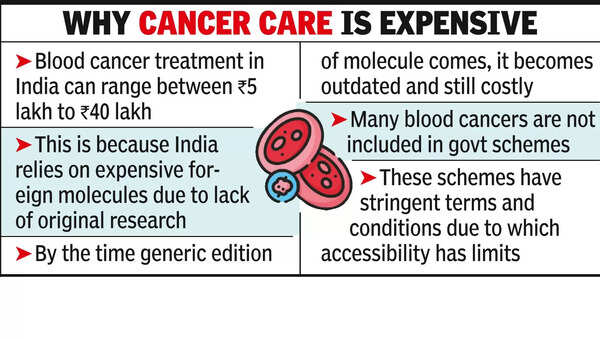
According to a study by the Indian Council of Medical Research (ICMR), the cost of treating blood cancer in India can range between Rs 5 lakh and Rs 20 lakh, depending on the type and stage of cancer. Bone marrow transplants, a final treatment option for blood cancer, can cost between Rs 15 lakh and Rs 40 lakh.
Patients require long-term care, and the expenses for medication, injectables, and hospital stays can run into lakhs of rupees. For many families, it becomes a choice between financial ruin and the hope of recovery.
A report by the World Health Organization (WHO) stated that around 70% of cancer patients in India incur catastrophic health expenditures, leading to financial hardships and often pushing families to poverty.
Dr Riya Ballikar, a renowned Haemat Oncologist, provided valuable insights. “Blood cancer, which includes leukemia, lymphoma, and myeloma, has been on the rise due to a variety of factors,” Dr Ballikar explained, adding, “Environmental pollution, lifestyle changes, genetic predispositions, and even exposure to certain chemicals can increase the risk of developing blood cancer.”
To address the financial challenges, she called for more government support and research initiatives. “The government of India should promote research to develop low-cost generic medicines. There is very little original research in India, and we often have to buy expensive foreign molecules. By the time these molecules are available as generics in India, they are outdated and still costly,” she said.
Dr Ballikar also highlighted the potential of clinical trials as a solution. “People should be aware that many hospitals offer clinical trials. Patients who are willing to participate can access the latest treatments at low costs. This practice is common in the USA and has shown good results,” she informed.
Haemat Oncologist, Dr Shailesh Bamborde, said patients should be made aware of NGOs and fundraising platforms. “We have several instances of fundraising platforms that proved to be extremely helpful to needy patients. We doctors keep telling patients about such solutions, but many are hesitant,” he said.
Raj Khandare, social worker and public health activist, said, “Government hospitals must have better facilities for cancer treatment. The conditions in these hospitals are poor. Strengthening government hospitals will allow poor patients to receive good facilities at no or low cost.”
Dr Manish Thakre, president of the Psychiatric Society of Nagpur, emphasized the importance of psychological support for cancer patients. “A counselling unit is essential in hospitals treating cancer patients. These patients and their relatives need someone to share their emotions and feelings with. Suicides can be avoided if a psychiatrist is available,” he said.
End of Article
FOLLOW US ON SOCIAL MEDIA







Photostories

Hot Picks
TOP TRENDING
Popular Categories
Hot on the Web
Top Trends
IND vs BAN Live ScoreRussell WilsonsVirat KohliMickey ArthurShantanu NaiduUGC NET ResultNobel Peace PrizeMahadev Betting AppAmazon LayoffsRatan Tata DiesCBSE Class 10 12 Practical ExamPopular Schools in Navi MumbaiManagement Colleges of IndiaTop Medical Colleges of IndiaTop Engineering Colleges of IndiaTop Pharmacy Colleges of IndiaLive Cricket Score
Trending Topics
Diwali WishesDussehra 2024 QuotesDussehra WishesVettaiyan OTT ReleaseVettaiyan CollectionVettaiyan ReviewNatasa StankovicDevara CollectionBigg Boss 18Deepika PadukoneShraddha KapoorRatan Tata Passed AwayJigra Movie ReviewVettaiyan Movie ReviewSwatantrya Veer SavarkarDussehra 2024Elon MuskDussehra Whatsapp StatusUltimate Football Codes October 2024Wordle Answer
Living and entertainment
Latest News
Challenging Aspects in Astrology: What They Mean for YouNew Zealand pile pressure on India after routing Sri Lanka'Promotion of players by agents...': Mickey Arthur criticizes PCB, media for team's declining performancesInfosys to no longer send job offer letters and attachments, the company will ...Sena vs Sena: Dusshera rallies in Mumbai turn political as Shinde, Uddhav take aim at each otherUS carries out airstrikes in Syria to avert Isis attack on American soilExclusive: Aishwarya Khare recalls his childhood memories of Dussehra, says 'my father used to take us all to watch Ram Leela and Ravan Dahan'Punjab NEET UG Counselling 2024: Round 3 provisional merit list out, steps to checkManasi Parekh celebrates National Award win with husband Parthiv Gohil: “What a year it’s been!”In the land of Ram, a Ramlila that unites Hindus and Muslims'Singham Again' stars Ajay Devgn, Kareena Kapoor, Rohit Shetty spotted at airport as they jet off for Raavan Dahan in Delhi - Watch VIDEOPapankusha Ekadashi 2024: Date, Parana Time, Puja Rituals and Significance'Bigg Boss OTT 3' contestant Ranvir Shorey admits lack of patience for 'Bigg Boss', enters the show unprepared7 dead, 1 missing after car plunges into canal in Haryana'HanuMan' director Prasanth Varma reveals 'difference of opinion' with Ranveer Singh, hints at future collaborationETimes Pic of the day: When Indrajith Sukumaran bumped into Mukesh Ambani at a traffic signalDid you know NTR is the only actor to play both Lord Rama and Ravana?Swearing-in ceremony of Nayab Singh government in Haryana on October 17: Manohar Lal Khattar
Copyright © 2024 Bennett, Coleman & Co. Ltd. All rights reserved. For reprint rights: Times Syndication Service