
- News
- City News
- nagpur News
- Nagpur: As city’s potholes grow in size, their repair cost too goes up
Trending
This story is from February 16, 2020
Nagpur: As city’s potholes grow in size, their repair cost too goes up
A study by Visvesvaraya National Institute of Technology (VNIT) has revealed that neglected potholes have cost the Nagpur Municipal Corporation (NMC) dear with the expenditure for repairs increasing manifold.
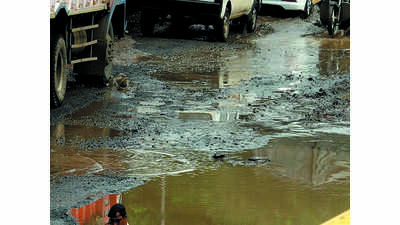
representative image
After the VNIT’s civil engineering department adopted a stretch of Hingna road for a year, a small pothole appeared in December 2016. If the NMC had repaired the pothole right away then the expenditure per sqm would have been in the region of Rs500-Rs700.

While the NMC failed to wake up from its deep slumber, the size of the pothole increased by February 2017.
However, three months later, in June 2017, the pothole became bigger and deeper and needed immediate repairs. The cost of repairs increased to Rs1,200—1,750 per sqm.
As the civic body continued to turn a blind eye, the small pothole turned into a huge crater by July 2017. This lackadaisical attitude proved costly for the civic body as now, it needs to relay the entire stretch at a cost of Rs50 lakh per km, the VNIT study revealed.
“It’s just the tip of the iceberg. With the city’s road network approximately 2,700km, the NMC needs to come up with a comprehensive road asset management system which can save wasteful expenditure worth crores of rupees,” said V Landge, head of VNIT’s civil engineering department.
The Central India’s premier institute has also submitted its study — carried out by Landge, Parag Deshpande, Udit Jain, Vivek Hokam and Abhay Tawlare — to the civic body.
“We have submitted a proposal to the NMC to launch the Nagpur road asset management system (N-RAMS) which will be a smart step for a smart city. Our service charges per annum would be Rs2 crore,” said Landge.
According to VNIT’s proposal, data collection will be done by traffic volunteers. They will use a mobile app to record details of faulty roads. VNIT has offered to develop the road severity index to help prioritize rehabilitation and also to strategize repair work within the limited budget.
The NMC has insufficient manpower to handle the city’s road network. The other concern is the limited budget for repairs and maintenance of roads.
Road maintenance is not based on measurable objective criteria but on ad hoc demands of elected representatives, stated the study.
Many a time, a bad road (especially in fringe areas) remains neglected while maintenance is carried out at locations where it is not required and the result is wasteful expenditure and deterioration of serviceability level of the overall road network, the study found.
The only solution is developing a comprehensive Road Asset Management System which will encompass the NMC assets, including roads, drains and related infrastructure, their condition (based on measurable technical criteria), its resources (budget, manpower, machinery) and contractor (quality of the work, history, reputation).
The NMC will not require permanent staff and hence, no need for additional investment as it can be done within the domain of the Smart City project.
About the implementation of the system, the study suggested geotagging of all roads, converting all roads into manageable road pieces of uniform sizes, assigning unique ID to each road, quantitative measurement to judge the quality of road in terms of defects and defect parameters, design algorithm to estimate repair cost based on defects and multidimensional analysis based on location, time, defect and contractor.
VNIT has offered to develop the road severity index to help prioritize restoration and simultaneously help to strategize repair work within limited budget.
Mayor Sandip Joshi appreciated VNIT’s study and said if NMC implements it then taxpayers’ money will be saved. “Next week a meeting between the premier institute and NMC’s chief engineer Ulhas Debadwar will be convened,” he said.

About the Author
Proshun ChakrabortyEnd of Article
FOLLOW US ON SOCIAL MEDIA










Hot Picks
TOP TRENDING
Trending Stories
In City
Entire Website
- Indian investors are rushing to buy properties in Greece; here’s why
- From Cristiano Ronaldo to Lionel Messi: Top 5 players to get fined over tax evasion
- Apple, Cisco, Microsoft and other tech giants are slashing jobs despite healthy revenues: Triggers behind the layoff culture, ways to safeguard your career and more
- 'Assigned task was not hers': Work pressure at EY Pune kills CA daughter from Kerala
- 'Stupid statement': Ex-Pakistan cricketer Basit Ali blasts Australian bowler for predicting 5-0 victory over India in Border-Gavaskar Trophy
- EXCLUSIVE | My sights are set on hitting the bullseye and changing the colour of medal at Los Angeles Olympics: Manu Bhaker
- Telangana to scrap 15-year-old vehicles from January 1
- What MS Dhoni said to Yuvraj Singh after he hit Stuart Broad for 6 sixes in 2007 T20 World Cup
- 'Attempt to polish your failed product': Nadda's response to Kharge's letter to PM Modi
- Pannun files civil lawsuit in US against GOI, Doval and others, seeks damages
- Bengal-Jharkhand face-off: Mamata blames ally Soren for flooding, closes border
- 30 launchers, 150 nests hit: Footage shows Israeli strikes on Hezbollah
- India beats China in yet another global benchmark
- Arvind Kejriwal to hold 'Janta ki Adalat' at Jantar Mantar on Sept 22
- 1st Test Live: After Ashwin, Jadeja eyes century vs Bangladesh
- SUV on wrong side kills biker in Gurgaon, tragic crash caught on cam
- Will exploding pagers spark an escalation in West Asia conflict?
- Cognizant loses another top exec as CMO resigns, read company's statement
- Sensex surges in opening trade; Nifty50 above 25,500
- Rahul's Chennai Test failure tagged 'innings without purpose'

Popular Categories
Hot on the Web
Top Trends
Mark ZuckerbergIND vs BAN LiveUS Fed Interest RatesSecret Lovers of WWEIndia Fastest Metro ServiceIsrael Air Strike in LebanonIsrael Hezbollah WarNPS VatsalyaThe RockHezbollah Chief NasrallahJohn CenaTirupati Laddu RowTop 5 Players to get Fined over Tax EvasionAmazonSukanya Samriddhi YojanaAppleLive Cricket Score
Trending Topics
Stree 2 CollectionSalim KhanAbdu RozikHema CommitteeJayamSana Khan HusbandTirupati Laddoo ControversyNandhan ReviewVaazha OTT ReviewPitra Paksha 2024CheetahsKangana RanautAditi Rao HydariDalljiet KaurHoliday DestinationVikas SethiBest Selling Earbuds Under 1000Apple iPhone 16 ProVirat KohliWordle Answer
Living and entertainment
Latest News
Fed cut won’t run deepCentre to examine EY India worker’s demiseBihar: Senior IPS officer Shivdeep Wamanrao Lande resigns from serviceReport on Indian arms reaching Ukraine misleading: MEA'Unwarranted, unsubstantiated': India reacts strongly to US court summons over pro-Khalistani terrorist Pannun's lawsuit over 'assassination bid'Tall talesFans find yet another doppelganger of John Abraham; videos of the 'Arabic' lookalike go viral - WATCHAnil Kapoor expresses joy as 'The Night Manager' bags the nomination at Emmy Awards 2024: 'I just couldn't believe it'Seeking refuge from strains of everyday lifeGangster's aide dies after jumping off Delhi flyover to evade arrestBully Ray Discusses Hell in a Cell's Spot at WWE Bad Blood 2024How to lower your pet dog's anxiety during festive celebrationsCon artist held for posing as customs inspector in SuratKisqali wins FDA nod for breast cancer treatment: Dosage, effectiveness and side effects of the breakthrough drugHaryana AAP chief Sushil Gupta slams BJP, criticises 'one nation, one election' as unrealistic promiseMafia ran govt in Samajwadi Party rule while 'babua' slept: Yogi AdityanathAnantapur court sentences one to life imprisonment and seven to rigorous imprisonment in a kidnap and murder caseDon’t cut trees for Porvorim project: Forest dept to PWD
Copyright © 2024 Bennett, Coleman & Co. Ltd. All rights reserved. For reprint rights: Times Syndication Service