
- News
- City News
- nagpur News
- 25cr homes can harvest 637GW rooftop solar energy: Report
Trending
This story is from November 17, 2023
25cr homes can harvest 637GW rooftop solar energy: Report

According to researchers, utilizing just one-third of this potential can support the entire electricity demand of the country’s residential sector.

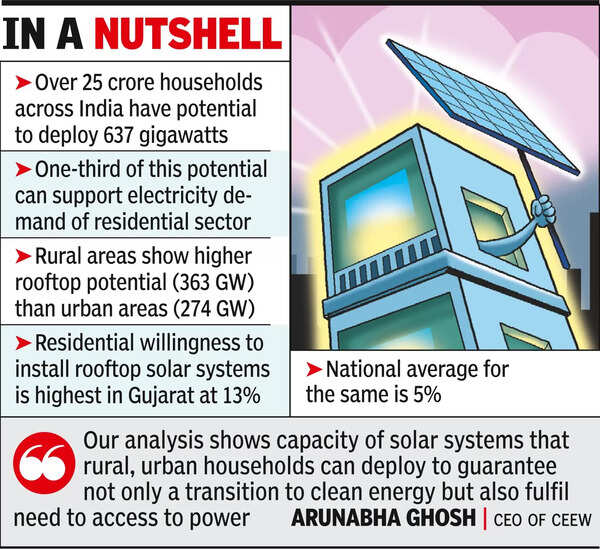
A bottom-up analysis across 21 Indian states that cover 97% of the country’s population found that 60% of the residential rooftop potential is concentrated in just seven states — Uttar Pradesh, Maharashtra, West Bengal, Odisha, Rajasthan, Andhra Pradesh and Tamil Nadu.
It further revealed that residential awareness of rooftop solar systems was less than 50% at the national level in 2020. “When it came to willingness to install rooftop solar systems, residential consumers in Gujarat were the keenest at 13%%, compared to the national average of 5%. However, residents across states perceive rooftop solar systems to be costly investments, impacting their willingness to pay,” researchers stated.
Furthermore, the rural areas show higher technical potential based on residential rooftop area (363 GW) compared to urban areas across states (274 GW). “India’s solar energy revolution–going from 2,000 megawatt (MW) of solar power capacity in 2010 to 72,018 MW now must reach households too to reach its full potential. Our analysis shows the mammoth capacity of solar systems that both rural and urban households can deploy to guarantee not only a transition to clean energy but also fulfil a basic need – access to power. But to get there, residents must get the right price,” said Arunabha Ghosh, CEO of CEEW.
Highlighting the initiatives taken by the government, joint secretary at the Ministry of New and Renewable Energy (MNRE) Lalit Bohra said, “Accelerating the adoption of rooftop solar is crucial to decarbonise the economy and help India achieve its net zero goal by 2070. MNRE has been actively promoting the rooftop solar sector through its strategic interventions. The national dialogue on rooftop solar by CEEW and the launch of its report on the potential are timely interventions to build a common consensus among stakeholders towards making rooftop solar central to India’s energy transition.”
Another CEEW analysis released on Thursday highlighted that solarising residential households will also offer huge economic benefits to power distribution companies (discoms).
“Solarising rural households in Bihar and Meghalaya highlights lifetime economic gains to the tune of ₹2,700 crore per 100 MW of solar capacity to discoms. The benefits will be due to reduced cross-subsidy burden, improved transmission and distribution losses, and lower average cost to serve consumers,” analysis stated.
End of Article
FOLLOW US ON SOCIAL MEDIA










Photostories

Hot Picks
TOP TRENDING
Popular Categories
Hot on the Web
Top Trends
Shantanu NaiduRussell WilsonsTom BradyAUS vs PAK Live ScorePakistan Cricket FanSuryakumar YadavNobel Peace PrizeMahadev Betting AppNew UPI Transaction LimitRatan Tata DiesPM ModiUGC NET Result 2024Management Colleges of IndiaTop Medical Colleges of IndiaTop Engineering Colleges of IndiaTop Pharmacy Colleges of IndiaLive Cricket Score
Trending Topics
Diwali WishesJigra ReviewDussehra WishesVettaiyan OTT ReleaseVettaiyan CollectionVettaiyan ReviewBlack Movie ReviewDevara CollectionBigg Boss 18Deepika PadukoneShraddha KapoorRatan Tata Passed AwayJigra Movie ReviewVettaiyan Movie ReviewSwatantrya Veer SavarkarDussehra 2024Elon MuskKing Legacy CodesUltimate Football Codes October 2024Wordle Answer
Living and entertainment
Latest News
Navratri 2024: Jaya Bachchan and Shweta Bachchan join Rani Mukerji at the Durga puja pandalInternship scheme: 193 companies post over 90,000 slots on portalOff Argentina's Patagonian coast, whales and their calves dive deep for foodApplications for new power connections among services moved exclusively onlineSara Arfeen Khan opens up about converting to Islam; says, 'I read all holy books and attended a lot of religious debates before converting'Amitabh Bachchan, Rambha, Khushboo and others check in on Govinda after gun misfire incident - ExclusiveCops on unusual hunt: For denturesHappy Dussehra 2024: Top 50 Wishes, Messages, Images and Quotes to Share with Your Loved OnesFortified-food plan faces questions from two PM panel membersKrushna Abhishek shares a heartwarming post for mama Govinda; says 'jab body mein adha blood supremely talented actor Govinda ka ho...'Could Tyreek Hill Return to the Chiefs? Cryptic Posts Fuel Trade Speculation'All is well': Ajit Pawar calls claims of rift in Mahayuti 'baseless'With special access card, disabled people can skip Exposition queuesForex reserves drop $3.7 billion in week, most since start of August'Jigra' box office collection day 1 early estimate: The Alia Bhatt starrer faces tough competition with Rajinikanth's starrer 'Vettitan' and Rajkummar Rao's Vicky Vidya Ka Woh Wala Video'Robert Gronkowski Reacts to His Hilarious Impression in FX's American Sports Story: Aaron HernandezIf Rahul Gandhi fails to deliver, INDIA bloc may make LoP post rotational: BJP‘Kallanum Bhagavathiyum’: The Vishnu Unnikrishnan and Mokksha starrer is set to get a sequel
Copyright © 2024 Bennett, Coleman & Co. Ltd. All rights reserved. For reprint rights: Times Syndication Service