
- News
- City News
- mysuru News
- With growing patrons, Garadi houses in Old Mysuru relive their glorious past
Trending
This story is from May 3, 2022
With growing patrons, Garadi houses in Old Mysuru relive their glorious past
The Old Mysuru region in Karnataka is known for garadi mane (wrestling house), traditional wrestling, and physical training centres. Until a few years ago, it was feared that they may not survive long with gyms mushrooming in the city.
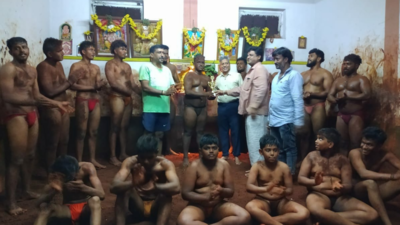
One of the most unique features of garadi manes is that no money is collected for training.
Mysuru: The Old Mysuru region in Karnataka is known for garadi mane (wrestling house), traditional wrestling, and physical training centres. Until a few years ago, it was feared that they may not survive long with gyms mushrooming in the city. However, over the last few months, the trend is reversing with garadi manes witnessing a surge in the number of patrons.

What is adding to the buzz is that girls are also joining the garadi manes, which was not the trend earlier. One of the most unique features of garadi manes is that no money is collected for training.
For Mysuru residents, the garadi manes are not new. For centuries, several garadi manes have been functional here training the youths, with royal patronage. Wrestling competition is an important and integral part of Mysuru Dasara celebrations. Many roads in the city are named after these garadis or well-known pailwans (wrestlers). There was a fear a few years ago that these garadis may become history with youths showing little interest in continuing training in these centres. But post Covid-19, they have received a new lease of life.
According to Mysuru District Bharatiya Shaili Kusti Sangha president and in-charge of Ittigegudu Hathu Janagala Garadi pailwan Chandrashekar, post-Covid, the demand for the training in the garadi manes has increased a lot. “People are now aware that practising in these centres is far better compared to the gyms,” he said. According to him, Mysuru district has around 206 garadi manes and around 190 are active now.
“We started our organisation to make the garadi manes popular, and to conserve the native wrestling styles. We are working for this cause,” he said.
His Ittigegudu Hathu Janagala Garadi is at least 162 years old and the road leading to this garadi mane is named after it. “My entire family is full of wrestlers. My son Bhavan Chandra, who is studying in Class 9 is also learning wrestling. The demand for training in garadi manes has increased. Now, girls are also coming forward for training in our garadi manes,” he said.
According to Chandrashekar, the exercise routine in garadi manes is very balanced and it includes full body workout. “We don’t take any money for training,” he added.
“Those who are preferring the garadi mane over gym say that traditional wrestling is more balanced and there is no fear of any health issues. I was going to a gym. But then, my family insisted on shifting to yoga and garadi mane. So, I have been training at a garadi mane for the last two months,” said Siddartha Patel, a resident of JC Nagar.
According to 68-year-old yajaman pailwan S Mahadev, general secretary, Jayachamaraja Wadiyar Garadi Sangha, Sahukar S Chennaiah Kusti Akhada, Doddakere grounds in the city, girls are coming forward to learn and practice in the garadi manes. “Around 30-35 young students are practising in our kushti akhada. Among them are five to six girls. More and more youngsters are coming forward to our centres,” he said.
Karnataka State Gym and Fitness Association president AV Ravi said: “Initially due to Covid-19, we faced problems. Now, some people have misconceptions about working out in gyms.”
Ravi informed that there are over 10,000 gyms spread across the state. “To set up a gym, an investment between Rs 15 lakh to 20 lakh is required. The government must consider extending financial help in line with the small scale industries to revive the gym industry,” he said.
He also appealed to the public to return to gyms as they are safe.
End of Article
FOLLOW US ON SOCIAL MEDIA









Hot Picks
TOP TRENDING
Trending Stories
In City
Entire Website
- Howard University: 10 landmark firsts of the institution that shaped Kamala Harris
- Earthquake of magnitude 5.8 strikes Pakistan, tremors felt in Delhi, neighbouring areas
- Who were Barack Obama's challengers in 2008 and 2012 US presidential elections?
- 'A in INDIA alliance': Rahul Gandhi's slip-up during address to Indian-Americans goes viral
- Trump vs Harris: Betting markets reveal who’s expected to win the US presidential debate
- IGNOU December 2024 Term-End Exam: Registration Details, Important Dates, and Fee Structure
- Top 10 TED Talks to Boost Confidence and Success for Female Students
- Case against British Indian woman for Hindu prayers on beach collapses
- China refuses to sign agreement to ban AI from controlling nuclear weapons
- 'Not merely due to diet ...': Tammy Slaton on her weight loss journey after losing 226 kg
- Tussle in Mahayuti: Total seats 288, but BJP wants 160, Shiv Sena 100+ and NCP 60+
- ACT Hockey: India hammer Malaysia 8-1
- What Apple's latest iPhones with built-in AI mean for us
- An Indian, not Columbus, found America, says MP education minister
- Malaika Arora's father Anil Arora dies by suicide
- Encounter breaks out between security forces and terrorists in Udhampur
- Is a select group of investors rigging the SME IPO game?
- iPhone 16 series launched: Complete features, price and how to pre-order
- Remembering 9/11: Key moments from the deadliest attack on US
- UN general assembly opens with historic new seat for Palestine

Popular Categories
Hot on the Web
Top Trends
Trending Topics
Deepika PadukoneMalaika Arora Father DeathArbaaz KhanJayram RaviAishwarya Rai BachchanSlat WaterWeight GainGOAT CollectionVikas Sethi DeathMalayalam ProducersIndia's Best Dancer 4Simi GarewalDilli BabuIndian National ParksLaung BenefitsVikas SethiiPhone 16Dubai Princess Sheikha MahraMG Windsor EvWordle Answer
Living and entertainment
Latest News
Manju Warrier expresses gratitude for birthday wishes: "Forever humbled and grateful"Haryana HPSC PGT admit card 2024 out at hpsc.gov.in: Direct link to download hall ticket here6,0,6,6,6 - Smashing Kieron Pollard rolls back the clock in Caribbean Premier League - WatchRelief for Amul in trademark war against Italian brandAfghanistan vs New Zealand: Why is Greater Noida stadium hosting a Test match?Shilpa Shetty and Raj Kundra spotted at the Siddhivinayak Temple; video insideDonald Trump and Kamala Harris shake hands as they meet for first time on debate stage: Watch the 'awkward' momentPrince William’s commitment to a lasting marriage with KateWhen Jaya Bachchan revealed she had a huge crush on Dharmendra, called him a 'Greek God' in front of Hema MaliniJr NTR starrer 'Devara: Part 1' completes censorship formalities; receives UA certificateGeorgia school shooting: Suspect's mom's call wasn't the only alert, multiple warnings overlooked before Apalachee high attack'Trump should not be telling a woman what to do with her body', says Kamala Harris on abortion rights during US presidential debateArbaaz Khan spotted outside Malaika Arora's house along with police after the tragic news of her father's demise by alleged suicide - WATCH VIDEOShivaji statue collapse: Sculptor’s custody extended till September 13Vijay Sethupathi and Trisha starrer '96' to have a sequel, reveals Prem Kumar7 Common veggies that are loaded with iron and essential nutrientsAir India Express and Scoot launch exciting flight sale for domestic and international travelBengaluru techie pockets 1k cryptocurrencies of his company, lands in police net
Copyright © 2024 Bennett, Coleman & Co. Ltd. All rights reserved. For reprint rights: Times Syndication Service