
- News
- City News
- mumbai News
- Scientist, scamster, ladies bar: Sunny House has seen it all
Trending
This story is from October 29, 2017
Scientist, scamster, ladies bar: Sunny House has seen it all
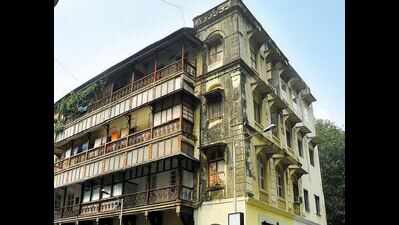
For 120 years, Sunny House has been home to sportspeople, artists, scientists-even counterfeiters.

Sunny House was built in 1897 by the Nawab of Surat. Fronted by columns that support a covered walkway, it is an example of turn-of-the-century colonnade architecture.
The ground floor was occupied by The Crown and Anchor, an Irani restaurant that wooed sailors and workers of the thriving port. The remaining three floors were snapped up by Bombay's burgeoning middle class, attracted by the long verandahs, wooden staircase and spacious rooms. The flats were so large that, occasionally, two or three families shared them.
For the first few years, Sunny House possessed serious bragging rights. It had an unimpeded view of the Arabian Sea and could gaze at the comings and goings of Wellington Pier; and, at the rising sun. With its lofty ceilings and generous windows, this may have been the sunniest building in Bombay. Then along came a glamorous neighbor in 1903, changing life forever.
The Taj Mahal Hotel was built famously back to front. The entrance did not face the Arabian Sea. Instead it stared at Sunny House. The Taj blocked the building's glorious view. But it provided entertainment of another kind: A steady stream of posh cars and visitors.
"My father was very proud of the view. And my mother often sent us across to the lawns for fresh air. It was later that the swimming pool was built and the entrance shifted," says my mother Khadija Minwalla, who was born soon after her parents, the Barmas, moved from Charni Road in 1941. Adds Percy Asundaria, who was also born in Sunny House 65 years ago, "There were people from every community. Next to us were Iranis. In the flat across was the grand old Jewish lady, Hilda Moses. Above us were Catholics and Muslims. That made Sunny House very special."
And, perhaps a bit eccentric. Through the 1940s and '50s, Keki Irani's voice floated up from the Crown and Anchor, calling for maska-pav and chai. The long verandahs running along Mandlik Road allowed the Barma children to become "shouting friends" with children in Candy House. And to monitor romances and scandals-which were duly reported in their newsletter, 'Sunny House Fortnightly'.
On the top floor, the tall and imposing Mildred Grant started Scholar School in 1961, and the building resounded with thundering feet till the school shifted. The other third-floor apartment was used by the Taj. The vast living room was a dormitory for waiters, while the smaller rooms housed families of employees.
On the second floor, across from the Barmas, lived the First Family of Indian Football. Neville D'Souza was the star who scored a hat-trick against Australia in the 1956 Olympics. His brother Dereyk became a well-known football coach. But as far as I was concerned, their mother Aileen D'Souza was the true celebrity. She had a day job but also sang for Hindi films, even popping up for a nano-second in Bobby.
For much of its life, Sunny House led a humdrum existence. But outside its walls, Colaba had a racy reputation. In the 1930s, Louis Bromfield's 'Night in Bombay' had described it as an area of European gamblers, "Russian trollops" and other flotsam of a troubled world. The bylanes near the Taj, with their cheap lodgings, attracted sailors, emigres, touts and chancers.
By the 1970s, racy had become seedy. Hippies and drug-dealers slumped under porticos. Handsome buildings crumbled and wept as landlords and tenants engaged in prolonged battles. One day, the lights at the Crown and Anchor dimmed and the friendly eatery morphed into a dance bar. Suddenly, Sunny House felt vulnerable and shabby.
In the past decade, the tide has turned again with gentrification. Like some of its neighbours, Sunny House has been restored by a lick of paint and the transition from tenancy to cooperative housing society. Old-timers have made way for pricey boutiques, elegant art galleries, famous artists-and Abdul Karim Telgi, the fake-stamp-paper kingpin, who acquired an apartment before his arrest in 2006.
Around the same time, the Asundarias shifted to Navi Mumbai, fed up with noisy restaurants and party crowds. Others, like the Barmas, including Mustansir, former head of TIFR, still live in Sunny House. But all talk of the time when neighbours popped in and out, using each other's phones and sewing machines.
End of Article
FOLLOW US ON SOCIAL MEDIA





Hot Picks
TOP TRENDING
Trending Stories
In City
Entire Website
- 'We were treated like slaves, made to work for 15 hours a day': Tricked into Ukraine war, 3 from Karnataka return home
- 'My father was on the flight': Jaishankar opens up about 1984 Air India hijack
- Airtel CEO Gopal Vittal sends letter to Reliance Jio, Vodafone-Idea, Tata Tele and BSNL CEOs; here's what he said
- Prince Harry to celebrate 40th birthday away from Meghan Markle
- Haitian immigrant pet-eating row: Ohio woman accused of eating cat is US citizen, video is not from Springfield
- Kejriwal out of jail; 'CBI arrest only to frustrate ED case bail': SC judge
- Donald Trump reveals what Laura Loomer is to his campaign: 'I don't control her'
- Hamster Kombat Daily Cipher Codes and Combo Cards for September 14, 2024: Unlock up to 1 million coins
- Laura Loomer's photo with Donald Trump viral. People ask where's Melania, where's wedding ring
- Garena Free Fire MAX redeem codes for September 13: Win in-game goodies and rewards
- Didi goes to protest site, doctors go to her house, but no talks
- Canada sees dip in post-secondary Indian students
- Is govt’s attempt to reverse Green Revolution a good idea?
- Neeraj finishes 2nd, misses title by 0.01 meters at DL Final
- 'Not eligible': Economist Ranade removed as VC of Gokhale Institute
- Trump defends 'loony' Laura Loomer amid MAGA meltdown
- Did doctors make a mistake in making Mamata wait for 2 hours?
- Bengaluru woman sparks controversy with comments about Swiggy delivery executive
- State's duty to compensate owners for land acquired: SC
- Doctor, aide swim across river in flood-hit Odisha to treat patients

Popular Categories
Hot on the Web
Top Trends
Trending Topics
World Largest HorseEID WishesGreen Apple BenefitsPriyanka Chopra TattooKottukkaali OTT ReleaseNarendra ModiGhaziabad Juice SellerHair LossSudha MurtyMalayalam ProducersIndia's Best Dancer 4Simi GarewalDilli BabuIndian National ParksLaung BenefitsVikas SethiApple iPhone 16Donald TrumpAadhar Card UpdateWordle Answer
Living and entertainment
Latest News
Man acquitted in 31 year old dacoity caseThis Strange Eventful History: Claire Messud's Ambitious Novel Spanning Generations and ContinentsNew season begins with renewed hope for BlastersPremier League: Erling Haaland hits another two in Man City's come from behind win over BrentfordMeerut building collapse: 3 dead; rescue operations continuePeople offer food, umbrellas to agitating doctors; thousands treated at free 'Abhaya' clinicDon’t rethink pink. Plane truth is we need women-friendly seatsWWE NXT Star Reunites With Father At TNA Victory Road'Nafrat ki dukaan pe ...': PM Modi attacks Congress over 'brutality' in US‘There is no affordable transport currently, the biggest problem in Goa is taxis’IIM Jammu hosts 'Fostering Academia and Industry Partnerships' event at BengalaruMP Bharat, TDP Andhra President Srinivas promise action to safeguard protection of steel plant workersLiverpool slump to shock 1-0 home defeat by Nottingham ForestHimanta urges banned ULFA(I) chief not to indulge in activity jeopardising future of Assam's youthActivists complain as showroom burns old papers; NMMC penalizes Rs 250 onlyVinith Venkatesh scores in ISL debut as Bengaluru FC edge past East BengalJitendra Jorwal takes charge as new Ludhiana deputy commissioner, vows seamless delivery of servicesGeorge R.R. Martin praises 'A Knight of the Seven Kingdoms' spinoff after criticising 'House of the Dragon'
Copyright © 2024 Bennett, Coleman & Co. Ltd. All rights reserved. For reprint rights: Times Syndication Service