
- News
- City News
- mumbai News
- Mumbai: Rare aquatints of 18th Century India on display in Colaba
Trending
This story is from November 6, 2022
Mumbai: Rare aquatints of 18th Century India on display in Colaba
An art gallery located in a South Mumbai hotel is hosting a noteworthy exhibition that is the "single-largest pictorial documentation of 18th Century India's landscape and architecture by any artist".
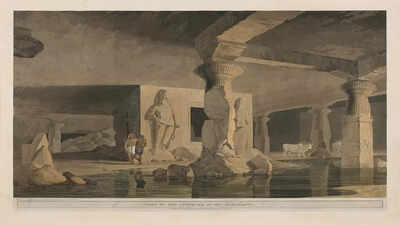
The English artists Thomas and William Daniell were uncle and nephew who travelled extensively through India during the 18th Century, and went back to Britain to create these artworks.
The English artists Thomas and William Daniell were uncle and nephew who travelled extensively through India during the 18th Century, and went back to Britain to create these artworks.

Titled 'Vision & Landscape', the exhibition is under way till December 11 at DAG, Taj Mahal Palace, Colaba. It has been assembled on the basis of the original six volumes, each with 24 prints. Collectively called 'Oriental Scenery', this is a complete set of 144 aquatint prints by the Daniells.
Ashish Anand, CEO and managing director at DAG, said, "These artworks were issued in pairs between March 1795 and December 1808, and produced by Thomas and William Daniell upon their return to Britain after their travels in India from 1786-1793. They are sourced from collectors worldwide because they deserve to be seen in India."
Thomas Daniell (1749-1840), an employee of The East India Company, and his nephew William (1769-1837) toured the length and breadth of India, up the river Ganga to Delhi, Calcutta, Madras, Madurai and other southern locations. The duo also recreated the Himalayan foothills, Garhwal, western India near Bombay, in particular the rock-cut temples at Ellora. DAG has released an accompanying book that delves into the history and style of the artworks.
The Daniells arrived in Bombay in March 1793 but there was little to depict in the city, given the bare landscape before the cotton boom of the 1860s, which they did not live to see. Their work consists of a handful of aquatints of Elephanta and Kanheri caves, and an extensive portfolio of Ellora caves, which interestingly, they did not visit but adapted from drawings by another artist James Wales who died after contracting a fever in Kanheri caves in 1795.
The curator Dr Giles Tillotson, senior vice president, exhibitions, at DAG, pointed to several artworks that will interest Mumbaikars. He said the caves of western India had begun to generate curiosity among Europeans by the latter half of the 18th Century. "The antiquities of western India were garnering inquisitiveness among Europeans who had begun to explore the region, particularly the Western Caves. In 1786, before the Daniells had arrived in India, so great was the interest excited that papers had been published by the Society of Antiquaries on Elephanta and Salsette, discussing the 'monuments of genius and superstition'."
Tillotson said, "The Daniells drew the entrances of the temples at Elephanta and Kanheri. They included the interiors, one of them even showing artist James Wales in conversation with a local while sketching the inside of Kanheri."
The Daniells only stayed for a short while before heading back to Britain in May 1793. The devoted Wales continued sketching Ellora in 1795. Unfortunately, he died the same year. But his dream of producing an illustrated book on these sites was fulfilled by the Daniells.
This collection was first displayed at Drishyakala at Red Fort, New Delhi, where it remained for three years. This is only the second time it is being shown.
End of Article
FOLLOW US ON SOCIAL MEDIA








Hot Picks
TOP TRENDING
Trending Stories
In City
Entire Website
- The Secret Behind NFL Marriages: How These Couples Make It Work
- UPI transaction limit to change from September 16! Here are the new limits for various UPI payments
- When Laura Loomer said she's single because she's too focused on Donald Trump
- South Delhi shooting: Sleuths see killing as a message to big businessmen
- Top 10 sports stars turned power couples: From Agassi-Graf to Conner-Comaneci
- 3 Zodiac Signs Most Likely to Become Multimillionaires
- Narayana Murthy faces backlash for parenting remarks on social media; users say, "after working 72 hours a week, there’s barely time left to have babies…”
- 'Would not fit in ... ': Princess Diana's brother warned Prince Harry about marrying Meghan Markle
- The 3 Strongest Zodiac Signs: Powerhouses of the Zodiac Wheel
- Dark Side Of Each Zodiac Sign
- 'Message for Modiji': Opposition takes jab at BJP over Nitin Gadkari's 'PM post' claim
- Kejriwal says he will resign in 48 hrs: Does this mean early polls in Delhi?
- Will Germany’s suspension of Schengen entry end the Europe dream?
- 'PR stunt ... gimmick': How BJP, Cong reacted to Kejriwal's shock announcement
- Taylor Swift's endorsement fails to move needle for Kamala Harris: Survey
- Kohli at his destructive best, shatters Chepauk wall with six
- Why you should not be fooled by ‘20-year SIP crorepati’ dream
- Melinda Gates reveals the 'best part' of not working with ex-husband Bill Gates
- 'Even Britishers didn't expect ruler more cruel in India': Kejriwal attacks BJP govt
- 'I am most senior MLA, will stake claim ...': Rumbling in Haryana BJP as Anil Vij eyes CM post

Popular Categories
Hot on the Web
Top Trends
Trending Topics
World Largest HorseEID WishesOnam WishesPriyanka Chopra TattooKottukkaali OTT ReleaseEngineers Day WishesGoat CollectionHair LossSudha MurtyMalayalam ProducersIndia's Best Dancer 4Simi GarewalDilli BabuIndian National ParksLaung BenefitsVikas SethiApple iPhone 16Donald TrumpAadhar Card UpdateWordle Answer
Living and entertainment
Latest News
PM Modi's Sunday roadshow in Jamshedpur cancelled due to heavy rain4 types of tea to improve gut health and ease digestive issuesFour Zodiac Signs That Are Hard to Control'Message for Modi': Opposition takes jab at BJP over Nitin Gadkari's 'PM post' claimNetflix denies filmmaker Soham Shah’s plagiarism allegations over Squid Games, says claim holds 'no merit''Virat bhaiya's passion and dedication for the game is...': Sarfaraz KhanFather rapes and murders 8-year-old daughter in Madhya Pradesh, throws body in wellWeekly Career Horoscope, September 15 to September 21, 2024: Read your weekly astrological work predictions for all zodiac signsZodiac Signs That Crave a Luxurious Lifestyle"Miami Dolphins Owner Stephen Ross Eyes Multi-Billion Dollar Deal: The $7 Billion Power Play"Rajkummar Rao hails Kareena Kapoor Khan's The Buckingham Murders as a 'gripping thriller'MoS Finance likely to be convenor of GoM on GST compensation cessRole Rewind: Did you know Ranveer Singh and Deepika Padukone's love story has a strong Kareena Kapoor Khan connection?Coin Master free spins and coins for 15 September, 2024: Earn 7 million coins using today’s linksHow to set up partner sharing in Google PhotosIndia, Pakistan players involved in heated exchange during Asian Champions Trophy. WatchNoida authority fraud: 2 arrested in Rs 3.9 crore scam linked to fake bank accountsGovinda’s wife Sunita Ahuja talks about losing their premature daughter at three months: ‘That’s why I brought up Yash in a cocoon’
Copyright © 2024 Bennett, Coleman & Co. Ltd. All rights reserved. For reprint rights: Times Syndication Service