
- News
- City News
- mumbai News
- Mumbai: Government plans SRA buildings on 65% of SDZ, not 80%
Trending
Mumbai: Government plans SRA buildings on 65% of SDZ, not 80%
The government recently revised its plan to restrict construction on SDZ plots in Mumbai, limiting it to 65% instead of the previously planned 80%. Citizens' activists have raised concerns about the environmental impact of developing eco-sensitive areas like mangroves and saltpans for slum redevelopment. The proposed regulation changes have invited public objections and suggestions.

The government revised construction plans in Mumbai's special development zones, restricting it to 65% with the rest allocated for open spaces. Activists expressed concerns about the environmental impact on mangrove and saltpan lands

While it sounds like good news for Mumbai, citizens' activists cautioned that any construction on saltpan and mangrove land would only spell a disaster for the city.
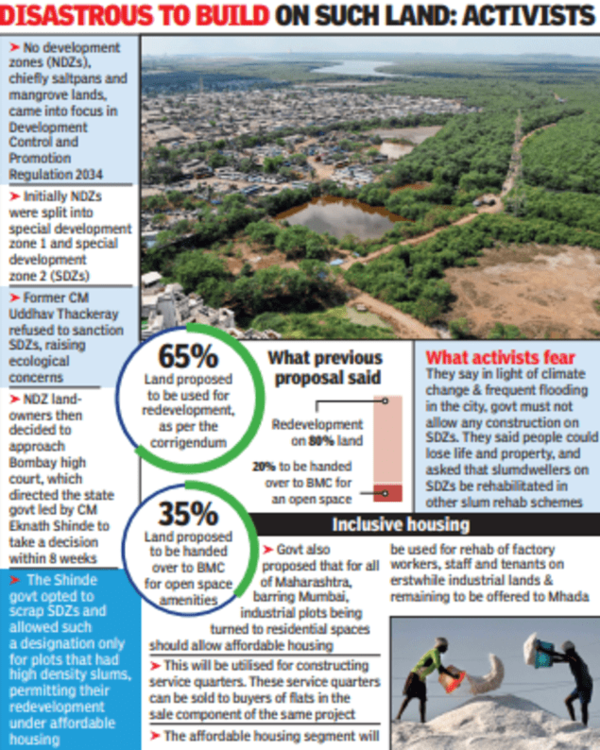
The state urban development dept issued a corrigendum last month inviting objections/suggestions to the proposed modification to regulation 33(8), dealing with construction of affordable housing in SDZs, of Development Control and Promotion Regulations 2034 (DCPR 2034)-the city's master plan-and regulation 34 of DCPR 2034, which deals with conditions for land use. This will apply to plots that have 350-499 tenements per hectare.
An activist said the corrigendum sought to "beguile people". "SDZs are saltpan and mangrove lands. They were earlier classified as no-development zones and later, the nomenclature was changed to SDZs. The Wayanad landslides just happened, and govt is trying to pull the wool over people's eyes. An eco-sensitive area is being converted into a reserved public open space. Mumbai has seen flooding, and if these lands, which are our environmental safeguards, are destroyed, we'll have no resources to fight climate catastrophes."
The activist pointed out that reserved public open spaces are recreation grounds, playgrounds, gardens and parks, which can be developed. However, while the city needs more open spaces, these cannot be developed on SDZ lands as they are eco-sensitive areas, said the activist.
Architect and activist Nitin Killawala said slums are dispersed throughout Mumbai and there is enough land to accommodate slums from these eco-sensitive areas. "Let govt truthfully develop within already notified slums, rather than adding more land for slum redevelopment," he said.
Considering the closure of industries and conversion of use for residential purposes, in another notification for all of Maharashtra, excluding Mumbai, govt has invited objections/suggestions to a proposal to allow affordable housing on such plots and one-fourth of the tenements built to be sold as service quarters. These service quarters are to be sold to buyers of flats in the sale component of the same project. Officials said buyers can use them for their household staff such as domestic help and drivers. The proposal said the affordable housing segment is also to be utilised to rehabilitate factory workers, staff and tenants on the erstwhile industrial plot, and the remaining units be offered to Mhada for allotment.

About the Author
Clara LewisEnd of Article
FOLLOW US ON SOCIAL MEDIA






Hot Picks
TOP TRENDING
Trending Stories
In City
Entire Website
- Breathtaking cosmic catwalk! SpaceX makes history with first-ever private spacewalk
- 2 Army officers thrashed, their female friend gang-raped in Madhya Pradesh
- Bangladesh announce Test squad for India tour
- Top fastest trains in the world: From China's CR Harmony to Germany's ICE
- Amid Shannon Sharpe Viral Video, Former ESPN Host Michelle Beadle Reacts Claiming It Was Not Her
- Ayushman Bharat insurance scheme expanded to cover elderly above 70
- 'Will be demolished if... ': Himachal minister's assurance amid Shimla mosque row
- Mumbai's Haji Ali and Mahim dargahs cancel Eid shamiana
- Garena Free Fire MAX redeem codes for September 11, 2024: Win free room cards, skins, diamonds, pet skins, and more rewards today
- GK for students: Top 8 Largest Mammals in the World
- In the (y)ear of conspiracy theories, Trump hears insults galore
- On Mamata's 'ready to resign' offer, protesting docs say 'want justice'
- Why you should not be fooled by ‘20-year SIP crorepati’ dream
- IAF wants Tejas jet production to be ramped up as US delays engines supply
- Haryana polls: Rebellion erupts after Congress leaders file independent nominations
- Pandya triggers speculation over his Test comeback
- Your cousin’s poo can now cure your chronic stomach problems
- Planning to buy iPhone 16? How much Apple will give for iPhone 12 & others
- 'Lady Macbeth of Bengal': CV Ananda Bose to 'socially boycott' Mamata Banerjee
- 2 dead, 20 police officials injured as Assam eviction drive turns violent

Popular Categories
Hot on the Web
Top Trends
Trending Topics
Alia BhattMalaika Arora Father DeathArbaaz KhanNatasa StankovicMr Bachchan OTT ReleaseNational Parks In IndiaSelena GomezGOAT CollectionVikas Sethi DeathMalayalam ProducersIndia's Best Dancer 4Simi GarewalDilli BabuIndian National ParksLaung BenefitsVikas SethiiPhone 16Microsoft 365 OutageCsir Ugc Net 2024Wordle Answer
Living and entertainment
Latest News
Epilepsy medication shows promise of treating sleep apnoea symptoms: StudyIndia successfully flight tests surface-to-air missileDigest this: Unhealthy gut may be linked to Parkinson’s diseaseCSIR UGC NET 2024 result declared: Steps to download scorecards at csirnet.nta.ac.in'Played a big role in turning the cricket around': Ricky Ponting applauds Virat Kohli’s brilliance as India’s former captainAadhaar card update: Do you have to compulsorily update details on your Aadhaar every 10 years?Single Indians are now choosing slow, meaningful dates over-elaborate outings, reveals an online dating platform’s surveyExclusive- Saurabh Gumber reveals joining a new show during Ganeshotsav says, "I consider it as Bappa's small gift and believe he has great plans for me ahead"Who was Illia 'Golem' Yefimchyk, the Belarusian bodybuilder who consumed 2.5 kg of meat and 108 sushi pieces daily before his death at 36?Pakistan: Bilawal cautions Shehbaz govt against political victimisation, points to Imran Khan's caseVijay Varma reveals he was DROPPED from 'Sacred Games' at the last minuteMahindra Thar Roxx with VIN 0001 to be auctiond for charity: How to registerWWE Star Discusses Why Sid Vicious Deserves a Hall of Fame SpotVijay Sathya-starrer 'Dhil Raja' to release in SeptemberHarvard University Sees Drop in Black Freshman Enrollment Post-Supreme Court Ruling on Affirmative ActionSalman Khan surrounded by bodyguards as he arrives at Malaika Arora's mother's house to offer his condolences - WATCHCMF Buds Pro 2 by Nothing review: Big delivery on a budgetArbaaz Khan spotted outside Malaika Arora's house along with police after the tragic news of her father's demise by alleged suicide - WATCH VIDEO
Copyright © 2024 Bennett, Coleman & Co. Ltd. All rights reserved. For reprint rights: Times Syndication Service