
- News
- City News
- lucknow News
- Sangharsh is legacy for this village
Trending
This story is from August 15, 2016
Sangharsh is legacy for this village
On the occasion of the country's 70th Independence Day on Monday, the villagers- almost all of whom are in one way or another related to the pre-Independence heroes - are set to launch a campaign demanding for a new inter-college for girls here.
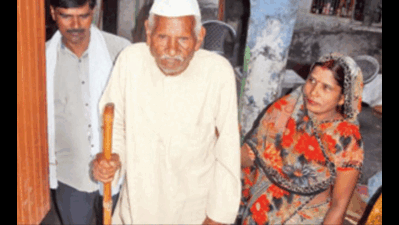
Freedom fighter Bhagwant Sharan with grand daughter-in-law. (TOI photo: Shailvee Sharda)
On the occasion of the country's 70th Independence Day on Monday, the villagers- almost all of whom are in one way or another related to the pre-Independence heroes - are set to launch a campaign demanding for a new inter-college for girls here.

"We are not ordinary people. Sangharsh (struggle) is our legacy," says Bhagwant Sharan (93), the only living member of the famous 33. The latest "sangharsh" will officially kick off after the flag hoisting ceremony on Monday morning and posters and banners will be used to showcase the demand for a new college, he said.
"I think no village in UP is home to 33 freedom fighters," says Abhay Raj, a former pradhan. "We have also given more than 40 soldiers to the Indian army. But development has always been a far-fetched dream for us."
A primary school was opened soon after Independence. "That school helped change the fate of many in our village by encouraging the youth to go for higher education," says village pradhan Suman, who also happens to be Bhagwant Sharan's great-daughter-in-law. "But it was mostly boys who opted for upper primary, intermediate and college level studies. At least 50% girls continue to quit school after Class V due to the absence of a proper school."
Primary school teacher Manju Devi says the nearest inter-college is in Paitepur, about 7km away. "Many parents, especially those with limited means, are reluctant to send their girls to this school because it is a private institution. Safety concerns for teenage girls also holds them back," she says. The village elders still talk about how much they were inspired when Gandhiji visited the village in the late 1920s, says Netra Pal Singh, a former government school principal. "But the politicians of today don't pay any attention to our demand. We have urged different politicians to help us start a college but to no avail," he says.
Home to 900 families, most people in Miranagar are direct descendants of the 33 freedom fighters. And almost everyone has an interesting pre-Independence story to share. But the most endearing tale comes from Bhagwant Saran, the lone surviving member from the group of 33.
"We used to hoist the national flag every day (before Independence). And most of us went to jail on charges of unlawful assembly," he says. Saran says he can also vividly recall how the village would serve as a hideout for freedom fighters on the run. "Our women used to make food packets and place them outside the house for a quiet take-away," he says. He also remembers how villagers united to give a pension of Rs 2 to the family of the Harijan freedom fighter duo Sukhai and Deena. "The women were starving when the village took upon the responsibility of their welfare," he says.

About the Author
Shailvee ShardaEnd of Article
FOLLOW US ON SOCIAL MEDIA





Hot Picks
TOP TRENDING
Trending Stories
In City
Entire Website
- 'We were treated like slaves, made to work for 15 hours a day': Tricked into Ukraine war, 3 from Karnataka return home
- 'My father was on the flight': Jaishankar opens up about 1984 Air India hijack
- Airtel CEO Gopal Vittal sends letter to Reliance Jio, Vodafone-Idea, Tata Tele and BSNL CEOs; here's what he said
- Prince Harry to celebrate 40th birthday away from Meghan Markle
- Haitian immigrant pet-eating row: Ohio woman accused of eating cat is US citizen, video is not from Springfield
- Kejriwal out of jail; 'CBI arrest only to frustrate ED case bail': SC judge
- Donald Trump reveals what Laura Loomer is to his campaign: 'I don't control her'
- Hamster Kombat Daily Cipher Codes and Combo Cards for September 14, 2024: Unlock up to 1 million coins
- Laura Loomer's photo with Donald Trump viral. People ask where's Melania, where's wedding ring
- Garena Free Fire MAX redeem codes for September 13: Win in-game goodies and rewards
- 'We were treated like slaves': Tricked into Ukraine war, 3 from Karnataka return home
- 'Safe and prosperous J&K is Modi ki guarantee,' says PM in J&K's Doda
- People will now elect judges in Mexico: Mistake or a masterstroke?
- Yechury's mortal remains in CPI office: Sonia, Sisodia, Pawar pay last tribute
- Watch: PM Modi welcomes birth of calf 'Deepjyoti' at residence
- India vs Pakistan Hockey Live: Pak take 1-0 lead in Q1
- Ham do hamare chaar: Why is south India junking population control?
- Sexual harassment probe opened against SAP CTO: What the company said
- The Windies-born cricketer who became India legend
- Wolves, jackals or stray dogs? Animal attacks stir up fear in UP's Bahraich

Popular Categories
Hot on the Web
Top Trends
Trending Topics
Korean TeaSector 36 ReviewGreen Apple BenefitsPriyanka Chopra TattooKottukkaali OTT ReleaseNational Parks In IndiaGhaziabad Juice SellerGOAT CollectionVikas Sethi DeathMalayalam ProducersIndia's Best Dancer 4Simi GarewalDilli BabuIndian National ParksLaung BenefitsVikas SethiApple iPhone 16Donald TrumpAadhar Card Update By Sept 14Wordle Answer
Living and entertainment
Latest News
Kaun Banega Crorepati 16: Can you guess the answer for this Rs 3,20,000 question on Navy, which contestant Naman Jain incorrectly answered?Exclusive - Has Palak Sindhwani aka Sonu from Taarak Mehta Ka Ooltah Chashmah breached her contract; Neela Film Productions to issue a legal notice to the actress?Ford drives into India for 3rd timePIL: Publicise laws, penalties to curb crimes against womenGrowth potential 7.5% or more: RBI governorHindus take to Bangladesh streets to stop attacks and demand justiceE-commerce speeds up to catch up with Quick commerce'Will take digital public infrastructure stack to 50 nations'Justin Timberlake faces DWI charges: Court-ordered apology, fine and community serviceDonald Trump on another debate with Kamala Harris: 'Maybe, if I got in the right mood ... 'Border Gavaskar Trophy: When Ricky Ponting's on-air analysis of Prithvi Shaw turned into match realitySebi gives clean chit to NSE, ex-executives in co-location caseRusty or Ready? Falcons' Cousins Falls Flat in $180M NFL DebutEdible oil import duty hiked by 20%Lucky houseplants for each Zodiac, as per a renowned astrologerBest Phones Under 35000 To Smoothly Carry Out Multiple Tasks On A BudgetOnam is a time when everyone comes together to celebrate: Manju Warrier'Calling all Swifties for Trump': Donald's new campaign merch imitates Eras Tour shirts
Copyright © 2024 Bennett, Coleman & Co. Ltd. All rights reserved. For reprint rights: Times Syndication Service