
- News
- City News
- lucknow News
- No woman in city’s poll arena which has sent many women to Parliament
Trending
This story is from May 9, 2024
No woman in city’s poll arena which has sent many women to Parliament

All 10 candidates in fray, including incumbent MP Rajnath Singh, Ravidas Mehrotra from the Samajwadi Party and Sarvar Malik from the BSP, are men.

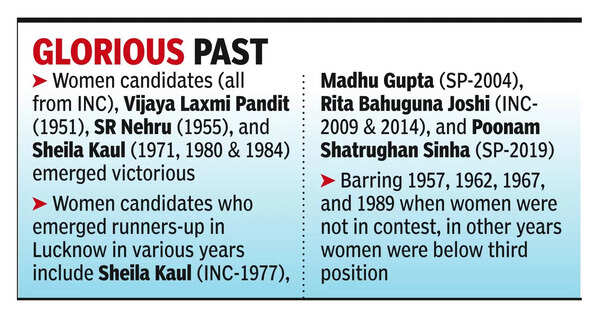
This will be the fifth time, out of 18 elections since 1951, that no woman will be contesting from the politically significant seat of Lucknow.
As per records, similar scenarios were witnessed in 1957, 1962, 1967, and 1989 elections.
Lucknow, which has around 21 lakh voters, nearly half of whom are women, has a history of electing women MPs.
In fact, Vijaya Lakshmi Pandit, the first woman MP from Lucknow, went on to serve in various capacities, including as India’s first ambassador to the Soviet Union and later to the US.
Sheorajvati Nehru, known for her contributions as a freedom fighter and social worker, succeeded Vijaya Lakshmi Pandit as MP in 1955.
Sheila Kaul, Jawaharlal Nehru’s sister-in-law, won the Lucknow seat in 1971 and served five times on a Congress ticket. Kaul was runner-up in the 1977 election.
In recent elections, Rita Bahuguna Joshi from the Congress came second in the Lucknow Lok Sabha constituency in both 2009 and 2014.
Despite her strong showings, Lal Ji Tandon of the BJP won in 2009 and Rajnath Singh, also from the BJP, won in 2014.
Similarly, Poonam Shatrughan Sinha from the SP also finished as a runner-up against Rajnath in 2019.
Uttar Pradesh has produced notable women leaders such as Sarojini Naidu, the first woman governor in India (1947-1949), and Indira Gandhi, who served as Prime Minister and represented the state in the Rajya Sabha before winning multiple terms in the Rae Bareli Lok Sabha constituency. Sucheta Kripalani was the state’s first female Chief Minister (1963-1967), and Mayawati broke barriers as the first Dalit woman Chief Minister.
“Post-independence, upper-middle-class women leaders dominated, stemming from the freedom movement where their leadership quality was cultivated. As a result, leaders like Vijaylakshmi Pandit, Sheorajvati Nehru, and Sheila Kaul led Lucknow. Similarly, Indira Gandhi was also a product of the freedom movement,” said Prof DR Sahoo, head of sociology department at Lucknow University.
In later years, political parties, barring a few examples like Mayawati, prioritized winnability, and sidelined grassroots women leadership.
“Barring Rita Bahuguna Joshi, who gave a tough contest to BJP candidates, no other strong women leaders could register her presence in the elections,” said Sahoo.
“Though political parties are putting efforts to cultivate women leaders, it’s not enough. For the development of democracy, the second line of women leaders must be developed, and parties should take initiative for this,” said Prof Sanjay Gupta from the political science department of Lucknow University.
End of Article
FOLLOW US ON SOCIAL MEDIA






Photostories

Hot Picks
TOP TRENDING
Popular Categories
Hot on the Web
Top Trends
Trending Topics
Living and entertainment
Latest News
First person died in UK from ‘liquid’ Brazilian butt lift: All you need to know about liquid BBL and risks it poses8 Spices that can help reduce high blood sugarDiddy's Lawyer defends buying 1000 Bottles of baby oil to pass Homeland security raidsShankar to bring Chiyaan Vikram and Suriya together for a film on the Velpari novelThere’s plastic in your chai-samosa, and India is No. 1 culpritKerala lottery results: Karunya Plus KN-540 winners for 26 September 2024; first prize Rs. 80 lakhs, second prize Rs 10 lakh and third prize Rs. 1 lakhLeo, Daily Horoscope Today, September 26, 2024: Positive developments are expected in love lifeDelhi high court extends interim arrest protection for former IAS officer Puja Khedkar'I'm not upset with Kangana but ... ': Chirag Paswan as Mandi MP apologises for farm law remarkThe most important lesson investors can learn from trekkersChennaiyin FC eye second win on the trot in Indian Super LeagueTaliban could face Hague tribunal for their treatment of women and girlsCandidates Protest Outside JSSC Office, Accuse Malpractice in Recruitment Exam“The Chiefs get way more calls”: Rob Gronkowski says that the Chiefs gets more favorable calls than the PatriotsMaharashtra polls: Mumbai's Byculla & Versova seats are sticking points in MVA talksGmail app on Android and iOS is getting Google’s blue verification checkmarks: Here's how it'll affect usersTop 5 WWE’s tallest wrestlers from Giant Gonzalez to The Great Khali'Bhool Bhulaiyaa 3' new poster: Kartik Aaryan reveals 'Rooh Baba Vs Manjulika' face off
Copyright © 2024 Bennett, Coleman & Co. Ltd. All rights reserved. For reprint rights: Times Syndication Service