
- News
- City News
- lucknow News
- Uttar Pradesh election: How a saffron surge also pushed victory margins
Trending
This story is from January 9, 2022
Uttar Pradesh election: How a saffron surge also pushed victory margins
Between 1989-2012, any political party getting about 30-33% of the total votes polled used to sweep elections in the state in a typical four-cornered contest. A shift of 3-5% votes due to various caste-based permutations and combinations as well as anti-incumbency from the ruling party to main challenger used to be enough for big gains in terms of seats required to tilt the balance.
In the multi-cornered contests, alliances with minor players can act as a force multiplier for parties.
Between 1989-2012, any political party getting about 30-33% of the total votes polled used to sweep elections in the state in a typical four-cornered contest.

In 2007, the BSP won just over 30% of the votes, SP about 26%. Five years later, the SP’s vote share increased by three percentage points, which led to a rise in tally of seats from 97 to 224.The BSP's vote share in 2012 was four-and-a-half percentage points lower than in 2007, but it's seats crashed from 206 to 80. Congress got just 11.65% votes (28 seats) in 2012 and 6.25% votes (7 seats) in 2017.
However, the Modi wave in 2014 Lok Sabha polls changed all the poll arithmetic. Since then, three elections – two Lok Sabha and an assembly – witnessed BJP’s vote share catapulting to almost double of main opposition parties. In the upcoming assembly polls, any political party who wishes to upset the ruling BJP will have to dig out at least 10% of the vote base of the saffron outfit.
Sample this: BJP won 47 seats in 2012 assembly polls with 15% votes. Five years later, it polled nearly 40% votes to bag a whopping 312 seats. Its allies won 19 seats and acted as a force multiplier. Hence, a loss of 10% votes can bring BJP’s tally below 200 in the coming elections, provided this loss is gain to a party which also manages to chisel out some votes from other opposition parties.
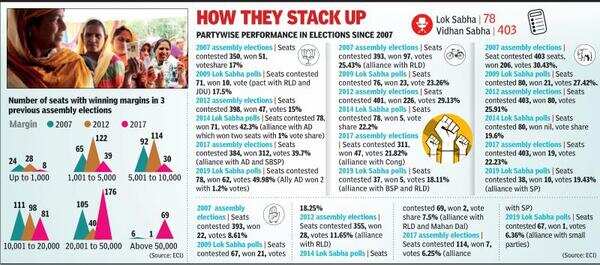
In a role reversal, the SP, which had won 2012 assembly elections bagging 226 seats with about 30% vote share, came down to 47 seats with around 22% vote share. However, the party's vote share in the 305 seats it contested was 28.3%, just 1% less than in 2012. It had left about 100 seats for its ally Congress. This means that SP has been able to hold on to its vote base, but BJP’s gains were huge. BJP’s vote percentage went further up to nearly 50% in 2019 Lok Sabha polls SP’s share came down to 18%. However, state elections are different. Besides, issues in state and national elections also differ. That’s why any predictions in UP elections is an exercise fraught with risk.
However, a look at the winning margins in the 403 seats over the years gives an idea about the change in dynamics. An assembly seat on an average has about 3-4 lakh voters. A winning margin of 10-20,000 votes (about 3-5%) in a constituency is considered small. The runner-up can hope of catching up or beating the winner in the next election with a slight increase in the vote share. In 2007 assembly polls, the fate of 292 seats was decided with victory margin between upto 20,000 votes and in 2012, the same happened in 362 constituencies. However, in 2017, only 158 seats witnessed winning margins upto 20,000 votes. In contrast, the victory difference in 176 seats was between 20-50,000 votes, which comes to be roughly 7-16% of the total votes in a constituency
Hence, a shift of at least 10% votes from the winning side to the challenger party will be required to substantially change the outcome of the elections in comparison to 2017. In the multi-cornered contests, alliances with minor players can act as a force multiplier for parties. This explains why various parties are wooing smaller sub-castes over and above their own caste/community vote base.
End of Article
FOLLOW US ON SOCIAL MEDIA







Photostories

Hot Picks
TOP TRENDING
Popular Categories
Hot on the Web
Top Trends
Haryana Election ResultNew UPI Transaction LimitHurricane MiltonRBI Monetary Policy MeetingWorld First Top 10 TrillionairesStock Market TodayKerala Lottery ResultElection Results 2024Biblical TreeJammu Kashmir Election ResultIsrael Hezbollah WarHardik SinghManagement Colleges of IndiaTop Medical Colleges of IndiaTop Engineering Colleges of IndiaTop Pharmacy Colleges of IndiaLive Cricket Score
Trending Topics
Navratri 2024 AshtamiBigg Boss Tamil 8 Contestants ListBhool Bhulaiyaa 3 TrailerNavratri Colours 2024Sanjay Leela BhansaliDurga Puja 2024Bigg Boss 18 House PhotoDevara CollectionBigg Boss 18Deepika PadukoneShailesh LodhaDevaraColdplayNational Film Awards 2024Swatantrya Veer SavarkarColdplay India tour 2025Watch NFL Live StreamDress To ImpressCall Of Duty Black Ops 6Wordle Answer
Living and entertainment
Latest News
CATS YouTube codes for October 9, 2024: Earn 500 CATS and know how to redeem the codesHurricane Milton: Why Tampa area is so vulnerable to stormsBeard Trimmer with Titanium Blades: Style Your Beard to Perfection with Unmatched SharpnessTHE World University Rankings 2025: IISc Leads India , Check the List of Top 10 Indian Institutes HereAre HDFC Bank, Axis, Kotak a value buy or value trap for investors?Triptii Dimri on emotional struggles following criticism for 'Animal’: Side effect of being in a mainstream filmDid the threat of ‘first Hindu CM’ help NC-Congress win J&K?Ethel Kennedy, widow of Senator Robert F Kennedy Sr suffers stroke in sleep, hospitalisedRanbir Kapoor's UNSEEN BTS pic from 'Shamshera' goes viralSum 41’s Deryck Whibley accuses former manager of sexual abuse in new memoirMudassar Aziz: A filmmaker needs to carefully study while pegging a film around the idea of stardomHyundai aims to raise up to $3.3 billion in record India IPOPrabhas starrer 'Kalki 2898 AD' gears up for its release in JapanMan declares income of Rs 9.6k, pays tax on Rs 43.5L after US earnings addedPatanjali Foods gets CCI nod for Rs 1,100-crore buyout of parent's home & personal care businessWho is Aniruddhacharya Maharaj? Know more about Pookie Baba’s life journey and net worthWill Allu Arjun be able to beat Prabhas in North America with Pushpa 2?OnePlus 12 is available for Rs 35,314 only on Amazon; check exchange deal and bank offers
Copyright © 2024 Bennett, Coleman & Co. Ltd. All rights reserved. For reprint rights: Times Syndication Service