
- News
- City News
- lucknow News
- Lok Sabha elections 2024: Experts vote for clean air, water
Trending
This story is from May 13, 2024
Lok Sabha elections 2024: Experts vote for clean air, water
Lucknow faces severe air and noise pollution, groundwater depletion, and river pollution. Urgent action is needed to combat these challenges, protect public health, and preserve the environment.
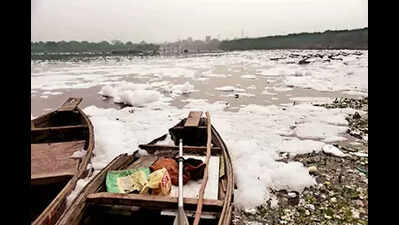
People in Lucknow are inhaling air loaded with hazardous particulate matter five to six times higher than permissible limits, besides enduring deafening noise levels almost double the safe limits.











LUCKNOW IN WORLD TOP 50 IN AIR POLLUTION
As per Swiss-based technology company IQAir's air pollution report 2022, Lucknow counts among 50 most air polluted cities of the world. The city reported ultra-fine particulate matter (PM)2.5 levels, 10 times more than the World Health Organisation approved limits. Lucknow stood at number 16 out of the top 50 most polluted cities of the world and at number 12 in the most polluted cities of Central and South Asia with an annual PM2.5 average level of 86 micrograms in 2021.
According to an updated Air Quality Life Index (AQLI) released by the Energy Policy Institute at the University of Chicago (EPIC) in 2023 fine particulate air pollution (PM2.5) is estimated to shorten an average Indian's life expectancy by 5.3 years and in Lucknow by 9.7 years when compared to the (WHO) standards of 5 micrograms per cubic meter.
As per the post-monsoon air quality report 2023 released by the Indian Institute of Toxicology Research, the concentration of hazardous particulate matter (PM 10 and PM 2.5) was found to be 49% and 14% above safe limits of 60 and 100, respectively in various locations of the city compared to the same period last year and experts said it was evidence that nothing concrete had been done about the problem.
DISSOLVED OXYGEN BELOW ZERO IN GOMTI
According to a recent survey led by environmentalist Prof Venkatesh Dutta, dissolved oxygen in Gomti was recorded below zero in different stretches and only eight species of fishes out of 51 were left. Barring hyacinth, there were no other water plants in the river. The minimum dissolved oxygen level in a river to make its water potable should be around 8.5 mg/litre and 5 mg/litre to support flora and fauna.
GROUNDWATER DEPLETION, POLLUTION
The city's groundwater level has dipped to worrisome levels. In Kukrail forest, the greenest area of the city, groundwater level dropped from 19.47 meters in 2007 to 24.83 meters in 2023. "Political will is required for groundwater management and there is need to formulate a robust, actionable groundwater management mechanism with an integrated national groundwater regulation law, framing and implementing aquifer-wise groundwater extraction norms," said R S Sinha, former hydrologist at UP state groundwater department, stressing development of an online system to find periodic data on groundwater extraction for all user sectors, including domestic users, farmers and government establishments, for evolving true picture of groundwater extraction, which is currently 40-50% under-estimated (as reported by CGWB). The correct estimates will help determine the real groundwater crisis.
"Groundwater quality/ pollution has emerged as a new challenge for resource sustainability along with challenge of ensuring safe drinking water supply, as contaminated groundwater (arsenic, fluoride, irony, heavy metals) is being used for irrigation, posing risk for human health," said Sinha, suggesting that with huge daily extraction (1,800 mld) and continuous groundwater depletion, the tubewells should be phased out gradually and new wells constructed in potential peri-urban areas with promising aquifers for subsequent supply. He added, "This will de-stress the depleted city aquifers in years to come. In urban areas, new submersible borings should not be permitted in areas in jal sansthan supply zones.."
NOISE POLLUTION RISING
According to experts, only if govt imposed strict fines and banned vehicles, factories and others from creating noise, would the menace of sound pollution be curbed. As per IITR's post-monsoon noise pollution report 2023, noise levels in residential, commercial and industrial areas rose by 5.8%, 3% and 5.8% during the day and by 6.3%, 2.8% and 2.6%, respectively, during night, compared to a year before.
End of Article
FOLLOW US ON SOCIAL MEDIA








Photostories

Hot Picks
TOP TRENDING
Popular Categories
Hot on the Web
Top Trends
ENG vs SCO Live ScoreBaba Siddique NewsSuryakumar YadavRussell WilsonsBaba Siddique DeathHardik PandyaWho was Baba SiddiqueMayank YadavWhere to Watch India vs Australia MatchMahadev Betting AppAmazon LayoffsToday IND vs AUS MatchManagement Colleges of IndiaTop Medical Colleges of IndiaTop Engineering Colleges of IndiaTop Pharmacy Colleges of IndiaLive Cricket Score
Trending Topics
Diwali WishesDussehra 2024 QuotesDussehra WishesVettaiyan OTT ReleaseVettaiyan CollectionVettaiyan ReviewNatasa StankovicDevara CollectionBigg Boss 18Deepika PadukoneShraddha KapoorRatan Tata Passed AwayJigra Movie ReviewVettaiyan Movie ReviewSwatantrya Veer SavarkarDussehra 2024Star Health Hacker DemandedViral MemesUltimate Football Codes October 2024Wordle Answer
Living and entertainment
Latest News
How each zodiac sign handles emotional distance in relationshipsBook review: 'The Scientist Entrepreneur' by Dr Kalpana Sankar is a nuclear scientist’s inspiring journey of women’s empowermentDid BTS' V get promoted to corporal in the South Korean military? recent appearance at an orchestra event has fans speculatingAccused did recce of Baba Siddiqui's house, monitored him for months: Mumbai PoliceParas Mhambrey joins Mumbai Indians as bowling coachSalman Khan’s security beefed up after Baba Siddiqui’s murder; ‘Sultan’ star looked uncomfortable after visiting the late politician’s family at 3 amBaba Siddique may have died prior to hospitalisation, says doctorsRanji Trophy: Thriller in the making as Krunal Pandya fifty helps Baroda lead by 226 runs vs MumbaiReading the Stars and Your Hands: How Astrology and Palmistry Complement Each OtherTaurus, Weekly Horoscope, October 13 to October 19, 2024: Focus on gains and accomplishmentsKrushna Abhishek shares a heartwarming post for mama Govinda; says 'jab body mein adha blood supremely talented actor Govinda ka ho...'2 flee Uttarakhand jail. Did they escape as Ramlila ‘vanars’ looking for Sita?Scorpio, Weekly Horoscope, October 13 to October 19, 2024: Health and self-care are essentialZodiac signs likely to have soul connectionsNumerology Predictions Today, October 13, 2024: Read your personalised forecast for numbers 1 to 9'Points towards failure of CM': Sanjay Raut slams Maharashtra govt over Baba Siddiqui's killingAshton Kutcher and Mila Kunis consider leaving Hollywood amid Sean 'Diddy’ Combs' arrest fallout: ReportVijay celebrates 'GOAT' success as Venkat Prabhu's directorial earns 100 crore share in Tamil Nadu
Copyright © 2024 Bennett, Coleman & Co. Ltd. All rights reserved. For reprint rights: Times Syndication Service