
- News
- City News
- kolkata News
- World Organ Donation Day: Docs, WB govt list ways to improve drive
Trending
This story is from August 14, 2018
World Organ Donation Day: Docs, WB govt list ways to improve drive

Representational image
The steps include making brain death declaration mandatory, training more grief counsellors and transplant coordinators, starting an organ-sharing registry and creating a WhatsApp group of doctors and relevant officials for better coordination.

With only two deceased organ donations this year, the state’s progress has been dismal so far. “Organ donation and transplant will materialize only when organs are available. To facilitate that, we need to have more brain death declarations. We will propose making declaration of brain death mandatory in hospitals,” said Dr Pradip Mitra, director, medical education.
The proposals could go a long way in making organ donations in the state a reality. Upgrading up trauma-care facilities in government hospitals, creating a more proactive role for neurosurgeons, coming up with advertisements on organ donation were some of the suggestions made by Dr Abhijit Chowdhury, haepatology head at SSKM Hospital.
“Why can’t we hammer the public with the concept of brain death and organ donation? Like the way dengue has been widely publicized, the government can rope in celebrities to endorse organ donation advertisements that will have a great appeal,” said Chowdhury.
Chowdhury and his team had spearheaded deceased organ donation long before the ROTTO and the state’s organ donation unit came up.
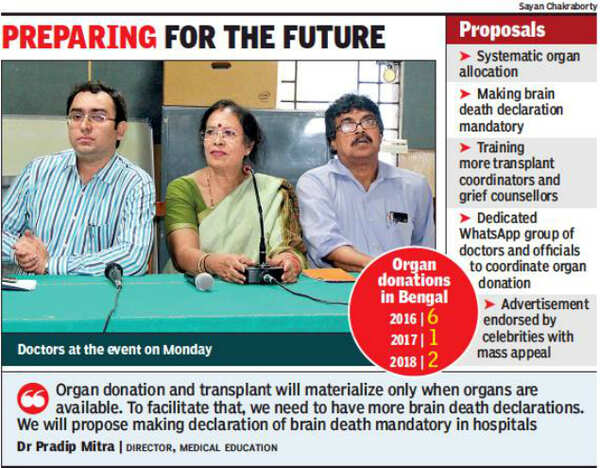
State nodal officer Dr Aditi Kishor Sarkar said, “We will ask hospitals to be vigilant in the emergency department as most road accidents reach here first. And these category of patients are brain-death patients.”
But doctors felt that until trauma care was improved to show the family that the best care was given to the patient, approaching fhem for brain death and organ donation could invite trouble for doctors.
Many pointed out the lack of coordination and the absence of an organ-sharing registry as major stumbling blocks.
“We should be getting at least five organ donations a month in the state/city. Shouldn’t we have a registry of brain death for better coordination?” asked Dr Suresh Ramasubban of Apollo Gleneagles Hospitals.
“We will work on having more transplant coordinators trained and also on a more systematic organ allocation system, as well as better coordination,” said Dr Arpita Ray Chaudhury, joint director of ROTTO.
End of Article
FOLLOW US ON SOCIAL MEDIA







Hot Picks
TOP TRENDING
Trending Stories
In City
Entire Website
- Howard University: 10 landmark firsts of the institution that shaped Kamala Harris
- Earthquake of magnitude 5.8 strikes Pakistan, tremors felt in Delhi, neighbouring areas
- Who were Barack Obama's challengers in 2008 and 2012 US presidential elections?
- 'A in INDIA alliance': Rahul Gandhi's slip-up during address to Indian-Americans goes viral
- Trump vs Harris: Betting markets reveal who’s expected to win the US presidential debate
- IGNOU December 2024 Term-End Exam: Registration Details, Important Dates, and Fee Structure
- Top 10 TED Talks to Boost Confidence and Success for Female Students
- Case against British Indian woman for Hindu prayers on beach collapses
- China refuses to sign agreement to ban AI from controlling nuclear weapons
- 'Not merely due to diet ...': Tammy Slaton on her weight loss journey after losing 226 kg
- Kolkata actor lodges complaint over 'kiss without consent'; innocent, says director
- Earthquake of magnitude 5.8 strikes Pak, tremors felt in Delhi
- Six takeaways from US debate where Kamala ‘trapped’ Trump
- Malaika Arora's father Anil Arora dies by suicide
- Shimla mosque row: As stir intensifies, police use water canons on protesters
- When Virat smashed Sachin's record to power India to biggest win vs Pakistan
- Why growing lure of protein supplements is worrying health experts
- Apple announces price cut on iPhone 15, iPhone 14 models: New prices
- ACT Hockey: India hammer Malaysia 8-1
- Musk’s offer to ‘give child’ to Swift sparks outrage: ‘How low can one go?’

Popular Categories
Hot on the Web
Top Trends
Trending Topics
Deepika PadukoneMalaika Arora Father DeathArbaaz KhanJayram RaviAishwarya Rai BachchanSlat WaterWeight GainGOAT CollectionVikas Sethi DeathMalayalam ProducersIndia's Best Dancer 4Simi GarewalDilli BabuIndian National ParksLaung BenefitsVikas SethiiPhone 16Dubai Princess Sheikha MahraMG Windsor EvWordle Answer
Living and entertainment
Latest News
Manju Warrier expresses gratitude for birthday wishes: "Forever humbled and grateful"Haryana HPSC PGT admit card 2024 out at hpsc.gov.in: Direct link to download hall ticket here6,0,6,6,6 - Smashing Kieron Pollard rolls back the clock in Caribbean Premier League - WatchRelief for Amul in trademark war against Italian brandAfghanistan vs New Zealand: Why is Greater Noida stadium hosting a Test match?Shilpa Shetty and Raj Kundra spotted at the Siddhivinayak Temple; video insideDonald Trump and Kamala Harris shake hands as they meet for first time on debate stage: Watch the 'awkward' momentPrince William’s commitment to a lasting marriage with KateWhen Jaya Bachchan revealed she had a huge crush on Dharmendra, called him a 'Greek God' in front of Hema MaliniJr NTR starrer 'Devara: Part 1' completes censorship formalities; receives UA certificateGeorgia school shooting: Suspect's mom's call wasn't the only alert, multiple warnings overlooked before Apalachee high attack'Trump should not be telling a woman what to do with her body', says Kamala Harris on abortion rights during US presidential debateArbaaz Khan spotted outside Malaika Arora's house along with police after the tragic news of her father's demise by alleged suicide - WATCH VIDEOShivaji statue collapse: Sculptor’s custody extended till September 13Bengaluru techie pockets 1k cryptocurrencies of his company, lands in police netThe Luckiest Zodiac Signs: Who's Got the Midas Touch?When Malaika Arora missed her father Anil Arora and the whole family during Covid - a memory set in monochromeChess Olympiad: Strength of India squad raises hopes of higher-placed finish
Copyright © 2024 Bennett, Coleman & Co. Ltd. All rights reserved. For reprint rights: Times Syndication Service