
- News
- City News
- kolkata News
- The secrets of city’s Chinese dry cleaners
Trending
This story is from January 25, 2018
The secrets of city’s Chinese dry cleaners
More than a century later, Chinese dry cleaners are still as popular but the future in uncertain
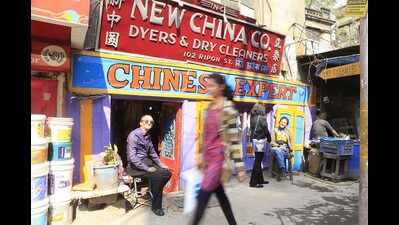
More than a century later, Chinese dry cleaners are still as popular but the future in uncertain
It was 1922 — the year the British Broadcasting Corporation (BBC) and the erstwhile USSR came into being — when 20-year-old Patrick Liu from Shandong province of China reached the then Calcutta to try his luck. Soon, his love affair began with the City of Joy, where he started life working in a Chinese dry cleaning store near old China Town. And after struggling and saving up for 26 years, he finally gave shape to his dream — he opened his own dry cleaning store, New China Co, on Ripon Street.
The year was 1948, when Calcutta was still recovering from the trauma of Partition, while savouring the new-found Independence.

But why dry cleaning?
No one is really sure why most Chinese migrants chose to be dry cleaners. But according to Mary Liu, Patrick’s elder daughter and the current owner of New China Co, one of the reasons was the fact that Calcutta didn’t have dry cleaners in early 1900s.
There were only dhobis, whose rough washing would destroy expensive clothes. So, when the Chinese arrived and started dry cleaning, it came as a relief for people,” Mary added.
Moreover, according to William Wong, a second-generation dry cleaner and the current owner of Shanghai Co. on Russel Street, the Chinese were really good at the job as most of them had formal training. “Back then, there was a three-year course on dry cleaning in China. In the first year, people received training on the washing process, the second year focused on ironing and the third year was specialisation — cleaning or ironing. Our store had a manager who had completed that course,” he added.
Trade secrets galore
The dry cleaners are tight-lipped about the exact solvents they use to clean the clothes, but they did reveal the process when we requested them. First, the garment is hung on a mannequin and cleaned part by part using either petrol or special turpentine oil. “The sleeves, collars and the body are cleaned in this way using the age-old techniques,” Mary said, while refusing to reveal details about the ‘technique’. “It’s a trade secret,” she added with a smile. But William reluctantly revealed that they haven’t used petrol after the 1980s, as it’s not colourless any more. “Now, petrol is dark orange and hence, not fit to be used in washing,” he said.
Business is still good
More than a century later, Chinese dry cleaners are still as popular, though quite a few have shut shop over the years. Almost all existing stores receive around 200 garments every day in winter, while that number reduces to 60 in summer. “The advent of washing machines has affected business a bit, but the scenario is still good,” said James Lee, the current owner of Golden China Cleaners near Bentinck Street. “The average income can be anything between `10,000 and `20,000 per day during the peak season. So, we can’t say business is bad,” he added.
Why is the future uncertain?
For one, the young Indian Chinese generation is very reluctant to join the business. The exodus of Chinese migrants from Kolkata, which started in the late 1980s, has decreased their population to a mere 15% of what it used to be. Moreover, those of the younger generation either prefer to go out of the country for work or are more into ‘big money businesses’ like restaurants. For instance, both of William’s sons are studying in Delhi. “I’ll never force them to enter this business; they can if they want to,” he added.
On the other hand, almost all the current owners are in their 50s. So after they retire, it’s not very sure how many of these stores will be taken over by the next generation.
End of Article
FOLLOW US ON SOCIAL MEDIA










Photostories

Hot Picks
TOP TRENDING
Popular Categories
Hot on the Web
Top Trends
India Qualifying ScenarioBaba Siddique NewsPakistan Cricket TeamRussell WilsonsSpacex StarshipRahul DravidWho was Baba SiddiqueBabar AzamNTA SWAYAM July RegistrationLawrence BishnoiAmazon LayoffsTaylor SwiftManagement Colleges of IndiaTop Medical Colleges of IndiaTop Engineering Colleges of IndiaTop Pharmacy Colleges of IndiaLive Cricket Score
Trending Topics
Diwali WishesNara RohithBaba SiddiqueShraddha KapoorVettaiyan CollectionVettaiyan ReviewNatasa StankovicDevara CollectionBigg Boss 18Deepika PadukoneShraddha KapoorRatan Tata Passed AwayJigra Movie ReviewVettaiyan Movie ReviewSwatantrya Veer SavarkarDussehra 2024Star Health Hacker DemandedViral MemesUltimate Football Codes October 2024Wordle Answer
Living and entertainment
Latest News
10 deadliest snakes in Australia and know their venom toxicityOver 70 injured at Devaragattu Banni stick festival during Dussehra celebrationsPassion missing, players don’t want to work hard, lament former intl’sHow tomato, potato, onion influence food inflationBiker’s death ignites village fury in Odisha's Boudh, massive traffic jam on NH-57Reliance Jio sends 'complaint letter' to telecom minister Jyotiraditya ScindiaWomen's T20 World Cup: Why India need Pakistan victory over New Zealand to secure semifinal berthSpaceX's fifth Starship test flight achieves historic booster catchCops probing Bishnoi gang's links to Siddique's murderKrushna Abhishek shares a heartwarming post for mama Govinda; says 'jab body mein adha blood supremely talented actor Govinda ka ho...'Papankusha Ekadashi 2024: Date, Parana Time, Puja Rituals and SignificanceKenya's Ruth Chepngetich breaks women's world record at Chicago MarathonAI’S OppenheimerFormer Pakistan PM Imran Khan's sisters shifted to Jhelum jail on judicial remand'I truly believe ... ': What police said after third assassination attempt on Donald TrumpHow Ratan Tata started India's romance with ZaraBaba Siddique murder case: Slum dispute that sparked ED inquest to be part of probeFor 20 years, Thar getting more rain than normal
Copyright © 2024 Bennett, Coleman & Co. Ltd. All rights reserved. For reprint rights: Times Syndication Service