
- News
- City News
- kolkata News
- The end of single screen theatres
Trending
This story is from April 23, 2016
The end of single screen theatres
Since the advent of multiplexes, several iconic cinemas in the city have shut shop, unable to break even. Gone with them are a host of matinee memories, writes Priyanka Dasgupta

Since the advent of multiplexes, several iconic cinemas in the city have shut shop, unable to break even. Gone with them are a host of matinee memories, writes Priyanka Dasgupta
Kolkata: Mini was born two months ago. Days after her birth, her mother was killed in a road accident. Since then, her address is the plastic chair that stands guard in front of the defunct booking counters of Mahua cinema.

Welcome to the world of 26 leftover single-screen theatres in Kolkata, which are closing down at a pace that doesn’t care for speed-breakers. Welcome to the world that can’t match up to the glitz of multiplexes. Welcome to the world of abandoned show reels and empty projection rooms.
Last year saw 40 single screen theatres in Bengal closing down. It was at the peak of summer last year — on May 28, to be precise — that Mahua downed its shutters. In the week before its final closure, a cruel joke would do the rounds. The last film to be screened there was ‘Belaseshe’, the Soumitra Chatterjee-Swatilekha Sengupta starrer. This quirk doesn’t escape the 50-year-old Bishnu. “How ironical that this film should have marked the ‘bela sesh’ (end of days) for the theatre too. ‘Belaseshe’ is one name I will never forget. It brought such a sense of closure,” he smiles wryly, eyes glistening as he walks past the debris, leading the way into what used to once be a favourite entertainment destination for many south Kolkatans.
Today, the theatre can almost be mistaken as a set for Mrinal Sen’s ‘Khandahar’. Just ahead of Gate No. 1 that once led viewers inside is a small earthen oven. The wooden frames that weren’t sold off as scrap are now used by Gayatri to light the oven. The fire simmers long enough to let the 75-year-old boil some rice as she stares at the empty auditorium. Her husband used to work here as a mason before the hall opened on February 4, 1977. “It was an open door for us. There wasn’t a single day when I didn’t watch a film. In between my household chores, I would catch a few scenes. I never watched a film at one go. But it was fun that way,” she says.
Today, time stands still. The auditorium looks barren. First, the workable machines of the projection room were sold off. Then the AC machine, transformer and generator. Even the plaster of Paris tiles from the ceiling were hammered down. The chairs were sold. What remains as relics are the sponges, torn from the seats. “A single tile would take 25 days to make. And here, they hammered it down in minutes. When they first starting dismantling, I couldn’t even enter the auditorium. Each blow of the hammer seemed to strike my heart,” Bishnu says.

Mother and son wept like inconsolable babies after the final curtains came down after the last show at the theatre. The huge curtain in front has also been removed. Someone told them that a scrap dealer might sell it off to some small-time caterer to make use of as a curtain. But what about that screen? “Maybe someone somewhere will use it for projections in a village…” Bishnu’s voice trails off.
Upstairs in the projection room, nothing much remains, except for some torn bunches of unsold tickets and film reels. Bishnu uncoils one and holds it against the warm April sunlight filtering through the ventilator. At first glance, it’s difficult to recognize who the stars are. It’s only after a good 15 minutes that he identifies it as a reel from the Amitabh-Rekha starrer ‘Silsila’. “The film had a good run here. Today, all that is just memory,” he says, rubbing his eyes.
The story is no different at most single-screen theatres in the city — Grace, Purno, Ujjawala, Sree have all shut down. Sixty-year-old Chandan Datta had joined as a chief camera operator at Grace on College Street on February 10, 1985. Four years back, when Chandan heard that the hall would close down, he felt like being stranded in the epicentre of an earthquake. “Before my job, I had to take a verbal, written and medical examination conducted by the government to get my licence. The job of a camera operator was backbreaking, and I had to be on my toes to make sure the two machines were in order. While one reel would run for 17- to 20-odd minutes, I had to keep the other machine ready. The moment one reel got over, I had to start operating the next reel in the other machine. Unless there was a power shutdown, no time loss was allowed in the switchover,” Chandan says.
The job demanded a lot of precision and a sense of responsibility. Once the theatre shut down and digital cinema started taking over, Chandan started adapting himself to another profession. Now, he works at the Bina cinema, where he operates the computers that have movies uploaded on a server. “This work is less strenuous. One needs a little bit of education to be able to operate the computer and check whether the film is in running condition once the hard disk is uploaded,” he says. But, once in a while, he still walks along Mahatma Gandhi Road. “My heart aches when I see the building. People like us don’t own the theatres but we put in our blood and sweat to keep it running. Way before I joined, I had heard stories of Dharmendra and Hema Malini coming over to Grace, he says. Today, only a structure plastered with ads remain. Only the address written on the hoarding advertising a computer centre has mention of Grace Cinema as a landmark.
Stories about single screen theatres were inspiration for Kaushik Ganguly to pen the script of his soon-to-release ‘Cinemawalla’. However, one person he never bumped into while scripting was 43-year-old Pinku Das.
Interestingly enough, Das’ life story is what movies can be made of. He was an usher at Ujjala in 1986-’87. “I always wanted to make movies. In order to support my family, I joined as a staff member at Ujjala. Sometimes, I would usher in people. On other days, I would sit at the booking counter. But the owners were very helpful and they allowed me to sit in a room on the third floor and pen scripts,” Das says. He claims to have penned 11 scripts and one script for a Hindi serial, too. “I also wrote Satabdi Roy’s debut feature film, ‘Amar Bandhan’, and Prosenjit’s directorial debut, ‘Purushottam’. When Ujjala was folding up, I had already started directing my first feature film titled ‘Eri Naam Jibon’ starring Victor Banerjee, Sandhya Roy, Sreelekha and Jisshu. Unfortunately, it got stuck in a legal hassle and hasn’t yet seen light of day,” he says.
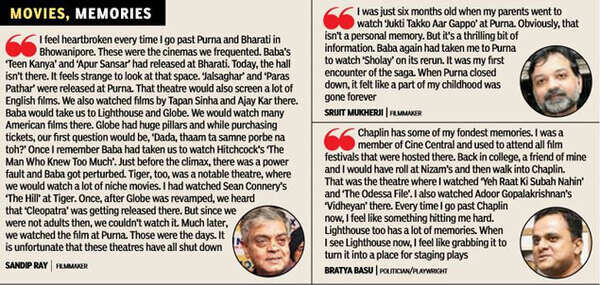
When Ujjala shut down, Das felt his career as a film director would sail him through. “But that never happened. I am still struggling. Yes, it feels bad that single-screen theatres are closing down. But what can be done? One has to just adapt to the times. The silver lining is that cinema has survived,” he says.
Even those working for the management feel the pangs of something getting lost forever when the owners are forced to take a decision to shut theatres down. Many insist that once the lights are turned off after the last show, the feeling is like that on the night of Bijoya Dashami… only this is no festival that will return next year. Gobindo Roy, who has worked as executive producer for producer R D Bansal, has long been associated with theatres like Sree, Uttara, Ujjala and Purabi. The last film to be screened at Sree was ‘Aashraya’. It was on October 31, 2000. On the same day, Uttara closed down with ‘Khauf’. Purabi downed shutters only recently, on April 1. “I felt like a father whose daughter had just been married off,” Roy says.
It’s tough to adjust to the vacuum. Roy recalls that the last show at Ujjala was of ‘Tomar Amar Prem’ on February 3, 2005. After the show, there is a gnawing feeling of emptiness. One suddenly realizes that one is no longer required to send bills to the amusement tax authority. There isn’t anyone to even enquire, ‘Ki boi lagchhe? (What movie is running?)’
But time has a way of mellowing down the pain. One understands the constraints of owners who run losses of over Rs 1 lakh to simply sustain a theatre each month. “Some cinemas have litigation problems and lease issues too. Over the years, the attitude of staff has also changed. Earlier, they would feel a sense of attachment towards the theatre. With time, that grew less,” Roy explains.
Arijit Dutta, the owner of Priya, Art Gallery (Jalpaiguri), Netaji Subhas Sadan (Baidyabati), Balaka (Ilambazar), Vidyasagar (Ghuskara) and Vidyasagar (Balurghat), says single screen theatres in Bengal are shutting down like a pack of cards. He is suffering ‘disastrously’ for all his single screen theatres in the districts. “For the last three years, Priya is being forced to bear the losses of my five other theatres in the districts. Ten years ago, the Left Front government had given us permission to recover service charge and reduced the taxes. We were given a tax exemption on modernisation/upgrade. We expected the present government to increase the service charge amount and abolition of the government duty on electricity. The government has to realise that single screen is the backbone of regional cinema. Unfortunately, it is only bothered about stars and directors. Cinema halls are too non-glamorous for our government.”
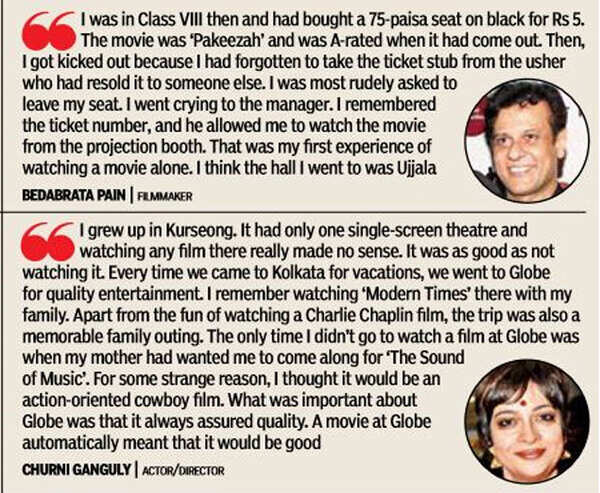
Kaushik Sen, the owner of Debasree in Barrackpore, remembers that the hall was established in 1991 with a capacity of 1400. “There was a time when films like ‘Chrodini… Tumi Je Amar’ ran for 20 weeks. But after 2010, there was a major dip in sales. The audience just didn’t turn up to watch Bengali cinema. I was running a loss of 1 lakh per week. Sometimes, films were pulled down mid-week too. In 2013, the hall was razed to the ground,” Sen says.
For 30-something Shafiqul Islam Shabaz, the last New Year’s Eve was the worst day in his life. Shabaz, part-partner of Tasweer Mahal at the Rajabazar crossing, was in mourning while the rest of the city was partying. December 31, 2015, was the day the last film was screened at the theatre. Escalating costs, dip in sales figures and not enough funds to pay staff salaries were some of the reasons Shabaz decided to close it down.
Shabaz’s friends had proposed to have a party at the theatre after the last screening of a Bhojpuri movie. But he just couldn’t bring himself to agree. Mutton biryani can’t be gulped down while bidding adieu to a theatre that had been witness to countless happy and sad moments in his life. Shabaz excused himself. His friends had understood, and shifted their party venue elsewhere. “It was too sentimental for me. There were just 40 people who came for the last show. I recorded video footage of them leaving the auditorium after the movie was over,” he says.
That night, he was unable to control his tears. 2016 began on a sad note. Since that day, he has played the video just once. But reliving the moment of closure is difficult to handle. “My grandfather was the owner. I used to come to this theatre with my father. When I was in school, it was such a grand affair to be the grandson of a theatre-owner. I’d often get requests from friends who wanted free tickets. It felt good to oblige as well,” he recalls.
After ‘Sholay’ released, it had run here for 50 weeks at this theatre. ‘Coolie’ had played for 30 and ‘Dilwale Dulhania Le Jayenge’ for 15 weeks in a row. Mithun Chakraborty had dropped by at the theatre when ‘Jallaad’ was being screened. The day ‘Raja Hindustani’ played, Shabaz had done his first booking. “It was the big day of my life and the film ran for houseful for two weeks straight. The film had run for 12 weeks,” he recalls proudly.
But when multiplexes came up around 2005 onwards, the sales dropped drastically. To cut costs, the original staff strength came down from 40 to a meagre six. December 31 was the day when everyone bid the hall a teary farewell.
Once in a while, Shabaz now drops by at the theatre. Some accounts-related work need to be taken care of. There are some payments to be made. Well-wishers from his neighbourhood sometimes share his sentiments while rueing the closure. They are as nostalgic as Shabaz, though they know it’s difficult to pull along while running in huge losses. Shabaz’s nine-year-old daughter too understands that loss. But for her, the glitz of a multiplex can compensate. Shabaz’s emotions are still raw.
A sweeper comes once in 10 days to dust. Shabaz isn’t sure what he will do with the property now. But he has one grand plan left. One day, he will walk inside the theatre and sink into the seat again. For one last time, he will relive the experience of watching a movie there. If possible, he will fetch a print of ‘Raja Hindustani’ and watch it all by himself in the entire theatre… not alone, but with a myriad emotions to keep him company.
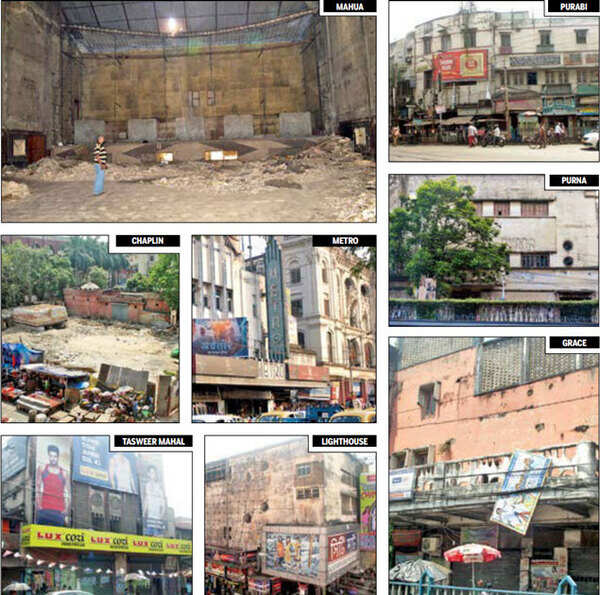
FINAL CURTAINS: Some iconic city single-screen theatres that have now shut down
ARUNA
40/2 Mahatma Gandhi Road, Kolkata – 9
Opening Date: 21.2.1949
Opening film: Ajit
GLOBE
7E, Lindsay Street, Kolkata – 16
Opening Date: 23.11.1922
Opening Film: A Sporting Double (Silent)
Previous Name: Opera House
GRACE
91, Mahatma Gandhi Road, Kolkata – 07
Opening Date: 11.12.1953
Previous Name: Alfred Theatre, Natya Bharati, Deepak and Mitra Theatre
LIGHTHOUSE
2, HUmayun Place, Kolkata – 13
Opening Date: 24.10.1938
Opening Film: Fantasia
LOTUS
106A SN Banerjee Road, Kolkata – 14
Opening Date: 26.9.58
Opening Film: Sadhana
Previous Name: Anjan
METRO
5 Jawaharlal Nehru Road, Kolkata – 13
Opening Date: 05.12.1935
Opening Film: Bonemian Girls
MINERVA (CHAPLIN)
Chowringhee Place, Kolkata – 13
Opening Date: 28.02.1969 (re-opened)
Opening Film: The Taming of the Shrew
Previous Name: Elphinstone Picture Palace, Madan Bioscope
PURABI
40/1, Mahatma Gandhi Road, Kolkata – 09
Opening Date: 14.08.1936
PURNA
4, Shyamaprasad Mukherjee Road, Kolkata – 25
Opening Date: 14.10.1921
Previous Name: Paris Cinema & Varieties Ltd., Russa Theatre
SREE
1382, Bidhan Sarani, Kolkata – 04
Opening Date: 18.03.36 (renamed)
Opening Film: Queen of the Jungle
Previous Name: Cornwallis Theatre
TIGER
19, Jawaharlal Nehru Road, Kolkata – 13
Previous Name: Picture House, Plaza, Gaiti Theatre
UJJALA
14, Shyamaprasad Mukherjee Road, Kolkata – 26
Opening Date: 12.01.1946
Opening Film: The Bathing Beauty

About the Author
Priyanka DasguptaEnd of Article
FOLLOW US ON SOCIAL MEDIA










Photostories
Hot Picks
TOP TRENDING
Popular Categories
Hot on the Web
Top Trends
Baba Siddique NewsRussell WilsonsBaba Siddique DeathSanju SamsonWho was Baba SiddiqueMayank YadavIndia Team Qualifying ScenarioWhere to Watch India vs Australia MatchMahadev Betting AppAmazon LayoffsToday IND vs AUS MatchSuryakumar YadavManagement Colleges of IndiaTop Medical Colleges of IndiaTop Engineering Colleges of IndiaTop Pharmacy Colleges of IndiaLive Cricket Score
Trending Topics
Diwali WishesDussehra 2024 QuotesDussehra WishesVettaiyan OTT ReleaseVettaiyan CollectionVettaiyan ReviewNatasa StankovicDevara CollectionBigg Boss 18Deepika PadukoneShraddha KapoorRatan Tata Passed AwayJigra Movie ReviewVettaiyan Movie ReviewSwatantrya Veer SavarkarDussehra 2024Star Health Hacker DemandedViral MemesUltimate Football Codes October 2024Wordle Answer
Living and entertainment
Latest News
Book review: 'The Scientist Entrepreneur' by Dr Kalpana Sankar is a nuclear scientist’s inspiring journey of women’s empowermentAccused did recce of Baba Siddiqui's house, monitored him for months: Mumbai PoliceParas Mhambrey joins Mumbai Indians as bowling coachSalman Khan’s security beefed up after Baba Siddiqui’s murder; ‘Sultan’ star looked uncomfortable after visiting the late politician’s family at 3 amBaba Siddique may have died prior to hospitalisation, says doctorsReading the Stars and Your Hands: How Astrology and Palmistry Complement Each OtherTaurus, Weekly Horoscope, October 13 to October 19, 2024: Focus on gains and accomplishmentsRoblox dismisses claims made by Hindenburg report: "...don't support their agenda"'Procrastination greatest thief of time': HC junks 'belated case'Krushna Abhishek shares a heartwarming post for mama Govinda; says 'jab body mein adha blood supremely talented actor Govinda ka ho...'RSS chief Mohan Bhagwat: Hindus must take lessons from Bangladesh violence2 flee Uttarakhand jail. Did they escape as Ramlila ‘vanars’ looking for Sita?Scorpio, Weekly Horoscope, October 13 to October 19, 2024: Health and self-care are essentialNumerology Predictions Today, October 13, 2024: Read your personalised forecast for numbers 1 to 9Ashton Kutcher and Mila Kunis consider leaving Hollywood amid Sean 'Diddy’ Combs' arrest fallout: ReportVijay celebrates 'GOAT' success as Venkat Prabhu's directorial earns 100 crore share in Tamil NaduLoneliness across generations: Why is it important to address this hidden danger?For 500 years, this village in Madhya Pradesh worships Ravan as ‘Kul Devta’
Copyright © 2024 Bennett, Coleman & Co. Ltd. All rights reserved. For reprint rights: Times Syndication Service