
- News
- City News
- kolkata News
- People’s will only shield against political violence in Bengal, say speakers in debate
Trending
This story is from April 24, 2022
People’s will only shield against political violence in Bengal, say speakers in debate
Violence had been linked inextricably with politics in Bengal for more than a century and it could only be dissociated if people rejected those who used it as a tool to wrest power, said speakers at a debate titled, “In contemporary Bengal, non-violent politics is impossible”.
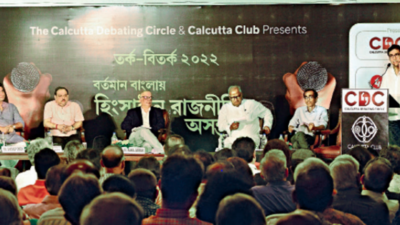
The debate, ‘In contemporary Bengal, non-violent politics is impossible’ was held by the Calcutta Debating Circle and Calcutta Club at the club on Friday
Speaking in favour of the motion, Prof Biswanath Chakrabarty said violence had been used by political parties through decades and it’s now entrenched in society.

In purely mathematical terms, the number of violent incidents was still negligible and so it was possible to get rid of it, argued Prof Subhamay Maitra, speaking against the motion. “If you look at the numbers, violence is not as widespread as it’s being made out to be. There will be some friction in politics. While we all want everything to be peaceful, some violence can’t be ruled out. Even Vatican City has pickpockets,” he said.
CPM’s Shatarup Ghosh pointed out that violence in politics was linked to economy. “If you look at all the recent violence, including the Bogtui killings, it involved people from the same party. They are fighting over the share to which they are now entitled. A super-structure of political power and money has been created across the state that can’t be easily broken. It has always been there and we have seen it grow over years,” said Ghosh, speaking for the motion.
The state, too, patronized violence for without it, the state would collapse, said actor Kaushik Sen. “The ruling party has merely added corruption to violence. Having said that, even Left leaders, like Benoy Choudhury and Buddhadeb Bhattacharjee, had spoken against corruption in their ranks. The CPM has fielded candidates accused of murders. But the BJP is a dangerous force for it has been targeting a particular community,” Sen said.
India was created through a series of violent incidents and on communal lines which have legitimized aggression in politics, said BJP leader Samik Bhattacharya. “Unless people, like Gopal Pantha, took up arms in 1947, many of us would have lost our ancestors. In contemporary Bengal, there’s no investment, industry or job. The youths have naturally been sucked into politics. They are being used to terrorize people,” he said.
We now live in a Bengal and India, which are different from 1947, argued Trinamool MP Saugata Roy. Speaking against the motion, Roy said he had never ever slapped anyone in his long political career. “I still survive so it’s possible to shun violence. It’s true violence has been used but those who resorted to it were rejected, like the Naxals. The Left used it in the sixties and changed their strategy to a controlled violence since the ’70s. When they took to open terror, they were shunned,” said Roy. The civil society could mobilize opinion against the BJP and help root out violence, observed Sen.
Writer and social commentator Chandril Bhattacharya said people must reject parties that used violence. “Only this can force leaders to shun violence who use it for votes. They essentially want votes, not violence,” Bhattacharya said.
End of Article
FOLLOW US ON SOCIAL MEDIA










Photostories

Hot Picks
TOP TRENDING
Popular Categories
Hot on the Web
Top Trends
Shantanu NaiduRussell WilsonsTom BradyAUS vs PAK Live ScorePakistan Cricket FanSuryakumar YadavNobel Peace PrizeMahadev Betting AppNew UPI Transaction LimitRatan Tata DiesPM ModiUGC NET Result 2024Management Colleges of IndiaTop Medical Colleges of IndiaTop Engineering Colleges of IndiaTop Pharmacy Colleges of IndiaLive Cricket Score
Trending Topics
Diwali WishesJigra ReviewDussehra WishesVettaiyan OTT ReleaseVettaiyan CollectionVettaiyan ReviewBlack Movie ReviewDevara CollectionBigg Boss 18Deepika PadukoneShraddha KapoorRatan Tata Passed AwayJigra Movie ReviewVettaiyan Movie ReviewSwatantrya Veer SavarkarDussehra 2024Elon MuskKing Legacy CodesUltimate Football Codes October 2024Wordle Answer
Living and entertainment
Latest News
Navratri 2024: Jaya Bachchan and Shweta Bachchan join Rani Mukerji at the Durga puja pandalOff Argentina's Patagonian coast, whales and their calves dive deep for foodHappy Dussehra 2024: Images, Quotes, Wishes, Messages, Pictures and GreetingsApplications for new power connections among services moved exclusively onlineHappy Dussehra 2024: Top 50 Wishes, Messages, Images and Quotes to Share with Your Loved OnesKrushna Abhishek shares a heartwarming post for mama Govinda; says 'jab body mein adha blood supremely talented actor Govinda ka ho...'Could Tyreek Hill Return to the Chiefs? Cryptic Posts Fuel Trade SpeculationHappy Dussehra 202: Top 50 Wishes, Messages and Quotes to share with your loved onesAmitabh Bachchan turns 82: Priyanka Chopra, Prabhas, Kajol, and other celebs extend heartfelt birthday wishes to the legendary starPutin won't discuss Ukraine peace with Germany's Scholz, Berlin saysKarnataka Congress faces backlash over case withdrawals linked to Hubballi riots'Jigra' box office collection day 1 early estimate: The Alia Bhatt starrer faces tough competition with Rajinikanth's starrer 'Vettitan' and Rajkummar Rao's Vicky Vidya Ka Woh Wala Video'Robert Gronkowski Reacts to His Hilarious Impression in FX's American Sports Story: Aaron HernandezIf Rahul Gandhi fails to deliver, INDIA bloc may make LoP post rotational: BJPAI is having its Nobel moment. Do scientists need the tech industry to sustain it?Type Soul codes October 2024: Redeem active codes to unlock benefitsSalami slicing: How China is eating into India’s territoryBELLY FAT BLUES: The Waistline Warning Sign of Diabetes
Copyright © 2024 Bennett, Coleman & Co. Ltd. All rights reserved. For reprint rights: Times Syndication Service