
- News
- City News
- kolkata News
- PCB eye in the sky to keep tabs on polluting industrial units
Trending
This story is from August 26, 2023
PCB eye in the sky to keep tabs on polluting industrial units
The West Bengal Pollution Control Board (WBPCB) on Friday kicked off its environmental drone surveillance against polluting industries.
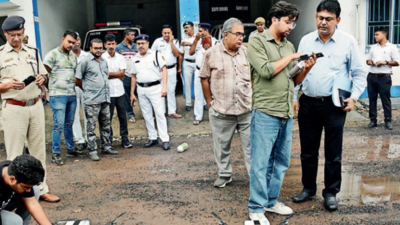
An experimental flight of the e-drone under way at Howrah Police Line on Friday
The polluting industrial units often switch off effluent treatment plants (ETP) and emission control devices (ECD) to save energy costs and dump the untreated effluents in canals and drains, which eventually flow into the rivers to pollute them badly.

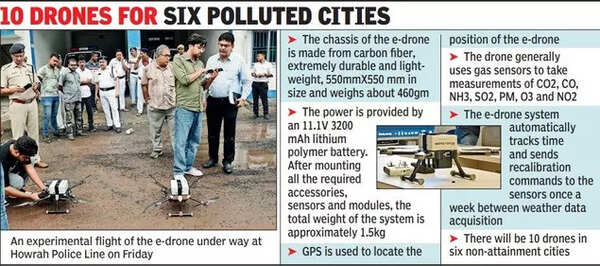
Environmental drones (e-drones) are programmed autonomous drones used for pollution monitoring, detection, and abatement at altitudes above ground level in a specific geographic region. E-drones produce Air Quality Health Index (AQHI) maps of covered areas for environmental data monitoring and long-term analysis. E-drones are the first aerial systems designed to fight pollution following successful detection.
As the drone had an experimental flight on Friday at Howrah Police line, WBPCB chairman Kalyan Rudra and member secretary Rajesh Kumar watched the live-streaming at the Command and Control Centre (CCC) at the headquarters.
“There will be 10 drones deployed across six non-attainment cities. We have seen that polluting industrial units tend to switch off the ETPs and ECDs, particularly during the night, to save costs, causing irreversible damage to the environment. We are focussing more on night surveillance to catch the polluters red-handed,” said Kalyan Rudra.
“Moreover, we have asked the agency engaged in surveillance to add land use patterns to detect whether the housing societies are following the norm of keeping mandatory 20% green space. From our experience, we have seen there is rampant violation of this norm by real-estate developers,” he added.
“The drones can measure PM2.5, NOx and SO2 levels in the air. They can revolve around the top of the stacks of polluting industries and measure the ambient air in the impact zone of the polluting industrial units. Besides, one drone stationed at PCB headquarters will carry out an aerial survey during Diwali against use of illegal fireworks,” said an officer.
Since PCB has all the polluting industrial units mapped, the drones just need instruction with the latitude-longitude coordinates for surveillance. When multiple e-drones are used in different locations, custom software generates an AQHI map of the region that can be used for present and long-term environmental analysis.
End of Article
FOLLOW US ON SOCIAL MEDIA










Photostories

Hot Picks
TOP TRENDING
Popular Categories
Hot on the Web
Top Trends
ENG vs SCO Live ScoreBaba Siddique NewsSuryakumar YadavRussell WilsonsBaba Siddique DeathHardik PandyaWho was Baba SiddiqueMayank YadavWhere to Watch India vs Australia MatchMahadev Betting AppAmazon LayoffsToday IND vs AUS MatchManagement Colleges of IndiaTop Medical Colleges of IndiaTop Engineering Colleges of IndiaTop Pharmacy Colleges of IndiaLive Cricket Score
Trending Topics
Diwali WishesDussehra 2024 QuotesDussehra WishesVettaiyan OTT ReleaseVettaiyan CollectionVettaiyan ReviewNatasa StankovicDevara CollectionBigg Boss 18Deepika PadukoneShraddha KapoorRatan Tata Passed AwayJigra Movie ReviewVettaiyan Movie ReviewSwatantrya Veer SavarkarDussehra 2024Star Health Hacker DemandedViral MemesUltimate Football Codes October 2024Wordle Answer
Living and entertainment
Latest News
Book review: 'The Scientist Entrepreneur' by Dr Kalpana Sankar is a nuclear scientist’s inspiring journey of women’s empowermentDid BTS' V get promoted to corporal in the South Korean military? recent appearance at an orchestra event has fans speculatingAccused did recce of Baba Siddiqui's house, monitored him for months: Mumbai PoliceParas Mhambrey joins Mumbai Indians as bowling coachSalman Khan’s security beefed up after Baba Siddiqui’s murder; ‘Sultan’ star looked uncomfortable after visiting the late politician’s family at 3 amBaba Siddique may have died prior to hospitalisation, says doctorsRanji Trophy: Thriller in the making as Krunal Pandya fifty helps Baroda lead by 226 runs vs MumbaiReading the Stars and Your Hands: How Astrology and Palmistry Complement Each OtherTaurus, Weekly Horoscope, October 13 to October 19, 2024: Focus on gains and accomplishments'Procrastination greatest thief of time': HC junks 'belated case'Krushna Abhishek shares a heartwarming post for mama Govinda; says 'jab body mein adha blood supremely talented actor Govinda ka ho...'2 flee Uttarakhand jail. Did they escape as Ramlila ‘vanars’ looking for Sita?Scorpio, Weekly Horoscope, October 13 to October 19, 2024: Health and self-care are essentialZodiac signs likely to have soul connectionsNumerology Predictions Today, October 13, 2024: Read your personalised forecast for numbers 1 to 9'Points towards failure of CM': Sanjay Raut slams Maharashtra govt over Baba Siddiqui's killingAshton Kutcher and Mila Kunis consider leaving Hollywood amid Sean 'Diddy’ Combs' arrest fallout: ReportVijay celebrates 'GOAT' success as Venkat Prabhu's directorial earns 100 crore share in Tamil Nadu
Copyright © 2024 Bennett, Coleman & Co. Ltd. All rights reserved. For reprint rights: Times Syndication Service