
- News
- City News
- kolkata News
- Humanities clear winner in HS this year
Trending
This story is from June 9, 2018
Humanities clear winner in HS this year

Representative image
For Granthan, it wasn’t easy to pursue his dreams.

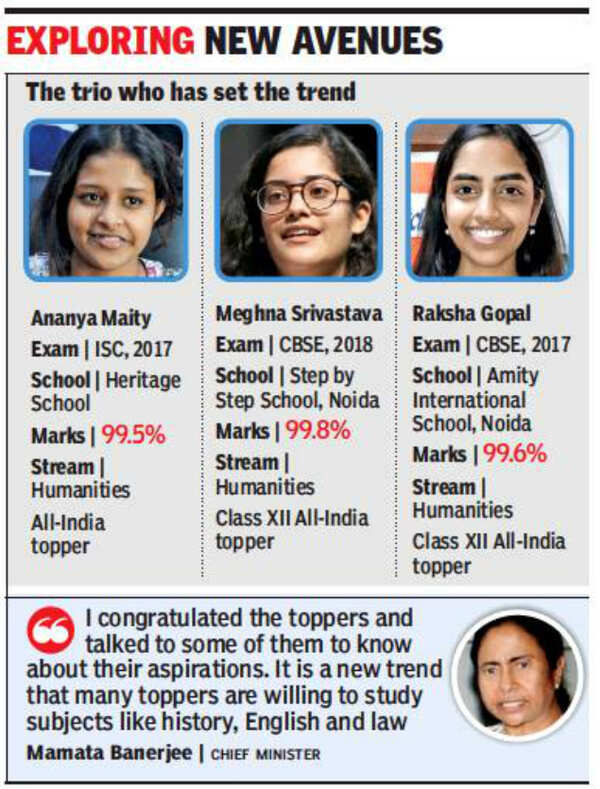
Passion for humanities might be reason for this ‘historic performance’ but academicians believe this is possibly not the only reason. A change in evaluation pattern, introduction of MCQs, very short answer type questions (VSAQs), projects and question-cum-answer booklet pattern have increased the opportunity to score more marks in humanities. Others believe that good students are opting humanities nowadays, and this is yielding better results.
Bengal chief minister Mamata Banerjee said that she was happy with the results of the students from Madhyamik board and state HS Council, as they have done excellently. “I congratulated the toppers and talked to some of them to know about their aspirations. It is a new trend that many toppers are willing to study subjects like history, English and law.”
“The success of humanities students reflects the studentfriendly evaluation pattern. In every arts subject, 20 marks are allotted to projects and it is internally evaluated. Though it started four years back, MCQs and VSAQs are being evaluated on a question-cum-answer booklet. As a result, students are almost getting full marks. In a 80-mark question paper, almost 50% is allotted to the question-cum-answer booklet,” said Saugata Basu, the secretary of government school teachers’ association.
“Earlier, students with average or below par intelligence opted for humanities. To ensure parity between curriculum, science syllabus has now become vast and books are voluminous. In comparison to humanities, science text books have almost 30 times more pages. As a result, many students decide to give up science and opt for humanities,” physics teacher Arindam Nandi. Another teacher from JU pointed out that many move to humanities since they prefer not to take national engineering or medical entrance examinations, which is organized by the central boards.
“It’s a presumption that science is for bright students. I think the changing trend is encouraging. It’s a recognition of the fact that students can go on to have great careers in different fields, instead of becoming doctors or engineers. Now there are many openings and career options, which is perhaps encouraging bright students choosing humanities,” said Nilanjana Gupta, a teacher of the English department in JU.
End of Article
FOLLOW US ON SOCIAL MEDIA





Photostories

Hot Picks
TOP TRENDING
Popular Categories
Hot on the Web
Top Trends
Baba Siddique NewsRussell WilsonsBaba Siddique DeathSanju SamsonWho was Baba SiddiqueMayank YadavIndia Team Qualifying ScenarioWhere to Watch India vs Australia MatchMahadev Betting AppAmazon LayoffsToday IND vs AUS MatchSuryakumar YadavManagement Colleges of IndiaTop Medical Colleges of IndiaTop Engineering Colleges of IndiaTop Pharmacy Colleges of IndiaLive Cricket Score
Trending Topics
Diwali WishesDussehra 2024 QuotesDussehra WishesVettaiyan OTT ReleaseVettaiyan CollectionVettaiyan ReviewNatasa StankovicDevara CollectionBigg Boss 18Deepika PadukoneShraddha KapoorRatan Tata Passed AwayJigra Movie ReviewVettaiyan Movie ReviewSwatantrya Veer SavarkarDussehra 2024Star Health Hacker DemandedViral MemesUltimate Football Codes October 2024Wordle Answer
Living and entertainment
Latest News
Book review: 'The Scientist Entrepreneur' by Dr Kalpana Sankar is a nuclear scientist’s inspiring journey of women’s empowermentAccused did recce of Baba Siddiqui's house, monitored him for months: Mumbai PoliceParas Mhambrey in Mumbai Indians set-up as bowling coach?Salman Khan’s security beefed up after Baba Siddiqui’s murder; ‘Sultan’ star looked uncomfortable after visiting the late politician’s family at 3 amBaba Siddique may have died prior to hospitalisation, says doctorsReading the Stars and Your Hands: How Astrology and Palmistry Complement Each OtherTaurus, Weekly Horoscope, October 13 to October 19, 2024: Focus on gains and accomplishmentsRoblox dismisses claims made by Hindenburg report: "...don't support their agenda"'Procrastination greatest thief of time': HC junks 'belated case'Krushna Abhishek shares a heartwarming post for mama Govinda; says 'jab body mein adha blood supremely talented actor Govinda ka ho...'RSS chief Mohan Bhagwat: Hindus must take lessons from Bangladesh violence2 flee Uttarakhand jail. Did they escape as Ramlila ‘vanars’ looking for Sita?Scorpio, Weekly Horoscope, October 13 to October 19, 2024: Health and self-care are essentialNumerology Predictions Today, October 13, 2024: Read your personalised forecast for numbers 1 to 9Ashton Kutcher and Mila Kunis consider leaving Hollywood amid Sean 'Diddy’ Combs' arrest fallout: ReportVijay celebrates 'GOAT' success as Venkat Prabhu's directorial earns 100 crore share in Tamil NaduLoneliness across generations: Why is it important to address this hidden danger?For 500 years, this village in Madhya Pradesh worships Ravan as ‘Kul Devta’
Copyright © 2024 Bennett, Coleman & Co. Ltd. All rights reserved. For reprint rights: Times Syndication Service