
- News
- City News
- kolkata News
- Bear carcass found in Dooars, autopsy reveals starvation
Trending
This story is from December 14, 2021
Bear carcass found in Dooars, autopsy reveals starvation
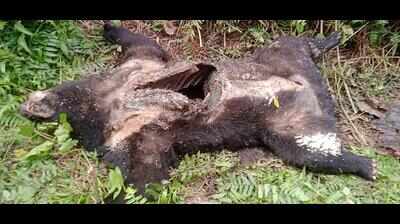
The carcass was found at the juncture of Dalmore forest and Makrapara tea estate in Alipurduar’s Birpara
Wildlife experts find it difficult to believe as the Dooars is known for its lush greenery and abundance of food, which helps wildlife thrive.
“The post-mortem revealed that the animal died of starvation two days ago,” said Jalpaiguri divisional forest officer Mridul Kumar.

The carcass was found at the juncture of Dalmore forest and Makrapara tea estate in Alipurduar’s Birpara. This is close to the Bhutan Hills; it is believed that the bear climbed down the hills to reach the plains.
“Although it is hard to believe, we have to accept that the bear died of starvation,” said state wildlife advisory board member Animesh Bose. “This is because Asiatic Black Bears stay in higher altitudes, where they get their food from. In the plains, supply of food is not enough.”
According to Bose, “their regular depredations suggest that there has been a scarcity of food in the higher altitudes”. “I have talked to people who visit the upper areas. They told me that the storm and heavy shower during Lakshmi Puja significantly reduced bearing of fruits in higher altitudes that are the natural source of food for bears.”
Bose further said that the “Jalpaiguri divisional commissioner would often discuss issues with his Bhutanese counterpart in the past”. “But that has stopped now,” he continued. “Our government should take up the issue with Bhutan to find out what exactly has happened that is leading to bear depredations.”
A bear’s death due to starvation has been a depressing inclusion on a list of more upbeat firsts this year, such as the sighting of 18 Asiatic Black Bears in the Dooars and Darjeeling Hills within 25 days, followed by that of a Bengal Tiger, clicked in Buxa Tiger Reserve after almost three decades.
End of Article
FOLLOW US ON SOCIAL MEDIA



Hot Picks
TOP TRENDING
Trending Stories
In City
Entire Website
- GK for students: Top 8 Largest Mammals in the World
- Arvind Kejriwal Resignation Live Updates: 'Kejriwal will be back', says Atishi after staking claim; BJP questions CM-designate's 'background'
- India vs China Highlights, Asian Champions Trophy 2024 Final: Jugraj Singh stars as India beat China 1-0 to clinch record fifth title
- Kolkata Murder Supreme Court Hearing Live Updates: Court extends ex-RG Kar principal Ghosh, cop's custody by 3 days
- Maharashtra schools closed on Sep 18: Here’s why
- Communal tension hits Karnataka towns over Palestinian flags at rallies
- 'If any shame left ... ': AAP slams Swati Maliwal's remark on Atishi, says she should seek RS ticket from BJP
- Work on bridges gains pace to ease Ghodbunder jams
- NMDC Steel Plant Seeks 100 Officers of Vizag Steel Plant
- UGC NET Result 2024 Live Updates: NTA expected to announced final answer key, scorecards shortly
- 'Security breach': 1000s of pagers explode across Lebanon, many Hezbollah fighters hurt
- Sri Lanka presidential polls: What's at stake for India
- ‘Oxford returnee’ to Delhi CM: The rise and rise of Atishi
- 'No glorification of bulldozer justice': SC bans property demolition till Oct 1
- PM Modi to visit US from Sept 21-23 for Quad summit
- Pak players wave Chinese flag during India-China ACT final
- Rs 15cr gold crown from the Ambanis: Meet Mumbai’s richest Ganeshas
- Reliance Jio confirms outage, here’s what the company said
- 'Kejriwal will be back', says Atishi; BJP attacks CM-designate
- 'Congress, its ecosystem angry': PM Modi over Ganesh Puja with CJI

Popular Categories
Hot on the Web
Top Trends
Dominique PelicotUS Fed Rate CutIndia vs China Champions TrophyUPI Transaction LimitWhere to Watch India vs China Final Hockey MatchUPS vs NPS CalculatorKolkata Commissioner Manoj VermaNEET UG Admission CriteriaAtishiKolkata Doctor Rape CaseArvind Kejriwal Resignation LiveAli Khamenei TweetSuryakumar YadavVince McMahonTech LayoffsDonald TrumpLive Cricket Score
Trending Topics
Munawar FaruquiLuxury BrandCancer CauseKhatron Ke Khiladi 14Chinas EggAtishi Marlena Singh QualificationSunita AhujaGoat CollectionSalman Khan FarmhousePitra Paksha 2024CheetahsKangana RanautAditi Rao HydariDalljiet KaurHoliday DestinationVikas SethiReliance Jio DownApple iPhone 16 ProVirat KohliWordle Answer
Living and entertainment
Latest News
Pankaj Kapur is proud of son Shahid Kapoor’s film choices, calls him ‘the finest actor in the country’Mukhtar Ansari died of heart attack, not poisoning: UP's Banda district magistrate's report4 types of tea to improve gut health and ease digestive issuesMemeFi daily codes for 17 September 2024: Boost your earnings with daily codes and know how to maximizeKhatron Ke Khiladi 14: Shalin Bhanot hosts a fun party for his co-contestants Krishna Shroff, Abhishek Kumar, KaranVeer Mehra and othersDecoding how log analytics systems are enabling brands to derive maximum value from dataAnother Mpox suspected case in India: Man showing symptoms admitted to hospitalTaurus, Daily Horoscope Today, September 17, 2024: Anxiety and stress diminishLiza Colon becomes 1st Latina to win Best Supporting Emmy AwardSelena Gomez recreates practiced applause she learnt from TV show Friends after losing at Emmys 2024Former WWE superstar is no longer listed on their internal rostersBeyond Paychecks: Job satisfaction, work-life balance more important than salary for Gen Z workforce‘You is sleep or you can sleep’: Students prank Benglauru’s ‘pookie professor’ in viral videoHow ‘Oxford returnee’ Atishi became chief minister of DelhiWhy more couples aged 50 or older are getting divorcedThese are the most toxic fresh produce of 2024Congress condemns Shiv Sena MLA's 'Rs 11 lakh reward to cut Rahul Gandhi's tongue' remarkThe 3 Strongest Zodiac Signs: Powerhouses of the Zodiac Wheel
Copyright © 2024 Bennett, Coleman & Co. Ltd. All rights reserved. For reprint rights: Times Syndication Service