
- News
- City News
- kolkata News
- Kolkata metro mishap: And this is how Tokyo manages its Metro rush
Trending
This story is from July 17, 2019
Kolkata metro mishap: And this is how Tokyo manages its Metro rush
Muri na gojoshya wa oyame kudasai’ — a phrase ubiquitous on platforms of Tokyo Metro is a request to passengers to avoid boarding trains forcefully. It is quite incredible that the world’s densest train network does not see a proportionate number of accidents, albeit.
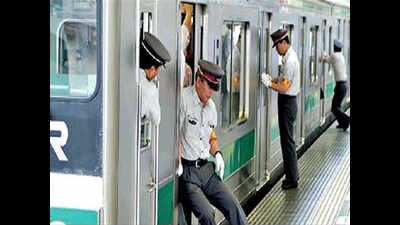
When trains in Tokyo are almost full to capacity, pushers request people to get off and catch the next one
While walking down any platform in Tokyo, even during the busiest hours, one is awed by the calm of passengers.

In Tokyo, the deepest line runs 48 metres below the surface and the highest elevation a monorail reaches is almost similar.
All drivers need to stop trains at the precise mark at the end of the platform and unless the perfect point is reached, the drivers won’t open the doors. Some stations, though, have double-door system — an automatic door on the station — for enhanced security.
It would be biased to say that there’s no rush boarding — often you see people jumping through the closing doors. It is the duty of the driver or co-driver to keep an eye on that. At their own discretion, they can hold the door from closing if they see a frantic passenger running in. Even if they miss, the sensors won’t. To support the driver, there are multiple assistants at most stations, who keep on announcing about the arrivals and departures and also communicate with the drivers using hand signals.
The security system also has multiple layers. There are layers of human and technological expertise working in cohesion to prevent accidents. While Japan is more famous for its bullet trains, the role the local metros play is often undermined. They are the easiest, fastest and cheapest mode of transport. Add ‘secured’ to this, and you get a perfect first-world service. Tokyo’s metro and subway line carry almost 20 million passengers a day.
(Roy is a former Kolkata photojournalist now based in Tokyo)
End of Article
FOLLOW US ON SOCIAL MEDIA





Hot Picks
TOP TRENDING
Trending Stories
In City
Entire Website
- Breathtaking cosmic catwalk! SpaceX makes history with first-ever private spacewalk
- 2 Army officers thrashed, their female friend gang-raped in Madhya Pradesh
- Bangladesh announce Test squad for India tour
- Top fastest trains in the world: From China's CR Harmony to Germany's ICE
- Amid Shannon Sharpe Viral Video, Former ESPN Host Michelle Beadle Reacts Claiming It Was Not Her
- Ayushman Bharat insurance scheme expanded to cover elderly above 70
- 'Will be demolished if... ': Himachal minister's assurance amid Shimla mosque row
- Mumbai's Haji Ali and Mahim dargahs cancel Eid shamiana
- Garena Free Fire MAX redeem codes for September 11, 2024: Win free room cards, skins, diamonds, pet skins, and more rewards today
- GK for students: Top 8 Largest Mammals in the World
- In the (y)ear of conspiracy theories, Trump hears insults galore
- On Mamata's 'ready to resign' offer, protesting docs say 'want justice'
- Why you should not be fooled by ‘20-year SIP crorepati’ dream
- Swiss authorities freeze more than $310mn linked to Adani Group: Hindenburg
- IAF wants Tejas jet production to be ramped up as US delays engines supply
- Haryana polls: Rebellion erupts after Congress leaders file independent nominations
- Your cousin’s poo can now cure your chronic stomach problems
- Planning to buy iPhone 16? How much Apple will give for iPhone 12 & others
- Pandya triggers speculation over his Test comeback
- 'Lady Macbeth of Bengal': CV Ananda Bose to 'socially boycott' Mamata Banerjee

Popular Categories
Hot on the Web
Top Trends
Trending Topics
Alia BhattMalaika Arora Father DeathArbaaz KhanNatasa StankovicMr Bachchan OTT ReleaseNational Parks In IndiaSelena GomezGOAT CollectionVikas Sethi DeathMalayalam ProducersIndia's Best Dancer 4Simi GarewalDilli BabuIndian National ParksLaung BenefitsVikas SethiiPhone 16Microsoft 365 OutageCsir Ugc Net 2024Wordle Answer
Living and entertainment
Latest News
Epilepsy medication shows promise of treating sleep apnoea symptoms: StudyIndia successfully flight tests surface-to-air missileDigest this: Unhealthy gut may be linked to Parkinson’s diseaseCSIR UGC NET 2024 result declared: Steps to download scorecards at csirnet.nta.ac.in'Played a big role in turning the cricket around': Ricky Ponting applauds Virat Kohli’s brilliance as India’s former captainAadhaar card update: Do you have to compulsorily update details on your Aadhaar every 10 years?Single Indians are now choosing slow, meaningful dates over-elaborate outings, reveals an online dating platform’s surveyExclusive- Saurabh Gumber reveals joining a new show during Ganeshotsav says, "I consider it as Bappa's small gift and believe he has great plans for me ahead"Who was Illia 'Golem' Yefimchyk, the Belarusian bodybuilder who consumed 2.5 kg of meat and 108 sushi pieces daily before his death at 36?Pakistan: Bilawal cautions Shehbaz govt against political victimisation, points to Imran Khan's caseVijay Varma reveals he was DROPPED from 'Sacred Games' at the last minuteMahindra Thar Roxx with VIN 0001 to be auctiond for charity: How to registerWWE Star Discusses Why Sid Vicious Deserves a Hall of Fame SpotVijay Sathya-starrer 'Dhil Raja' to release in SeptemberHarvard University Sees Drop in Black Freshman Enrollment Post-Supreme Court Ruling on Affirmative ActionSalman Khan surrounded by bodyguards as he arrives at Malaika Arora's mother's house to offer his condolences - WATCHCMF Buds Pro 2 by Nothing review: Big delivery on a budgetMallika Sherawat makes big screen comeback in Rajkummar Rao's 'Vicky Vidya Ka Woh Wala Video'; director reveals why he cast her
Copyright © 2024 Bennett, Coleman & Co. Ltd. All rights reserved. For reprint rights: Times Syndication Service