
- News
- City News
- kochi News
- WWII bunker turned into museum
Trending
This story is from April 11, 2018
WWII bunker turned into museum
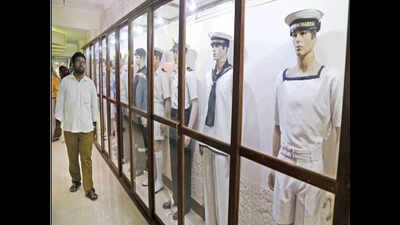
A wide array of old uniforms and badges used by officers and sailors on display at Indian Naval Maritime Museum in Fort Kochi
Finding the structure too tough to be demolished, the Southern Naval Command decided to turn the bunker into a shelter to store antiquities of the Indian Navy in 2001.

“One bunker has been used to narrate the history of Kerala, and the other for that of the Indian Navy’s history. The ground in between the bunkers is used for the display of various artillery and machineries used by the navy,” said Gerard George Joseph, curator of the museum.
While the first bunker has a 3D display of the pivotal events of the state’s history such as Dutch and Portuguese invasions and lifesize structures of fabled heroes like Kunjali Marakkar, the second bunker houses numerous collections relevant to the naval history, among which are arms used by naval officers during World War II and evolution of naval uniforms and badges over the years.
“One of the unique collections of the museum is the silver trophy presented to the Indian Navy by their Pakistani counterparts. When India became a republic, the royal Indian naval assets had to be partitioned between Indians and Pakistanis. Pakistani officers and sailors gifted this silver trophy to us wishing us goodbye and luck. A similar trophy was gifted back to them by us, wishing them the same,” Joseph said.
Just across the trophy is a faded lifebuoy, another relic precious to the history of Indian Navy.
“The lifebuoy was presented by VADM RKS Gandhi, who was the commanding officer on INS Betwa during the Goa Liberation War in 1961. During the operation, Portuguese ship Afonso de Albuquerque was firing at the Indian air force planes at Murma Goa harbour. This fire was neutralized by Indian naval ships Betwa and Beas, forcing the Portuguese ship to run aground. Once a ship is destroyed, something is taken from the ship for remembrance, and this lifebuoy was collected thus,” Joseph said.
Treasurable collection of the museum includes a survey vessel used by Robert Bristow during his inspection of Kochi into convert it into a world-class port, Seaking twin engine anti-submarine warfare helicopter of British origin, and other warfare artilleries distinctive of the Southern Naval Command.
End of Article
FOLLOW US ON SOCIAL MEDIA







Photostories

Hot Picks
TOP TRENDING
Popular Categories
Hot on the Web
Top Trends
Travis KelceIsrael Hezbollah WarIND vs PAK HighlightsElection Exit PollsIND vs BAN Live ScoreKayla NicoleShan MasoodPrince WilliamAmethi Murder CaseAssembly Election Result 2024UGC NET ResultDiddyWomen's T20 World CupTop MBA Colleges of IndiaT20 WC ScheduleWomen T20 World Cup Points TableLive Cricket Score
Trending Topics
Bigg Boss 18 Launch LIVE UpdatesBigg Boss Tamil 8 Contestants ListBigg Boss Tamil 8 Launch LIVE UpdatesNavratri Colours 2024Navratri Day 2 ColourDurga Puja 2024Bigg Boss 18 House PhotoDevara CollectionGOAT OTT ReleaseDeepika PadukoneGovindaDevaraGovinda NewsDevara Movie ReviewSwatantrya Veer SavarkarColdplay India tour 2025Maa Durga 108 NamesNavratri JewellerySony Bravia 55 inch 4k Ultra HD TVWordle Answer
Living and entertainment
Latest News
Long farewell: Yellow alert for today and tomorrowBigg Boss Marathi 5: Riteish Deshmukh condemns Nikki Tamboli and Aarya Jadhao's remarks on Varsha Usgaonkar and Jahnavi KillekarRevealed: The real reason Taylor Swift was missing from Travis Kelce's birthday celebrationDelhi ki festive vibe hi alag hai: Mannara ChopraPunjab AAP leader shot at during argument with Akali Dal leaderWill Varun Dhawan, Shraddha Kapoor, and Kriti Sanon come together in 'Stree' x 'Bhediya' film?Navratri 2024 Day 5: Maa Skandamata, Puja Vidhi, Mantra and SignificanceUttar Pradesh: Police station in-charge and SI suspended, two others removed in BahraichBhumi Pednekar’s Badhaai Do co-star Chum Darang to be a part of Bigg Boss 18? Here’s what we knowBigg Boss Tamil 8: Actress Sachana Namidass to participate in the upcoming season?Amul ready to enter European market after US: MDBigg Boss Marathi 5: Akshay Kumar reunites with Varsha Usgaonkar after 20 years on the reality show; says 'You Haven’t Changed a Bit'Flash flooding kills three in northern Thailand'We just walked the talk': Suryakumar Yadav elated after team executes plans to perfectionOptical Illusion: Can you find who's the boss in this picture?Fans Fume Over Whistle Mania: How the New York Jets' Early Penalty Struggles and Aaron Rodgers' Milestone Ignite Outrage and Calls for Accountability from NFL OfficiatingBigg Boss Tamil 8: Who will be the next host?Ducking Below The Waves
Copyright © 2024 Bennett, Coleman & Co. Ltd. All rights reserved. For reprint rights: Times Syndication Service