
- News
- City News
- kochi News
- Sugathakumari: Voice of the voiceless
Trending
This story is from December 24, 2020
Sugathakumari: Voice of the voiceless
If there is one poet who has so much relevance in contemporary Kerala, post floods, and whose verses are often quoted these days in public forums and debates, it would be Sugathakumari, undoubtedly.
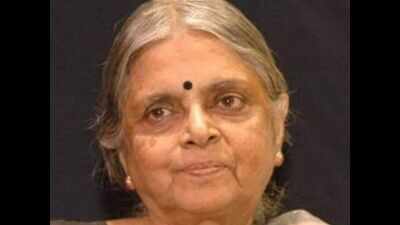
Malayalam poet Sugathakumari
For over five decades, the poet remained as the state’s overarching matriarch, speaking to its muted conscience as a poet and as a social activist, even as criminal misdemeanors and ecological plunders went unnoticed.


Though her contemporaries penned immortal poems blending nature, folklore and local myths, it was Sugathakmari who gave environmentally-themed poems a contemporary significance, beginning from the famous anthem ‘Ode To A Tree’ a soulful song decrying the destruction of 850 hectares of forest in the Western Ghats for the proposed Silent Valley hydel project.
While many writers led compartmentalized lives, letting their works speak for themselves and kept their ideological moorings hidden, especially in hyper-political Kerala, where public statements have the potential to destroy the literary careers of fledgling writers, Sugathakumari was an exception.
Though she was a progressive poet it came as a surprise for many when she criticized the Supreme Court order allowing entry of women into Sabarimala temple.
When this writer met her in September last year at her home in Thiruvananthapuram, a year after the Kerala floods, I asked her about her stand. The 85-year-old ailing poet smiled for a moment and said: “I do not want Sabarimala temple, situated in the Periyar Tiger Reserve, turn into a mega family pilgrimage centre, violating all norms. I do not want more concrete resorts and sewage dumping sites to come up there.’’ Her childhood memories of Aranmula, a green heritage village along the banks of Pamba, proved a decisive inspiration in her poems on nature, bio-diversity and dying traditions. Though the poet lived in Thiruvananthapuram, the village remained close to her heart, and she returned to her ancestral home, time and again, to light a lamp at her family serpent shrine and lovingly preserved the Tharavad as a wild green haven.
It was no wonder then that she played an active role in the protests against the proposed Aranmula airport that would have destroyed 500 acres of wetlands.
She would always say there is no greater joy than listening to bird songs in the morning or seeing a plant growing in a barren land. She planted trees and founded Krishna Vanam in Attapadi, a rains shadow region haunted still by tribal malnutrition deaths.
Creative work took a back seat over the years, as she allotted more time for social and green causes, though it never bothered her in the first place.
Pathos loomed large in all her works, beginning from the first collection of poems, Muthuchippi, published way back in 1962. In works like Gajendra Moksham, Ambalamani, and Radha Eviday, she explored the many aspects of love, from romantic to motherly and mystical to spiritual.
But the ethos of Sugathakumari’s later poems was dominated by concern for ecology, destruction of rivers and forest, and the habitat loss on birds and animals. In one such haunting poem, One More Song, the poet sees a forest bird with a broken wing, struggling to sing a song for her mate who had vanished forever.
Sugathakumari was at heart a romantic who was deeply influenced by her father Bodheswran’s Gandhian principles of nonviolence and Kumaranasan’s poetry.
Like P B Shelly who wrote, ‘Our sweetest songs are that of the saddest thought’ Sugathakumari too felt that it was only when she felt extremely sad that she could pen a poem. In her Ode To A Tree, she compares a tree to Lord Shiva and writes: “I pray to you, Neelakanda Swami, who consumes poison and provides us 'Pranavayu', the life-giving air.”
"Her works, which render full justice to the Indian poetic tradition, reflected her love for nature and a genuine concern for the abused and deprived sections of society," says Kerala governor Arif Mohammed Khan.

About the Author
Viju BEnd of Article
FOLLOW US ON SOCIAL MEDIA










Hot Picks
TOP TRENDING
Trending Stories
In City
Entire Website
- The Secret Behind NFL Marriages: How These Couples Make It Work
- UPI transaction limit to change from September 16! Here are the new limits for various UPI payments
- When Laura Loomer said she's single because she's too focused on Donald Trump
- South Delhi shooting: Sleuths see killing as a message to big businessmen
- Top 10 sports stars turned power couples: From Agassi-Graf to Conner-Comaneci
- 3 Zodiac Signs Most Likely to Become Multimillionaires
- Narayana Murthy faces backlash for parenting remarks on social media; users say, "after working 72 hours a week, there’s barely time left to have babies…”
- 'Would not fit in ... ': Princess Diana's brother warned Prince Harry about marrying Meghan Markle
- The 3 Strongest Zodiac Signs: Powerhouses of the Zodiac Wheel
- Dark Side Of Each Zodiac Sign
- CM Kejriwal says he will resign in 48 hours: Does this mean early elections in Delhi?
- Trump's 'mass deportation' threat evokes images of WW2 internment camps
- Will Germany’s suspension of Schengen entry end the Europe dream?
- Union minister calls Rahul Gandhi 'terrorist'; 'seek psychiatric help', says Cong
- Who could be the next Delhi CM if Kejriwal resigns?
- ‘I Hate Taylor Swift!’: Donald Trump rages after singer endorses Harris
- She called 9/11 an ‘inside job’. Why is she part of Trump campaign?
- Wipro to employees: Attend office at least 3 days-a-week or risk losing…
- 'Message for Modiji': Opposition takes jab at BJP over Nitin Gadkari's 'PM post' claim
- 'Anti-constitutional mindset': VP targets Rahul over quota remark, Cong counters

Popular Categories
Hot on the Web
Top Trends
Trending Topics
World Largest HorseEID WishesOnam WishesPriyanka Chopra TattooKottukkaali OTT ReleaseEngineers Day WishesGoat CollectionHair LossSudha MurtyMalayalam ProducersIndia's Best Dancer 4Simi GarewalDilli BabuIndian National ParksLaung BenefitsVikas SethiApple iPhone 16Donald TrumpAadhar Card UpdateWordle Answer
Living and entertainment
Latest News
Four Zodiac Signs That Are Hard to Control'Message for Modi': Opposition takes jab at BJP over Nitin Gadkari's 'PM post' claimNetflix denies filmmaker Soham Shah’s plagiarism allegations over Squid Games, says claim holds 'no merit''Virat bhaiya's passion and dedication for the game is...': Sarfaraz KhanFather rapes and murders 8-year-old daughter in Madhya Pradesh, throws body in wellBakuchiol: Nature’s answer to youthful skin radianceSaudi Arabia footballer Fahad Al-Muwallad hospitalized after fall from balconyNeeraj Chopra misses second Diamond League title by an agonising 1 cm; finishes second behind AndersonZodiac Signs That Crave a Luxurious LifestyleRain washes out England-Australia T20I series finale"Miami Dolphins Owner Stephen Ross Eyes Multi-Billion Dollar Deal: The $7 Billion Power Play"Rajkummar Rao hails Kareena Kapoor Khan's The Buckingham Murders as a 'gripping thriller'MoS Finance likely to be convenor of GoM on GST compensation cessRole Rewind: Did you know Ranveer Singh and Deepika Padukone's love story has a strong Kareena Kapoor Khan connection?How to set up partner sharing in Google PhotosIndia, Pakistan players involved in heated exchange during Asian Champions Trophy. WatchNoida authority fraud: 2 arrested in Rs 3.9 crore scam linked to fake bank accountsGovinda’s wife Sunita Ahuja talks about losing their premature daughter at three months: ‘That’s why I brought up Yash in a cocoon’
Copyright © 2024 Bennett, Coleman & Co. Ltd. All rights reserved. For reprint rights: Times Syndication Service