
- News
- City News
- Hyderabad News
- I didn’t choose Dhrupad, Dhrupad chose me: Uday Bhawalkar
Trending
This story is from December 22, 2016
I didn’t choose Dhrupad, Dhrupad chose me: Uday Bhawalkar
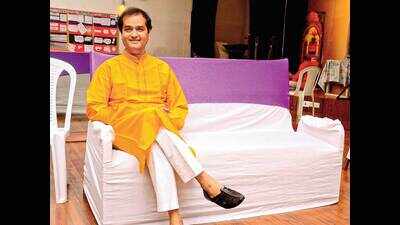
himself as the torch bearer of Dhrupad. For him music is an act of transcendence. “The real bliss of an artiste lies in immersing oneself in the ragas and let the music take over his or her existence,” remarked the Dhrupad maestro who was in Hyderabad to perform at music festival, Jashn-e-Deccan. In a tete-e-tete with Hyderabad Times, the acclaimed vocalist looks back at his musical journey. Excerpts:
Conventional education rarely interested me, it was music I was crazy about
My tryst with Dhrupad was a complete coincidence. I was born and brought up in Ujjain, Madhya Pradesh. In North India, people are more into harmonium, tabla, and sitar. Conventional education rarely interested me, right from my childhood. It was music I was crazy about. All I knew was that, I had to learn classical music. I was looking for a great guru, no matter which form of classical music he or she belonged to.
My tryst with Dhrupad was a complete coincidence
I remember the day I came across a newspaper ad in my neighbour’s house inviting applications for Dhrupad training under Ustad Zia Fareeduddin Dagar. I was 15 back then and had already started training in Khayal style under my elder sister. I applied without a second thought and got selected. My parents readily agreed because I would receive training in the highly respected Dagar tradition. Initially it was hard for me to figure out what was going on in the hour-long alaaps Ustad used to sing. It was only the ragas I could follow. Gradually with time, things fell into place. After finishing my four-year tenure at the Dhrupad Kendra in 1985, it was only Dhrupad that I wanted to sing.
Surviving on art is not easy
The journey was not easy, but it’s not easy for anyone, not even the Khayal singers. For any artiste, surviving on art is not easy. It takes time. For many years I had very few or no concerts at all. But I was happy. Music itself can be enlightening — when you hold a tanpura and render the ragas, the kind of upliftment you get is beyond the happiness of performing in any concert. For me connection with the raga I am rendering is more important than connection with people or the audience. Sthan se zyada sthiti mahatwapurna hai. That gives you strength, that gives you peace, that gives you love, that keeps you blessed by the divinity always. Once you are connected with the raga, the
audience will automatically connect with you. Happiness should be the priority of one’s life, and for me, music is the happiness.
End of Article
FOLLOW US ON SOCIAL MEDIA









Photostories

Hot Picks
TOP TRENDING
Explore Every Corner
Across The Globe
Delhi Election 2025Travis Head IPL CareerUPSC IFS Mains result 2024Jonathan and Simone Net WorthTaylor Swift
Pushpa 2 Box Office CollectionGame Changer Box Office CollectionCBSE Board Exam PrepJasprit BumrahRohit Sharma IPL Career
Popular Categories
Hot on the Web
Top Trends
Trending Topics
Living and entertainment
Latest News
Ben Affleck gets a visit by the FBI agents during the raging L.A. wildfiresNewly declassified MI5 files reveal Queen Elizabeth II kept in dark about Russian spyGame Changer box office collection Day 4: Ram Charan starrer chases Rs 100 crore mark as collections fall below Rs 10 crore on first Monday75+ Happy Makar Sankranti Messages, Greetings, Wishes and Quotes for 2025‘Marco’ box office collections day 25: Unni Mukundan’s action flick fights its way to Rs 59.2 croresNo rift between coach Gautam Gambhir and captain Rohit Sharma: BCCI VP Rajeev Shukla‘Saturday Night’ OTT release- When and where to watch the docudramaNnamdi Asomugha and Kerry Washington Combined Net Worth: How the Couple Built Their EmpirePushpa 2 box office collection Day 40: Allu Arjun starrer records LOWEST numbers as collections drop to Rs 1 crore'Fateh' box office collection day 4: Sonu Sood’s action drama sees a major drop, fails to make even Rs.1 crore while Ram Charan’s ‘Game Changer’ takes the lead'President’s characterizations incorrect ': Lead prosecutor David Weiss defends Hunter Biden case, rejects Joe Biden's 'mistreatment' claims'Recovery will require tens of billions of dollar': Joe Biden offers condolences and federal support amid LA wildfire devastationSA20: MI Cape Town triumph in Cape Derby with 33-run victory over Paarl RoyalsILT20: Shai Hope's century goes in vain as MI Emirates beat Dubai Capitals by 26 runsBigg Boss 18: Elvish Yadav backs Rajat Dalal, hopes to bring the Trophy to HaryanaGeorge R. R. Martin’s ‘In The Lost Lands’ to release on THIS dateDespite tensions, Bangladesh to continue to import diesel from IndiaFinal draft of Gaza truce deal presented to Israel & Hamas after 'breakthrough'
Copyright © 2025 Bennett, Coleman & Co. Ltd. All rights reserved. For reprint rights: Times Syndication Service