
- News
- City News
- Hyderabad News
- Amid quota cacophony, Muslim youth in Telangana & Andhra Pradesh turn the corner
Trending
This story is from May 31, 2024
Amid quota cacophony, Muslim youth in Telangana & Andhra Pradesh turn the corner
Introduced by Y S Rajasekhar Reddy-led Govt in 2007
Born to farmer parents, he is the first from his family to go where he has, with three higher-education degrees and a job that pays him more a month than his kin combined would have ever hoped to earn.

This first-generation learner acknowledges that he might have been tilling a patch of land with his siblings had the seed of change not been sown through an administrative decision .
Depending on which side one is in, the decision remains a hot-button topic. But Munsif and scores of others like him who grabbed that opportunity can't help but wonder where they would have been without the benefit of reservation.
"It worries me that the current political discourse centres on reservation. I have no qualms about admitting to being a beneficiary of the quota system, but I don't want to become a target of any political group," says the 34-year-old with a PhD in economics. A decade after the reservation tweak , the K Chandrasekhar Rao-led BRS govt in Telangana proposed to raise the quota to 12%. The Centre refused.
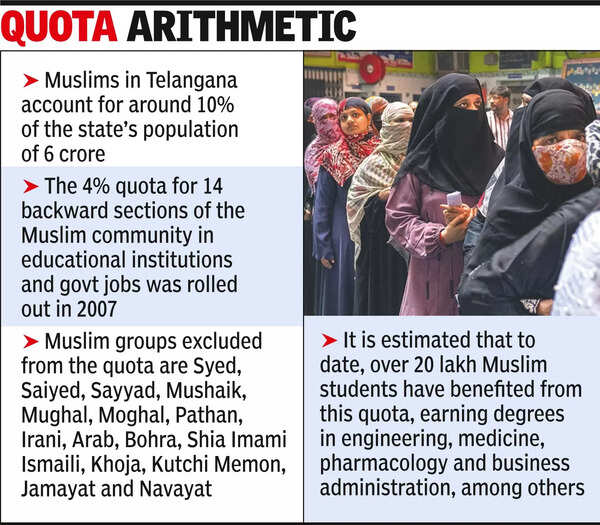
It is estimated that over 20 lakh Muslim students have benefited from the BC-E quota in the state to date, earning degrees in engineering, medicine, pharmacy, and business administration, among other fields.
Amer* is one among them. Just over a decade ago, his autorickshaw driver father would struggle to put food on the table. Life changed for the better after Amer completed his master's in pharmaceutical sciences. "I have a job in a pharmaceutical company that pays me well," says the 30-year-old, who lives and works in Secunderabad.
When the going was tough, he would take up odd jobs-even drive an auto, like his father-to supplement the family income. His engineer brother, who is employed with a large tech company in Hyderabad's IT corridor, would do the same. "Yes, I am a beneficiary of the quota system. But I am scared to admit it these days," says Amer.
He had initially invited TOI to his house for a chat, only to change the plan at the last minute.
IT analyst Shabbir*, too, was reluctant to speak, agreeing to a conversation only when he was assured that his real identity wouldn't be divulged. "Growing up in AP's Anantapur, I thought - like most people from my background - that I would maybe open a cybercafe or run a cable dealership. But then, I got a BTech seat at a college in Kurnool through the BC-E quota, and my life changed, recounts the young man, the oldest of three siblings.
Shabbir, whose father was a cement dealer before an accident left him unemployed, bought a house in the city to give his parents the life they never dreamt of.
"The other benefit of reservation has been that I have got married. Otherwise, who would give their daughter to a man without a decent degree or job?" Shabbir quips.
Similar success stories resonate across AP and Telangana. Mohammed Shabbir Ali's book, The Struggle, narrates dozens of accounts of Muslim girls and boys who embraced transformative change.
*Names changed to protect identities
End of Article
FOLLOW US ON SOCIAL MEDIA








Photostories

Hot Picks
TOP TRENDING
Popular Categories
Hot on the Web
Top Trends
Hurricane Milton LiveRBI MPC Meet LiveWorld First Top 10 TrillionairesVinesh Phogat Election ResultTravis KelceElection Results 2024Haryana Election ResultJason KelceJammu Kashmir Election Result 2024Israel Hezbollah WarHardik SinghAakash ChopraJammu Kashmir Election Winners ListGurgaon Election ResultHaryana Election Winners ListFaridabad Election ResultLive Cricket Score
Trending Topics
Tulsi KumarBigg Boss Tamil 8 Contestants ListAjay DevgnNavratri Colours 2024Sanjay Leela BhansaliDurga Puja 2024Bigg Boss 18 House PhotoDevara CollectionBigg Boss 18Deepika PadukoneShailesh LodhaDevaraGovinda NewsNational Film Awards 2024Swatantrya Veer SavarkarColdplay India tour 2025Watch NFL Live StreamDress To ImpressCall Of Duty Black Ops 6Wordle Answer
Living and entertainment
Latest News
After crackdown, Hyderabad’s infamous ‘bride bazaar’ moves onlineMozambique votes in tense election likely to see ruling party winAdnaan Shaikh's father Abdul Mabood Shaikh makes a shocking revelation amid the ongoing feud with his sister Iffat; says 'My daughter's in-laws are forcing her to do this'Hyundai aims to raise up to $3.3 billion in record India IPOLibra, Daily Horoscope Today, October 09, 2024: Today is a test of your resilienceWrestler-turned-politician Vinesh Phogat's educational qualifications and net worthMan declares income of Rs 9.6k, pays tax on Rs 43.5L after US earnings addedHarmanpreet Kaur fit for Sri Lanka match, conditions have been different from expectations: MandhanaPatanjali Foods gets CCI nod for Rs 1,100-crore buyout of parent's home & personal care businessDocumentary suggests Bitcoin creator Satoshi Nakamoto is developer Peter ToddDry Anjeer vs soaked Anjeer: Which one's better for a glowing skin?2024 Haryana assembly election result: 5 reasons why BJP's victory is significantHappy Durga Puja 2024: Best Messages, Quotes, Wishes, and Images to Share on Durga PujaShweta Bachchan Nanda reveals Amitabh Bachchan and Jaya Bachchan's great skin is due to mustard oil: 'They never had cosmetic treatments or procedures done'Alexander Zverev scrapes through, set to face David Goffin at Shanghai Masters pre-quartersRoh Yoon Seo shines as a supportive sister in 'Hear Me: Our Summer'Best TVs Of 2024 In India: Top Picks For Every BudgetSuhana Khan pens a fun caption directed to Shah Rukh Khan and Karan Johar along with picture of ‘birthday girl’ Gauri Khan
Copyright © 2024 Bennett, Coleman & Co. Ltd. All rights reserved. For reprint rights: Times Syndication Service