
- News
- City News
- guwahati News
- 3L households demand drinking water supply ahead of GMC polls
Trending
This story is from March 28, 2022
3L households demand drinking water supply ahead of GMC polls
About 3 lakh parched households in the city, who are awaiting proper drinking water supply for decades, have urged the state government, Guwahati Municipal Corporation (GMC) and other authorities to ensure potable tap water ahead of the urban body polls on April 19.
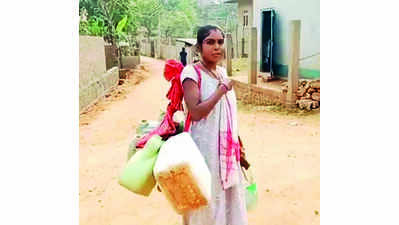
Around 70% of the households in the densely populated city depend on private water suppliers despite Guwahati being located on the banks of the Brahmaputra.

The GMC demarcated its wards in January increasing their number from 31 to 60. Of these, ward numbers 2, 19, 35 and 55 are some of the worst hit by drinking water crisis.
The residents of ward no. 2, which comprises the northern side of parts of Gotanagar, Jalukbari and Nambari railway colony, had voted for a Congress candidate as councillor, who allegedly did not pay heed to the issue.
Ajit Das, a resident of Gotanagar, said the area has no access to drinking water supply. “Big pipes of the water projects, construction of which is going on, were installed a few years ago but people are still waiting to get potable tap,” he added.
Meanwhile, Jiten Sarma, an octogenarian resident of Chandmari area, which falls under ward no. 35, said, “I had a well which has now dried up. Now, I must pay whatever the private water suppliers ask because we cannot live without drinking water. Being a resident of this city, I feel ashamed that the authorities concerned as well as the government have completely failed to provide basic amenities. I would like to urge the authorities to find a solution to the crisis in an urgent manner.”
It must be noted that the Kamrup (Metro) district administration on March 17 put on hold its order banning extraction of ground water by private water suppliers. It had on March 10 issued an order “prohibiting all types of extraction of groundwater in any form in the district without prior permission from the Central Ground Water Board (CWCB)”.
Deputy commissioner Pallav Gopal Jha also directed the GMC to ensure strict implementation of the order. But within 24 hours, the DC issued a second order by which households which are extracting groundwater only for domestic use and the armed forces establishments were exempted from the prohibition.
End of Article
FOLLOW US ON SOCIAL MEDIA










Hot Picks
TOP TRENDING
Trending Stories
In City
Entire Website
- UPI transaction limit to change from September 16! Here are the new limits for various UPI payments
- GK for students: 7 Fascinating Features of These Unique Birds
- No look shot gone wrong! Pakistan batter hilariously trolled after dismissal. Watch
- Andhra suspends 3 IPS officers for 'framing', arresting Mumbai actress
- UP medical aspirants converting religion to secure MBBS seats: A look at NEET UG admission criteria around minority reservation rules
- Who is Ryan Wesley Routh? Man held for 'apparent assassination attempt' on Trump
- Virat Kohli at his destructive best, shatters Chepauk wall near India dressing room with six
- 'Prince Harry is not even the spare to his wife': Meghan Markle’s treatment of Duke under fire
- Vince McMahon’s Expensive Properties, Bungalows, Villas, Private Jet, Car Collections, and More
- "Miami Dolphins Owner Stephen Ross Eyes Multi-Billion Dollar Deal: The $7 Billion Power Play"
- 15 phones, knives, omelette stoves found in prison where actor Darshan was 'relaxing'
- 'Fifth & final time': Mamata govt invites protesting doctors again for talks
- Doctors’ protest shows Mamata’s hold over Bengal is slipping
- National Award-winning choreographer Jani Master booked for rape
- 'They could be knocked down ... ': Gavaskar to India
- Furore as fishermen return with shaved heads from Sri Lanka
- Cow vigilantes killing a Brahmin is the wake-up call India needed
- Apple's biggest 'iPhone update' for 2024: India time, how to prepare
- When Suresh Raina silenced Pakistan fans
- Trump assassination bid: Suspect 'planned' to recruit Afghan soldiers in Ukraine

Popular Categories
Hot on the Web
Top Trends
Who is Ryan RouthUPI Transaction LimitArvind Kejriwal ResignationNEET UG Admission CriteriaYounis KhanBorder Gavaskar TrophyRohit SharmaSports Stars Turned Power CouplesIBPS RRB Clark PO ResultDonald TrumpBianca Belair Net WorthVivek RamaswamyBMW Accident Madhya PradeshIndore BMW CrashPrince HarryMiami Dolphins OwnerLive Cricket Score
Trending Topics
Living and entertainment
Latest News
4 types of tea to improve gut health and ease digestive issuesWho was Illia 'Golem' Yefimchyk, the Belarusian bodybuilder who consumed 2.5 kg of meat and 108 sushi pieces daily before his death at 36?When Shah Rukh Khan performed 'Kanyadaan' at Farah Khan's wedding- See PICSFather-son duo Eugene and Dan Levy's dazzling entrance at the EmmysLodi-era mosque collapses in AgraJr NTR on shooting under water scene for 35 days in 'Devara Part 1': It is an important sequence!Last Lunar Eclipse of 2024: What it means for your zodiac signKejriwal says he will quit as CM in 2 days, wants aam aadmi's 'honesty certificate'Jessica Gunning wins her 1st Primetime Emmy for 'Baby Reindeer'‘Stree 2’ star Shraddha Kapoor to reveal her character name! But there’s a catchSathiyan set to partner Sreeja in mixed doubles'Seven varsities in Odisha have potential to be in top 100'Capricorn, Daily Horoscope Today, September 16, 2024: Harmonious relationships with partners are likelyThrowback: When Sunita Ahuja said that she has a worse temper than her husband GovindaIndia fall to Sweden, face Davis Cup relegationEid Milad Un Nabi 2024: Date, Rituals and Significance of Eid e MiladETimes Pic of the Day: When Mohanlal joined the crew of ‘Pulimurugan’ to help set up the shoot location'Overspeeding' BMW & Mercedes send cab spinning on sea link; no casualty
Copyright © 2024 Bennett, Coleman & Co. Ltd. All rights reserved. For reprint rights: Times Syndication Service