
- News
- City News
- gurgaon News
- Pahadi Platter: Greens to lentils, more than just momos & noodles
Trending
This story is from October 23, 2022
Pahadi Platter: Greens to lentils, more than just momos & noodles
At its most essential, food is communal. It’s also a living memory, a thread linking the past to the present. And the food of Himachal Pradesh—or, as it’s more widely (and more fondly) known, Pahadi cuisine—is no different.
There’s nothing as reassuringly authentic, or more satisfying to the soul, than partaking of a meal in its place of origin, among the people who keep its aromas and flavours alive. Failing which you could spend time in the company of one who has roots in the region, a chef and storyteller like Nitika Kuthiala.
Nitika grew up in the Kangra valley, a beautiful corner of this beautiful state in the Western Himalayas. Here, the food is as simple as the folks who call this part of the country home—simple but undeniably tasty. It is this combination that comes through in Pahadi Pattal, Nitika’s at-home pop-up that she started in 2019, before Covid weakened our bodies and overwhelmed our minds, and hopes to revive very soon.
The table in her Noida flat seats six, at the most eight, a cosy enough gathering that allows room for an opening of minds, even among people whose proclivities, and the contexts and circumstances of whose lives, might be as far removed as are the hills from the plains. Yet, no emotional distance is too great that it can’t be bridged by food. And each of Nitika’s lunches finds its way to every guest’s heart.
However, when it comes to preparation, little trumps the old ways. “We cook on the chulha, which is common all over Himachal because wood is available in abundance. Stoves were introduced later and are used mostly in the chillier areas, to keep the kitchen warm,” she adds.
Presenting, the Pahadi spread
During the winters, greens such as spinach and tubers like jimikand (elephant foot yam) find space on Himachali tables. So too does Panjeeri, a popular sweet dish made from frying wholewheat flour in sugar and ghee. Admits Nitika, “I get requests from people in the US and UK to make Panjeeri, because it’s healthy, more so than, say, energy bars—and it travels well!”
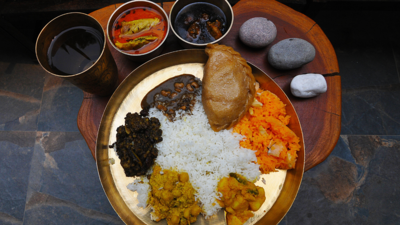
But this was September, and still hot and humid, so the menu was heavy on light dishes, though there was one exception—Siddu, the rich and scrumptious dumpling-like steamed bread stuffed with poppy seeds and dried fruit. It’s a perfect winter meal by itself, a filler of stomachs and souls. The whole spread, in fact, could best be described as a ‘Dawat e Shiraz’, a term of Persian origin that refers to a hearty repast prepared with generous doses of love.
Usually, a Himachali thali would feature Chaa meat, a mutton gosht redolent of the hills, yet here instead was Chaa chicken, which came with an invigoratingly tangy twist but was beautifully balanced. The Khatta meat, meanwhile, tasted as if it came out of a Mughal kitchen, so delicately spiced and succulent was it. Side by side was the delicious Tailey Maah, a sabut urad daal cooked in mustard oil, Rong da Mahni, a sweet-and-sour amchoor-based curry, the comforting Madra, a thick yoghurt-based curry twinned with white chickpeas, and the Gorkhali aloo, a dark horse of a potato pickle. Sweetened rice made for a perfect finish to a meal where everything was in harmony, each item of food complementing the other in a kaleidoscope of flavours.
Some of that which was served would find place in a Dhaam, a traditional Himachali feast that can be both celebratory and sacred. “Dhaam consists essentially of Sattvic food which would be based around lentils and would also include rice. It is prepared whenever there is a birth, wedding, religious occasion—or even a retirement!” reveals Nitika.
Here, then, is a community that shares each other’s joys and reaches out in times of need and sorrow. This down-home spirit is reflected in the food, and it is this spirit that Nitika Kuthiala endeavours to capture, by familiarising others with the culinary delights of Himachal Pradesh. “For me, the most memorable experience is seeing how people are pleasantly surprised to taste and relish genuine Himachali cuisine, to see how it is much more than the Maggi and Siddu they have usually eaten in the state.”
End of Article
FOLLOW US ON SOCIAL MEDIA




Photostories

Hot Picks
TOP TRENDING
Explore Every Corner
US Election Results
Popular Categories
Hot on the Web
Top Trends
CBSE Date SheetUS States Winner ListUS Election Results 2024UPSC Calendar 2025Donald Trump Net WorthRobin UthappaKapil DevCBSE Disaffiliated School ListWPL Full Retention ListTaylor Swift EndorsementKamala HarrisDonald Trump SonSean CombsWPL 2025 RCB Retention ListSRK Death ThreatUS Election Winners and LosersFreshworks LayoffLive Cricket Score
Trending Topics
Bhool Bhulaiyaa 3 ReviewKaun Banega Crorepati 16Shark Tank IndiaHair FallSuniel ShettyRaja KrishnamoorthiSingham Again ReviewTom Cruise MoviesYellowstone Season 5Kaun Banega Crorepati 16Indian Breakfast RecipesAmaran Box Office CollectionSingham Again 3 OTT ReleaseAmaran ReviewMutton CurryDigvijay Singh RatheeDonald Trump Net WorthUS Presidents List
Living and entertainment
Latest News
'Voted for Donald Trump but not Kari Lake': Arizona election latest updatesManisha Koirala reveals she penned a heartfelt letter to Princess Kate Middleton amid cancer battle: 'Because I could resonate with her'TN to launch bike ambulances having patient cabinsShaitani Rasmein actress Sumit Singh shared her travelling experiencesWith Trump election win, China braces for higher US tensionsJohn Wright was ideal India coach, he gave players free-hand unlike Greg Chappell and Anil Kumble: Sandeep PatilDeutsche Bank honours Ratan Tata’s legacy with commemorative plaque at erstwhile Tata HouseICC rates Kanpur outfield 'unsatisfactory', Chepauk deemed 'very Good'Kash Patel to head CIA, Vivek Ramaswamy homeland security? What a Trump 2.0 Cabinet may look likeGermany arrests US citizen on suspicion of spying for ChinaJaish terrorists killed two VDG members in Kishtwar, encounter begins in Sopore in north KashmirDon is America's most wanted!The Great Indian Kapil Show: Deepinder Goyal reveals the flirty texts for his food delivery App as notifications were initially meant for his wife Gia'The nightmare': Germany's media react to Trump's victoryMedical Recruitment Board to conduct exam on Jan 27 to recruit 2,553 doctorsEquatorial Guinea official fired over sex tape scandalThe week that was in international affairs: Trump is back, Zelenskyy invites India’s helpShoojit Sircar: 'Shayad Irrfan Khan ko main agar bolta ki go for alternate therapy, maybe he would have been alive little more'
Copyright © 2024 Bennett, Coleman & Co. Ltd. All rights reserved. For reprint rights: Times Syndication Service