
- News
- City News
- gurgaon News
- Haryana government to provide water till tail-end areas: CM Manohar Lal Khattar
Trending
This story is from September 3, 2018
Haryana government to provide water till tail-end areas: CM Manohar Lal Khattar
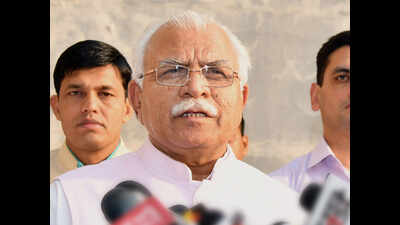
Chief minister Manohar Lal Khattar
“A Rs143-crore scheme has been initiated for the restoration of Jawaharlal Nehru feeder, the lifeline of this area. Not only this, for the last two years water is being continuously supplied up to 30,000 acre feet in Masani barrage constructed on Sahibi river in Rewari district,” he said while interacting with mediapersons after inspecting the feeder in Salhawas in Jhajjar district.

The chief minister inspected the pump house and inaugurated Neer Salhawas rest house constructed at a cost of over Rs1.95 crore. He also interacted with villagers at the farm of Ramnarayan, who is using micro-irrigation system for farming and conserving energy by installing solar pump set at Salhawas village. While inspecting the pump house, the CM also honoured 102-year-old Kanwar Singh of Ridau in Sonipat with a shawl.
He said the state had shortage of water but if the available water was utilized optimally, then during rains water could be collected in ponds and water reservoirs, which could be utilized when required. The CM said that to overcome the shortage of water, recently six states, including Haryana, have signed a memorandum of understanding regarding Lakhwar Dam. This dam would be ready in two years and Haryana would have 47% share in its waters. Giving details of the restoration of the feeder, he said for the first time since its construction in 1977, the present government had made a provision of Rs 143 crore on its restoration. He said after lifting from Salhawas pump house, water is supplied till the tail end of 460 feet at Nangal Chaudhary in Mahendergarh district of the feeder.
He said there were 10 pump houses from Salhawas till the tail end. With the restoration of all, the water capacity of the canal has also increased to 3,100 cusecs. At the same time, a successful attempt was made to rejuvenate Sahibi, Krishnavati and Dohan rivers in southern Haryana and many villages benefited from ground water recharge.
End of Article
FOLLOW US ON SOCIAL MEDIA





Hot Picks
TOP TRENDING
Trending Stories
In City
Entire Website
- 'We were treated like slaves, made to work for 15 hours a day': Tricked into Ukraine war, 3 from Karnataka return home
- 'My father was on the flight': Jaishankar opens up about 1984 Air India hijack
- Airtel CEO Gopal Vittal sends letter to Reliance Jio, Vodafone-Idea, Tata Tele and BSNL CEOs; here's what he said
- Prince Harry to celebrate 40th birthday away from Meghan Markle
- Haitian immigrant pet-eating row: Ohio woman accused of eating cat is US citizen, video is not from Springfield
- Kejriwal out of jail; 'CBI arrest only to frustrate ED case bail': SC judge
- Donald Trump reveals what Laura Loomer is to his campaign: 'I don't control her'
- Hamster Kombat Daily Cipher Codes and Combo Cards for September 14, 2024: Unlock up to 1 million coins
- Laura Loomer's photo with Donald Trump viral. People ask where's Melania, where's wedding ring
- Garena Free Fire MAX redeem codes for September 13: Win in-game goodies and rewards
- 'We were treated like slaves': Tricked into Ukraine war, 3 from Karnataka return home
- Ind vs Pak Hockey Live: India lead 2-1 with Harman's brace
- Five things to keep in mind before betting on Bajaj Housing Finance
- Yechury's mortal remains in CPI office: Sonia, Sisodia, Pawar pay last tribute
- Came to meet as your 'didi': Mamata on 'last attempt' to resolve doctors crisis
- 'Three families destroyed ... ': PM Modi attacks Cong-PDP-NC in J&K' Doda
- People will now elect judges in Mexico: Mistake or a masterstroke?
- Sexual harassment probe opened against SAP CTO: What the company said
- Watch: PM Modi welcomes birth of calf 'Deepjyoti' at residence
- Army man demands sexual favours to pass student in NCC test

Popular Categories
Hot on the Web
Top Trends
Trending Topics
Korean TeaSector 36 ReviewGreen Apple BenefitsPriyanka Chopra TattooKottukkaali OTT ReleaseNational Parks In IndiaGhaziabad Juice SellerGOAT CollectionVikas Sethi DeathMalayalam ProducersIndia's Best Dancer 4Simi GarewalDilli BabuIndian National ParksLaung BenefitsVikas SethiApple iPhone 16Donald TrumpAadhar Card Update By Sept 14Wordle Answer
Living and entertainment
Latest News
Kaun Banega Crorepati 16: Can you guess the answer for this Rs 3,20,000 question on Navy, which contestant Naman Jain incorrectly answered?Exclusive - Has Palak Sindhwani aka Sonu from Taarak Mehta Ka Ooltah Chashmah breached her contract; Neela Film Productions to issue a legal notice to the actress?Ford drives into India for 3rd timePIL: Publicise laws, penalties to curb crimes against womenGrowth potential 7.5% or more: RBI governorHindus take to Bangladesh streets to stop attacks and demand justiceE-commerce speeds up to catch up with Quick commerce'Will take digital public infrastructure stack to 50 nations'Justin Timberlake faces DWI charges: Court-ordered apology, fine and community serviceDonald Trump on another debate with Kamala Harris: 'Maybe, if I got in the right mood ... 'Border Gavaskar Trophy: When Ricky Ponting's on-air analysis of Prithvi Shaw turned into match realitySebi gives clean chit to NSE, ex-executives in co-location caseRusty or Ready? Falcons' Cousins Falls Flat in $180M NFL DebutEdible oil import duty hiked by 20%Lucky houseplants for each Zodiac, as per a renowned astrologerOnam is a time when everyone comes together to celebrate: Manju Warrier'Calling all Swifties for Trump': Donald's new campaign merch imitates Eras Tour shirtsTovino on training for Kalaripayattu in ‘ARM’: I practiced every single day, even if I had a hectic day on set
Copyright © 2024 Bennett, Coleman & Co. Ltd. All rights reserved. For reprint rights: Times Syndication Service