
Trending
This story is from March 25, 2019
Where shrines are cut out of a single rock
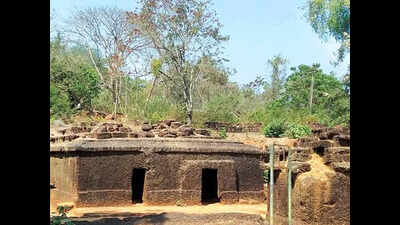
Four rock-cut caves dating back nine centuries lie in this village.
Khandepar has rock-cut caves, the Shri Saptkoteshwar Temple and a Shivling (representation of Lord Shiva) dating back eight centuries. In modern times, Khandepar’s Opa water supply works quenches the thirst of the talukas of Ponda and Tiswadi.
“Khandepar is a very distinct village of Goa because of its special attributes of geography and culture,” states Suresh Anant Satarkar of Panchami.

Village chroniclers like Suresh and Ganpat Shripad Gobre of Opa believe that “‘Khand is 20 and Par is dry land. Hence, there were 20 patches of dry land that used to appear in the Khandepar river to cross it from the village to Usgao. But, today no such dry lands are visible.”
On the other hand, Carlos Fernandes, of Campa, cites two writers on the etymology of the term ‘Khandepar’. Anant Ramakrishna Sinai Dhume, in his article ‘Gomantakachaya Vasahtichi Ruprasheha, published in the 1973-released book ‘Gomantakachi Pratima’ states that it is derived from the term ‘Kudanpar’ (a river flowing between two lands).
Pandurang Nagvekar, in his 2018-released book ‘Gomantakachi Matrabhasha’ says that the word ‘Khandepar’ is derived from Khategram or Khatgram.
The village, which has 20% of its land under forest area and houses a spice plantation and an amusement park, is home to around 5,000 persons. Khandepar is bordered by the four villages of Curti, Betora, Usgao and Vagurme on one hand and Khandepar river on the other.
Historically and traditionally, Khandepar has its own village comunidade/gaunkari called the Comunidade of Candeapar. After 1963, it was given a panchayat which it shares with Curti, which also has its own village comunidade/gaunkari. The traditional wards of Khandepar are Opa, Campa, Kadsal, Kerlem, Panchami, Nandan, Murdi, Bag, Nallakond, Mettar and Angdi.
End of Article
FOLLOW US ON SOCIAL MEDIA



Photostories

Hot Picks
TOP TRENDING
Popular Categories
Hot on the Web
Top Trends
Hurricane MiltonRatan Tata NewsNew UPI Transaction LimitRatan Tata DiesPM ModiRafael NadalShantanu NaiduTom BradyStock Market TodayNarayana MurthyIsrael Hezbollah WarRatan Tata Inspiring QuotesManagement Colleges of IndiaTop Medical Colleges of IndiaTop Engineering Colleges of IndiaTop Pharmacy Colleges of IndiaLive Cricket Score
Trending Topics
Diwali WishesBigg Boss Tamil 8 Contestants ListBhool Bhulaiyaa 3 TrailerVettaiyan Twitter ReviewSanjay Leela BhansaliVettaiyan ReviewSalman KhanDevara CollectionBigg Boss 18Deepika PadukoneShraddha KapoorRatan Tata Passed AwayColdplayVettaiyan Movie ReviewSwatantrya Veer SavarkarDussehra 2024Watch NFL Live StreamDress To ImpressRatan Tata DeathWordle Answer
Living and entertainment
Latest News
How Chennai Night Race swerved past challenges to zoom toward a brighter motorsports futureAll-Star Tower Defense (ASTD) Codes October 2024Ranveer Singh: I have a man crush on Tiger ShroffWho is Noel Tata? Meet Ratan Tata’s half-brother, who could be successor at Tata TrustsHow to make Ginger Turmeric Shots for seasonal changeWhen Amitabh Bachchan slept on Marine Drive with rats as neighbours: I didn’t have a place to stayEthel Kennedy, widow of Senator Robert F Kennedy Sr suffers stroke in sleep, hospitalised'Stree 2' hits OTT after record-breaking box office success: Here’s where to watch!Da Hood Codes October 2024: Unlock new weapons to elevate your gameplay'Thalapathy 69': Here's how much Vijay will be earning in his last film!How The Tarot Suit Can Be Associated With The Elements'You're drunk': Britons stunned by BBC app's shocking 18,995 mph wind forecast!Hanging Lights For Living Room: Transform and Illuminate Your SpaceICC Women's T20 World Cup: Harmanpreet Kaur, Smriti Mandhana, bowlers demolish Sri Lanka as India get NRR boostArko: The reach of Bollywood is greater than single albumsOnly a true creative genius can spot the odd unicorn in 12 seconds!Ratan Tata no more: When his throwback pic had netizens saying he looked like a Hollywood star'Vettaiyan' Twitter review: Rajinikanth shines in this investigative thriller
Copyright © 2024 Bennett, Coleman & Co. Ltd. All rights reserved. For reprint rights: Times Syndication Service