
Trending
This story is from October 8, 2018
Tantalising glimpses of prehistoric Goa
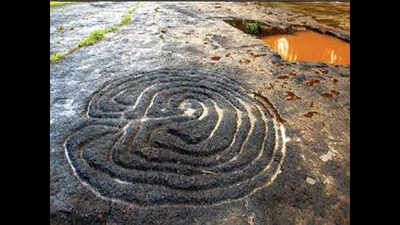
The magnificent carvings of the Mesolithic site at Pansaimol have been entirely abandoned to the elements for many years

That dating is consistent with the dominant themes represented in the petroglyphs of both, Goa and Maharashtra, which are the preoccupations of hunter-gatherer social groups that define what we know of the Mesolithic period (often referred to as the Stone Age). The last Ice Age was coming to an end, and early humans were on the loose in the newly warmer world. From other Mesolithic sites in India, we know our ancestors were experimenting with agriculture and starting to build structures for shelter, storage and worship.
But hunting and fishing were still central, as we can see from the Konkan petroglyphs: Huge bulls, herds of deer, sharks and whales, wild boar, and at least one rhinoceros.
Also apparent throughout is ancient humankind’s preoccupations with the night sky. Hunters needed to know the phases of the moon, which determine the availability of light at night, and fishermen have always depended on the tides.
Thus, many of the Konkan etchings appear to be forms of astronomical calendars and records that catalogue solstices, equinoxes and lunar events. Here, another finding announced earlier this year is relevant. An Indo-German team of astrophysicists led by Mahank Vahia, conclusively found that ancient images discovered in Burzahama in Kashmir are “the oldest depiction of a supernova, the final explosion of a dying star, ever discovered.” Vahia says, “They had drawn the entire sky.”
As far as we go back in history, there are accounts of Goa. The late scholar Anant Ramkrishna Dhume somewhat controversially made a case for considerable “Sumerian influence” in this territory, which would align to literally the first civilisation known to mankind. But even leaving that aside, there are mountains of evidence bolstering our understanding that this tiny sliver of the western coastline of India has been continuously inhabited throughout recorded time. But what we are learning from technologically-aided research in the 21st century is that the story goes much further back.
A host of sites in and around Goa have yielded the insight that early humankind flourished here as well. Now, we are on the verge of learning much more about that period and those people.
According to the BBC, the Maharashtra government has set aside Rs 24 crore to preserve and study the newly identified Konkan petroglyphs. That sum may sound inadequate given the number and broad distribution, but it is superior to Goa’s cavalier and shameful neglect of the crown jewel the Mesolithic site of the Konkan at Pansaimol where the magnificent carvings have been entirely abandoned to the elements for many years and remain extremely vulnerable to unsupervised groups that regularly walk all over them while leaving trash piled up all around.
At the same time, various new sites have been found with great potential, such as at Cabo de Rama, but the state authorities have demonstrated no interest whatsoever and are continuing to abdicate responsibility as they have for decades on end.
End of Article
FOLLOW US ON SOCIAL MEDIA






Photostories

Hot Picks
TOP TRENDING
Popular Categories
Hot on the Web
Top Trends
Hurricane MiltonRatan Tata NewsNew UPI Transaction LimitRatan Tata DiesPM ModiShantanu NaiduTom BradyStock Market TodayNarayana MurthyHarry BrookIsrael Hezbollah WarRahat Tata Inspiring QuotesManagement Colleges of IndiaTop Medical Colleges of IndiaTop Engineering Colleges of IndiaTop Pharmacy Colleges of IndiaLive Cricket Score
Trending Topics
Diwali WishesBigg Boss Tamil 8 Contestants ListBhool Bhulaiyaa 3 TrailerVettaiyan Twitter ReviewSanjay Leela BhansaliVettaiyan ReviewSalman KhanDevara CollectionBigg Boss 18Deepika PadukoneShraddha KapoorRatan Tata Passed AwayColdplayVettaiyan Movie ReviewSwatantrya Veer SavarkarDussehra 2024Watch NFL Live StreamDress To ImpressRatan Tata DeathWordle Answer
Living and entertainment
Latest News
How Chennai Night Race swerved past challenges to zoom toward a brighter motorsports futureAll-Star Tower Defense (ASTD) Codes October 2024Ranveer Singh: I have a man crush on Tiger ShroffWho is Noel Tata? Meet Ratan Tata’s half-brother, who could be successor at Tata TrustsHow to make Ginger Turmeric Shots for seasonal changeWhen Amitabh Bachchan slept on Marine Drive with rats as neighbours: I didn’t have a place to stay'You're drunk': Britons stunned by BBC app's shocking 18,995 mph wind forecast!Hanging Lights For Living Room: Transform and Illuminate Your SpaceICC Women's T20 World Cup: Harmanpreet Kaur, Smriti Mandhana, bowlers demolish Sri Lanka as India get NRR boostOnly a true creative genius can spot the odd unicorn in 12 seconds!Ratan Tata no more: When his throwback pic had netizens saying he looked like a Hollywood star'Vettaiyan' Twitter review: Rajinikanth shines in this investigative thriller'Vettaiyan' early and first review: Rajinikanth starrer has a good twist!CATS YouTube codes for October 10, 2024: Enhance your gameplay and know how to redeem the codesKarnataka BJP chief hints at CM Siddaramaiah’s possible exit amid 'fast-paced political changes'Bigg Boss 18: Karan Veer Mehra opens up about losing his father at the age of 10; says 'Main apne dad ki death par nahi roya'Exploring the link between spirituality and mental health on World Mental Health DayAAP alliance could've helped Congress in Haryana, but just to boost its tally by 3
Copyright © 2024 Bennett, Coleman & Co. Ltd. All rights reserved. For reprint rights: Times Syndication Service