
Trending
This story is from September 15, 2019
Songs of Goa’s marginalised maidens
The songs of our mother’s mother, and her mother before that may no longer be part of our collective memory, but even the briefest of brushes with their creative lyrical outbursts is enough to lend an insight into their lives, their joys, trials and tribulations. Of the vast oeuvre of songs, the grinding or millstone songs are the least feted and doomed to obscurity, much like their marginalised authors.
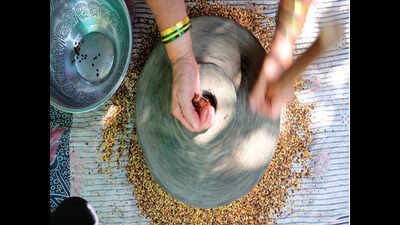
BORN OF TOIL: In the absence of education, the compositions also served as a means of matri-linear transference of information about social rules and customs
“Sometimes, the grinding stone was the only friend a young Hindu bride had in a hostile environment.

When the term ‘young’ is used to describe the bride, remember the reference timeframe is far removed from today and girls would be married off as young as seven and eight. Separated from her family at such a tender age, the child, who more oft than not would serve as the family workhorse, would burst into verse from her lonely perch behind the millstone.
The monophonic songs sung to the rhythm of the turning stone would serve as a means for the daughter-in-law to vent her sorrows, her homesickness and more often than not her pining for her brother. But not all the ‘oviyos’ were sad. “There were verses that recounted legends and mythologies, ballads of bravery and valour and even wedding songs,” says Pandit.
However, experts would beg to part the veil of the verse to reveal a sub-culture that has been made redundant with the improvement of women’s lot.
“The folk songs composed and sung over the grinding stone may have been a vehicle of expression but were also a means of imparting the various rules of society, customs and traditions to Goan women, who did not receive any formal education,” says Pournima Kerkar. Hers is knowledge born from close observations and a lived experience.
Pandit, who has translated these songs from Konkani and in the process given the lost voices a voice, explains how these songs were about matri-linear transference of social rules. She elucidates her point by sharing what one singer of these songs told her: “In our days there were no schools, we did not understand the ways of the world. We did not know what society allowed and what was forbidden. It is only through songs and stories that we were taught the rules of society.”
Strangely, such folklore is missing from the Catholic community of Goa, but in the foreword of the book ‘Grinding Stories, Songs from Goa’ by Pandit, writer Damodar Mauzo explains the reason for this.
In 1684, the Portuguese passed a decree banning Konkani, which converts had to follow, he writes. He adds that, according to folklorist Jayanti Naik, the folk element that seemed lost to the Catholics of Goa, found a back-door entry in the form the famous Konkani ‘cantar’.
Like with so many other things, the song of the women of Goa have been lost in the din of modernisation. But not entirely. There are still a few women in rural Goa who keep the culture alive, but the spontaneity of verse is no more. How long that too will continue, is anybody’s guess. In the meantime, research and storage of this intangible heritage is one way to keep it alive.
End of Article
FOLLOW US ON SOCIAL MEDIA











Hot Picks
TOP TRENDING
Popular Categories
Hot on the Web
Top Trends
Tirupati Laddu Case HearingIND vs BAN Live ScoreRohit SharmaIftikhar AhmedMayank YadavUGC NET Result 2024Taylor SwiftCanada Study Permit Pilot ProjectSean CombsIsraeli AirstrikeNaomi Net WorthWho is Dominik Mysterios WifeWho is Hassan NasrallahIsrael Hezbollah WarDiddyShah Rukh KhanLive Cricket Score
Trending Topics
Devara CollectionBigg Boss Kannada 11 Launch Live UpdateKangana RanautJungle SafariStree 2 OTT ReleaseRose GardenDevara CollectionOTT Release MovieMasala OmeletteEmergencyDevaraTaaza Khabar 2 Twitter ReviewDevara Movie ReviewHealthy RaitasSwatantrya Veer SavarkarColdplay India tour 2025Smartphone DealsApple Macbook Air M1Amazon SaleWordle Answer
Living and entertainment
Latest News
UP man kidnaps boy to arrange UPSC funds, heldAishwarya Rai Bachchan touches Nandamuri Balakrishna's feet as a sign of respect, the Telugu star blesses herCovid lockdown on earth led to dip in Moon's temperature: StudyFrom A.R. Rahman to Satyajit Ray: Indian Oscar winners who made historyHost Kiccha Sudeep to Bigg Boss Kannada 11 contestant Aishwarya Shindogi: Come back as a stronger personManipur CM Biren accuses Kuki militants of abducting 2 Manipuri youthsKhatron Ke Khiladi 14 winner: Karan Veer Mehra lifts the trophy and Krishna Shroff becomes the first runner-upWhat to expect after a facelift procedureFPIs buy Rs 57k crore stocks in September, flows hit 9-month highDelhi PWD to restore roads by Diwali; CM Atishi inspects Okhla as part of govt's repair drive"It sounds like they really had to squeeze responses out of Vince": WWE Hall of Famer discusses Vince McMahon's reluctance in speaking during Netflix seriesColleagues remember braveheart Delhi Police constable Sandeep: 'Would rush to crime scene alone'‘Nadikar’ OTT release: Reason why the Tovino Thomas starrer is on hold10 desk exercises for 40-plus men for a healthy lifeA killing & a tipping pointFun-filled inside pictures from Inaaya Naumi’s 7th birthday party with Kareena Kapoor, Saif Ali Khan, Taimur, Jeh, Soha, Kunal Kemmu and more family membersIndia to maintain LAC troop deployment as trust deficit with China remainsWith $3.16 Million Lost in Game Checks, Can Haason Reddick Afford to Keep Holding Out?
Copyright © 2024 Bennett, Coleman & Co. Ltd. All rights reserved. For reprint rights: Times Syndication Service