
Trending
This story is from November 5, 2022
RED EARTH AND WHITE LINES
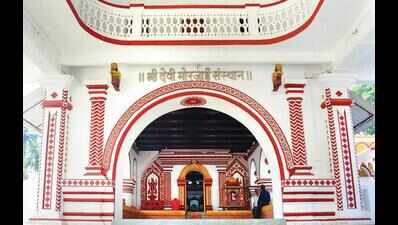
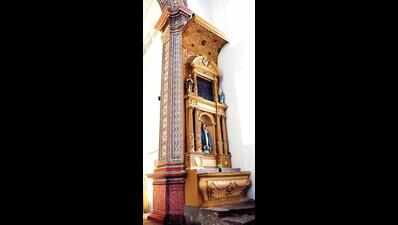
It took a dramatic mention from none other than Prime Minister Narendra Modi for these paintings to find a revival—the first since Goa’s Liberation over 60 years ago—when in his weekly broadcast ‘Mann Ki Baat’ on December 26 last year, Modi spoke about the efforts to revive kaavi technique.

Today, there are no living kaavi artists and researchers are busy trying to piece together the lost years of kaavi.
Kaavi’s chequered history and its origins are still a mystery for researchers. Some believe kaavi was brought to the Konkan coast by artists from Punjab-Sindh region, having travelled with the Saraswat community when they migrated to the West coast due to environmental adversities.
Archaeologist Sawani Shetye has spent five years researching kaavi art and its origins and has found links between kaavi patterns and yakshagana puppet tradition of Karnataka.
“The origins of kaavi are not certain,” says Sawani. “Some say it has come through the Portuguese to Goa, others believe it has Indian roots. And in general, throughout the history of human civilisation, red soil has been used to draw and paint across the globe. Goa with its natural port was a melting point, which makes it even more difficult to pinpoint its origin.”
Kaavi art is the use of red iron-rich soil and lime to decorate walls and ceilings, mainly of places of worship, but not limited to it.
“A lime plaster derived from crushing seashells is used to coat the wall, this is followed by a layer of the red soil. The artist then etches a design using a stencil, while the paint is still wet. The red is gradually removed to reveal the white, creating beautiful patterns,” says Sagar Mule, whose revival efforts were noted by the Prime Minister in ‘Mann ki Baat’.
The oldest kaavi pattern today can be traced to 16th century structures and there is no pre-Portuguese structure in existence with kaavi, which has served as a limitation for researchers, reckons Sawani.
“One thing is for certain that kaavi travelled to Karnataka through Saraswat community families. And it is not found in mutts belonging to Kannada speaking people, but only Konkani Gaud Saraswat Brahmin mutts. But this is possible because kaavi requires good pigment of kaav or red soil, fine walls and is a labour and skill incentive and this was only possible for affluent families,” she says.
This is probably why kaavi patterns are also found inside houses of affluent Dessai and Rane families in Goa.
Kaavi is Goa’s only traditional native art technique and the first effort of restoration was taken up by the state government recently at the Shree Saptakoteshwar temple at Naroa.
In most cases, the art is found on private homes or temples owned by private managements, making it all the more tough to engineer a mass revival. At times, not-well-thought through reconstruction and renovations of temples have affected kaavi’s preservation, like the Shri Brahmanimaya temple of Caranzol that was demolished a few years ago to construct a new temple.
A majority of the kaavi patterns found today are on structures that are New Conquests or parts of Goa which did not come under Portuguese control for around 150 years after colonisation.
According to researcher Krishnanand Kamat’s authoritative book Konkanyangele Kavikala, some records are available indicating the year in which the art was completed like the Mahalasa Narayani temple of Kumta constructed in 1565 and Rama Mandir of Honavar erected four centuries ago. However, no temple constructed in the last 50 years contains any kaavi art that is worth mentioning, he states.
There are no living kaavi artists either.
“The Chari or other communities who were possibly doing this work of painting using kaavi probably stopped getting patronage from the community and gave up the work. There was almost a 40-50-year gap before any revival or restoration efforts were made post-Liberation and no one tried to replicate the designs during this period, so the art is nearly extinct,” says Sawani.
While outside Goa, standalone figurative patterns from Indian mythology are found made in kaavi form, within the state the patterns are mostly geometric and floral. Temples display floral borders (nakshi) with peepal tree leaves and geometric shapes, while churches bore simple floral bands.
Traditionally, kaavi can be seen on walls, columns and ceilings, while also being used to delineate sacred spaces and niches in temples and homes.
Kaavi being a technique, and not a style of painting, was versatile and had the scope to be secular.
The patterns were recently discovered under layers of lime wash during restoration of the Chapel of the Convent of Santa Monica, leaving restorers stunned, says curator of the adjoining Museum of Christian Art, Natasha Fernandes.
Besides the Chapel, Mule recently helped restore kaavi on the walls of the Shree Maruti Temple belonging to the Deshprabhu family of Pernem. He is now working on putting a contemporary spin to kaavi in the hopes of its revival.
“I am trying to use the kaavi technique to paint new designs, instead of the traditional designs. I have also successfully used the original kaavi technique on paper, while it was only seen on walls so far. Now that it is on paper, it can travel to other places in India and abroad and we could possibly see a new interest in kaavi,” says Mule.
HISTORY ON THE WALLS
Prominent structures in Goa having remnants of kaavi art
Temples
* Shri Kshestrapal, Agarvaddo, Pernem (has oldest known kaavi art)
* Shri Morjai, Morjim
* Partagal Mutt
* Shri Mulver, Malpem, Pernem
* Shri Parshuram, Poinguinim, Canacona
* Shri Betaal, Poinguinim, Canacona
* Shri Maruti, Advapale, Bicholim (restored and protected under Goa Ancient Monuments, Sites and Remains Act)
* Shri Brahmanimaya, Caranzol, Sattari (now demolished)
* Shri Venkatesh, Phansawadi, Canacona
Churches (Old Goa)
* Chapel of Our Lady of Mount (restored)
* Chapel of Our Lady of the Rosary
* Church of St Francis of Assisi
* The Archiepiscopal Palace
* St Catherine’s Chapel
Houses
* Boruskar Desai House, Poinguinim, Canacona
* Desai House, Lamgaon, Bicholim
* Deshprabhu Palace, Pernem
* Rane mansion, Sanquelim
The Technique
The wall is plastered with lime first (made from sea shells). It is then cured with water over two days. A steel bodkin is used to etch the design and then the design is scratched out (all done with a free hand). The cavities are filled with ‘kaav’, which is made up of fine red soil, charcoal powder and the extract of a milky plant locally called paal kudi (milk sap creeper) or liana for binding. Only the areas that are sacred are decorated and defined with kaavi. The kaav or red soil (tambdi maati) of Goa provided the most auspicious colour. Kaav was also used for medicinal purposes.

About the Author
Gauree MalkarnekarEnd of Article
FOLLOW US ON SOCIAL MEDIA










Photostories
Hot Picks
TOP TRENDING
Popular Categories
Hot on the Web
Top Trends
IND vs BAN Live ScoreRussell WilsonsVirat KohliMickey ArthurShantanu NaiduUGC NET ResultNobel Peace PrizeMahadev Betting AppAmazon LayoffsRatan Tata DiesCBSE Class 10 12 Practical ExamPopular Schools in Navi MumbaiManagement Colleges of IndiaTop Medical Colleges of IndiaTop Engineering Colleges of IndiaTop Pharmacy Colleges of IndiaLive Cricket Score
Trending Topics
Diwali WishesDussehra 2024 QuotesDussehra WishesVettaiyan OTT ReleaseVettaiyan CollectionVettaiyan ReviewNatasa StankovicDevara CollectionBigg Boss 18Deepika PadukoneShraddha KapoorRatan Tata Passed AwayJigra Movie ReviewVettaiyan Movie ReviewSwatantrya Veer SavarkarDussehra 2024Elon MuskDussehra Whatsapp StatusUltimate Football Codes October 2024Wordle Answer
Living and entertainment
Latest News
Challenging Aspects in Astrology: What They Mean for You'Promotion of players by agents...': Mickey Arthur criticizes PCB, media for team's declining performancesInfosys to no longer send job offer letters and attachments, the company will ...US carries out airstrikes in Syria to avert Isis attack on American soilExclusive: Aishwarya Khare recalls his childhood memories of Dussehra, says 'my father used to take us all to watch Ram Leela and Ravan Dahan'Punjab NEET UG Counselling 2024: Round 3 provisional merit list out, steps to checkDiscover 8 animals that suck blood for survivalHappy Dussehra 2024: Top 50 Wishes, Messages, Images and Quotes to Share with Your Loved OnesIn the land of Ram, a Ramlila that unites Hindus and Muslims'Singham Again' stars Ajay Devgn, Kareena Kapoor, Rohit Shetty spotted at airport as they jet off for Raavan Dahan in Delhi - Watch VIDEOPapankusha Ekadashi 2024: Date, Parana Time, Puja Rituals and Significance'Bigg Boss OTT 3' contestant Ranvir Shorey admits lack of patience for 'Bigg Boss', enters the show unprepared7 dead, 1 missing after car plunges into canal in Haryana'HanuMan' director Prasanth Varma reveals 'difference of opinion' with Ranveer Singh, hints at future collaborationETimes Pic of the day: When Indrajith Sukumaran bumped into Mukesh Ambani at a traffic signalDid you know NTR is the only actor to play both Lord Rama and Ravana?Ashton Kutcher and Mila Kunis consider leaving Hollywood amid Sean 'Diddy’ Combs' arrest fallout: ReportSwearing-in ceremony of Nayab Singh government in Haryana on October 17: Manohar Lal Khattar
Copyright © 2024 Bennett, Coleman & Co. Ltd. All rights reserved. For reprint rights: Times Syndication Service