
Trending
This story is from November 4, 2021
Part of Ribandar causeway side wall gives way
A half-meter long side section of the Portuguese-era Ribandar causeway collapsed on Wednesday evening. Even though a small portion was affected, the North Goa collector’s office issued instructions to divert traffic as a precaution for the safety of commuters.
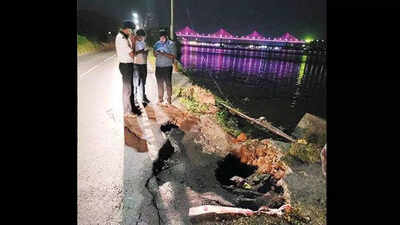
The historic Ponte de Linhares bridge is 383-year-old
Traffic personnel were posted to monitor flow of vehicles at the site, while PWD officials said that the repair work would be taken up by 8.30am on Thursday and that work is expected to be completed within 24 hours.

The historic Ponte de Linhares (Linhares bridge) was constructed by the Portuguese to link Panaji to Old Goa via the village of Ribander. And the 383-year-old bridge still continues to serve as a useful link.
The bridge was once considered the longest bridge in Asia, and is perhaps India’s oldest. Built in 1634 for horse-drawn carriages, it has withstood the devastation of time and is today used by all kinds of traffic, including buses.
As part of the move to promote pedestrianisation and protect the Portuguese-built structure, the state government in 2017 mooted the proposal to close the Ponte de Linhares bridge, or Ribandar causeway, for traffic permanently. The proposal was part of the Smart City Mission.
Officials say the bridge can survive a few more years if traffic is phased out or brought to a complete stop.
In 2016, North Goa collector Nila Mohanan had declared the bridge unsafe for heavy traffic and had notified that traffic had to be stopped, PWD officials said.
End of Article
FOLLOW US ON SOCIAL MEDIA










Hot Picks
TOP TRENDING
Trending Stories
In City
Entire Website
- Indian investors are rushing to buy properties in Greece; here’s why
- From Cristiano Ronaldo to Lionel Messi: Top 5 players to get fined over tax evasion
- Apple, Cisco, Microsoft and other tech giants are slashing jobs despite healthy revenues: Triggers behind the layoff culture, ways to safeguard your career and more
- 'Assigned task was not hers': Work pressure at EY Pune kills CA daughter from Kerala
- 'Stupid statement': Ex-Pakistan cricketer Basit Ali blasts Australian bowler for predicting 5-0 victory over India in Border-Gavaskar Trophy
- EXCLUSIVE | My sights are set on hitting the bullseye and changing the colour of medal at Los Angeles Olympics: Manu Bhaker
- Telangana to scrap 15-year-old vehicles from January 1
- What MS Dhoni said to Yuvraj Singh after he hit Stuart Broad for 6 sixes in 2007 T20 World Cup
- 'Attempt to polish your failed product': Nadda's response to Kharge's letter to PM Modi
- Pannun files civil lawsuit in US against GOI, Doval and others, seeks damages
- Satellite sniper, poison, pager and walkie-talkie blasts: How Mossad can kill Israel's enemies
- Tirupati laddu row: Lab reports confirm lard, tallow in ghee supplied to Tirumala
- How one drug might work for weight, fertility and dementia
- 'We will keep close watch': Kolkata docs to resume work from Saturday
- FATF report warns 'Left-wing groups seeking to overthrow Indian govt'
- Unwarranted & unsubstantiated: India on Pannun lawsuit in US
- India beats China in yet another global benchmark
- Accenture delays promotions globally, after denying salary hikes to employees in India
- Report on Indian arms reaching Ukraine misleading: MEA
- Ukraine war, Global South, IPEF on agenda as PM Modi heads to US

Popular Categories
Hot on the Web
Top Trends
Mark ZuckerbergIND vs BAN LiveUS Fed Interest RatesSecret Lovers of WWEIndia Fastest Metro ServiceIsrael Air Strike in LebanonIsrael Hezbollah WarNPS VatsalyaThe RockHezbollah Chief NasrallahJohn CenaTirupati Laddu RowTop 5 Players to get Fined over Tax EvasionAmazonSukanya Samriddhi YojanaAppleLive Cricket Score
Trending Topics
Diljit DosanjhsSalim KhanAbdu RozikKhatron Ke Khiladi 14Ocean WaterBigg Boss 18Tirupati Laddoo ControversyNandhan ReviewLebanon Pager BlastPitra Paksha 2024CheetahsKangana RanautAditi Rao HydariDalljiet KaurHoliday DestinationVikas SethiBest Selling Earbuds Under 1000Apple iPhone 16 ProVirat KohliWordle Answer
Living and entertainment
Latest News
Centre to examine EY India worker’s demise'Unwarranted, unsubstantiated': India reacts strongly to US court summons over pro-Khalistani terrorist Pannun's lawsuit over 'assassination bid'Thalapathy Vijay’s GOAT is inching towards Rs 15 crore mark in HindiHaryana AAP chief Sushil Gupta slams BJP, criticises 'one nation, one election' as unrealistic promiseRavichandran Ashwin's sixth Test ton vs Bangladesh seals rare cricketing featAnantapur court sentences one to life imprisonment and seven to rigorous imprisonment in a kidnap and murder caseBanks to play important role in making in Viksit Bharat : FM SitharamanAdulteration of cow ghee used in Tirupati Laddus triggers political slugfest between TDP and YSRCPSuch knocks will help me become strong and play in all conditions, says Yashasvi Jaiswal after making fiftyOnePlus 12 is available for Rs 35,314 only on Amazon; check exchange deal and bank offersAccenture shifts promotion cycle to JuneI am looking at finite projects right now: Prachee Shah PaandyaSujitha Dhanush to Priyanka Deshpande: A look at the Top 3 finalists of Cooku With Comali season 55 ways cottage cheese can transform your well-beingFrom puke to popcorn: Tupperware's bankruptcy incites memes and memoriesHamster Kombat Daily Cipher Codes and Combo Cards for September 20, 2024: Unlock up to 1 million coinsBest Double Door Refrigerators Under 30000 for Smart Buyers Looking to Save Money & EnergyRBI lifts restrictions on IIFL Finance's gold loan business
Copyright © 2024 Bennett, Coleman & Co. Ltd. All rights reserved. For reprint rights: Times Syndication Service