
Trending
This story is from December 19, 2021
How the Saint of the East remained in the East
Less than three weeks ago, thousands of devotees thronged to Old Goa for the novenas and feast of St Francis Xavier, a high point in Goa’s religious calendar. Throughout the year, thousands of pilgrims visit the 16th century Basilica of Bom Jesus, which houses the relics of the Spanish Jesuit missionary.
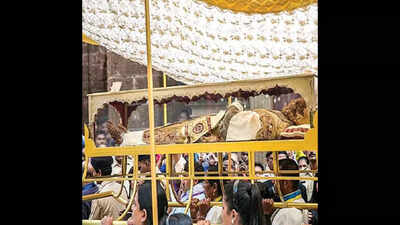
Throughout the year, thousands of pilgrims visit the Basilica of Bom Jesus, which houses the relics of the Spanish Jesuit missionary
But if former Portuguese PM Antonio de Oliveira Salazar had his way in 1961, the relics wouldn’t even have been in Goa.
It was the then Portuguese governor general, Manuel Antonio Vassalo e Silva, who put his foot down and refused to transfer the relics to Portugal — as he had been ordered to by Salazar — despite knowing he would face court martial.
“The relics of St Francis Xavier are a moral patrimony of the Portuguese Estado da India, around which they (the people) will gather in the moments of danger that are certainly approaching,” Vassalo e Silva replied to Salazar, according to history writer Vasco Pinho. “St Francis Xavier is Saint of the East, and as such, his place is here. In view of this, it is not possible for me to obey the order.”
In his book, Snapshots of Indo-Portuguese history-II, Pinho notes that this was one of three orders by Salazar that Vassalo e Silva deliberately disobeyed.
Another writer, the Jesuit Delio de Mendonca, wrote that he disregarded Salazar’s orders fearing an adverse reaction from Goan Catholics.
The Basilica’s current rector, Fr Patricio Fernandes, says that had the relics been moved away, things would have been very different in Goa.
“There would have been a big lacuna,” he said. “With the presence of St Francis Xavier, things are very different here in the way we live, perceive, and act. The relics have a different kind of aura, and people are drawn to the place and to the mysterious experience. They feel at peace here and we want to enhance this pilgrim experience for the people.”
Fernandes added that many people are under the impression that the relics have been mummified and embalmed.
“It has to be made clear that the relics were not embalmed. In fact, there were three attempts to hasten the decomposition of the body to bring it to Goa, but this didn’t work.
“It is miraculously stored by God, and continues to remain a miracle even today. After so many years, the scalp on the bones, etc, could have fallen apart when moving the casket up and down, but this hasn’t happened. It cannot be called a mummy but a pure and simple relic,” he said.
In 1961, Vassalo e Silva hurriedly organised an exposition, looking for a miracle for Goa. “The exposition ended with the arrival of Indian troops. In 1962, when Chinese troops crossed India’s northern border, the Indian military governor of Goa ordered a private exposition, but this again failed to influence events,” said Maurice Hall in his book, ‘Window on Goa’.
This Exposition was scheduled to be held between December 13 and 31, 1961, under threatening circumstances of the large Indian military contingent assembling near the Goan frontier, with tension looming, Mendonca wrote in his book, Francis Xavier in India.
“Under these threatening circumstances, the Exposition was peremptorily sanctioned by Portuguese authorities — for imploring the saint’s intercession, and with attendance reserved to the military and civil officials of Portuguese Goa,” Mendonca wrote.
However, even as the Exposition was scheduled to last till December 31, it was abruptly terminated when the Indian Army entered Goa on December 18.
“Even as the sacred relics were returned to its casket, it may well have been that many Goans were still not intimated concerning the hastily-arranged Exposition,” Mendonca notes. “It was suggested in some quarters that when the Indian Army made its 1961 incursion into Goa, Goencho Saib failed to heed the earnest prayers beseeching him to maintain the political status quo, as he was believed to have done in 1693 when the Marathas had threatened to invade. However, such claims have not had the effect of diminishing the popular respect and devotion accorded to Xavier by his loyal devotees.”
Stay updated with the latest news on Times of India. Don't miss daily games like Crossword, Sudoku, and Mini Crossword.
End of Article
FOLLOW US ON SOCIAL MEDIA









Hot Picks
TOP TRENDING
Popular Categories
Hot on the Web
Top Trends
Ravichandran AshwinVirat KohliWTC Points TablePushpa 2 StampedeIndia vs AustraliaWorld Most Powerful Business Leaders 2024Countering hoax airline bomb threatsBrabu Result 2024Popular CBSE Schools in MaharashtraR Ashwin RecordsOne Nation One ElectionKaran Aujla ConcertR Ashwin EmotionalNEET UG SyllabusKarnataka NEET PG Counselling ScheduleKallakurichi Hooch TragedyNitin GadkariLive Cricket Score
Trending Topics
Pushpa 2 America Box Office CollectionPushpa 2 ReviewVijay DeverakondaOptical illusionAkshay KumarPushpa 2 OTT ReleaseDiabetes Type 2Major Predictions for SaturnPadma Shri Tulsi GowdaPushpa 2Shahid AfridiFull Cold Moon December 2024Skincare Tips for WinterWeight Loss TipsHair FallNYT ConnectionsNarayana MurthyElon Musk
Living and entertainment
Latest News
New directors announced for ‘Spider-Man: Beyond the Spider-Verse’Bill Skarsgard praises Yayan Ruhian, calls him a 'true master' ahead of 'Boy Kills World' OTT premiereSri Lanka wins agreement with IMF for tax relief: President DissanayakeWatch: Virat Kohli perfectly sets up Travis Head dismissal, convinces Rohit Sharma to...89/7, no problem! Pat Cummins overlooks India's parting shot in drawn Gabba Test'Ghar Ke Kalesh': Drunk man gets beaten up with broomstick by angry wife, video goes viralIs protein powder a scam? This is what experts have to sayShark Tank India: Ashneer Grover recalls approaching Anupam Mittal to raise money for his digital pay brand, says 'He only gives ‘gyaan’, not money'CBI books four central GST officials for demanding Rs 5lakh bribe from Madurai businessman5 predictions of Nostradamus that are believed to have come trueTabu's liplock with Mark Strong in 'Dune: Prophecy' goes VIRALReeshma Nanaiah on comparisons with Sreeleela: 'I want to be known for my performance, not just dancing'How to change luck from bad to good in 2025 by doing these remediesRohit Sharma admits going through a rough patch, says 'it's all about ...'UPSC 2024 Expert Guide: What every UPSC aspirant should know about DAFThis 5-second finger test can help detect early lung cancer signsICC to hold emergent meeting on Champions Trophy on TuesdayHybrid Champions Trophy after political unrest in Pakistan?
Copyright © 2024 Bennett, Coleman & Co. Ltd. All rights reserved. For reprint rights: Times Syndication Service