
Trending
This story is from January 29, 2021
How Manohar Parrikar put his foot down and saved Mollem
Circa 2013. Manohar Parrikar was the chief minister when the three contentious linear projects, cutting across the biodiversity paradise of Mollem, were first proposed. But contrary to many claims, edited video excerpts and blatant falsehoods being spread, Parrikar had rejected these proposals outrightly.
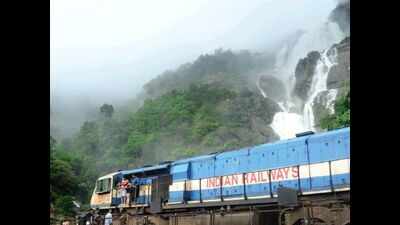
With four engines required to propel a single rake up across the steep gradient of the Braganza Ghat, forest officials voiced concern over its imminent adverse effects over the pristine yet fragile forest environment.
The reason: It would entail largescale destruction of the biodiversity hotspot of Mollem.


For one of the projects—the 440KV power transmission project by Tamnar—Parrikar even made them rework their proposal to keep the damage to the minimum.
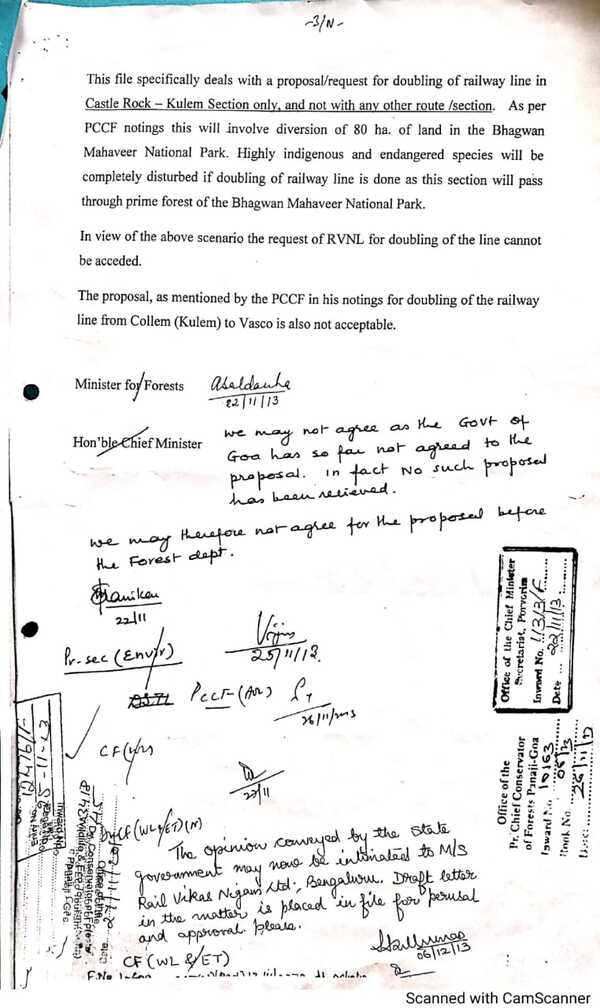
It all started when Rail Vikas Nigam Ltd (RVNL) proposed double tracking through Bhagwan Mahavir National Park at Mollem to the forest department. The then principal chief conservator of forests, Richard D’Souza, vehemently put forth his objections to the proposal in writing in the file.
D’Souza had noted that the proposed second railway line passes through the prime forest of Bhagwan Mahavir National Park which has “highly indigenous and endangered species like Black Panther, leopard, Gaur and a host of other fauna, which will be completely disturbed if doubling of the railway line is done”.
The then forest minister Alina Saldanha concurred with D’Souza and placed her objections, too. When the file reached Parrikar on November 22, 2013, he wrote: “We may not agree as the government of Goa has so far not agreed to the proposal. In fact no such proposal has been received. We may, therefore, not agree for the proposal before the forest department.”
Sources said sensing Parrikar’s disinclination, the Railways put the proposal on the backburner but vigorously renewed its efforts only after Parrikar moved to Delhi to take over as the defence minister.
With Parrikar away from the state, RVNL for the second time in September 2016 pushed for the case with the help of the forest department. And it got support from the then chief secretary R K Srivastava.
“Doubling of railway track in question assumes significance from the national perspective and in order to improve overall economy and efficiency into the system (sic). Project has already been approved by GOI. Proposal may be considered for approval please,” Srivastava noted in the file, before it was placed before the forest minister and the chief minister for their approval.
The then forest minister Rajendra Arlekar and then chief minister Laxmikant Parsekar both gave the nod immediately without a single remark, as seen from the notings in the file, a copy of which is with TOI.
Seven years after he put his foot down over the track doubling proposal, TOI spoke to D’Souza who voiced his concern over the vulnerability of the Braganza Ghat section to landslides, if the track doubling is carried out.
“The Portuguese had carved out the railway track through the fragile ghat section very professionally, owing to which there hardly occurs any landslide during the monsoon. Can one be reassured that there will be no landslides following the construction of the second track, especially considering the landlslides on the Konkan railway track every monsoon? If the iconic Dudhsagar gets affected owing to the damage caused by the project, it will also adversely affect state’s tourism industry,” he said.
Considering the high rainfall Goa receives—an average of 2,500mm—D’Souza said: “Disaster is waiting in the wings to happen in the ghat section. There’s no doubt about it.”
With four engines required to propel a single rake up across the steep gradient of the Braganza Ghat, and the pollution-causing cargo that will be transported through open wagons, forest officials have voiced concern over its imminent adverse effects over the pristine yet fragile forest environment.
As regards the national highway expansion project, sources in the forest department disclosed how Parrikar vehemently told the highway authorities that the proposal won’t be passed until all necessary mitigation measures were incorporated in the project.
“He categorically told them that the proposal will never see the light of the day if you don’t give mitigation measures, and that they need to be incorporated in the project proposal,” a senior forest official familiar with the developments told TOI.
“When the project consultants put forth the argument that the cost of incorporating mitigation measures would be prohibitive, Parrikar shot back saying, ‘If you want your project to be executed in a timely manner, you should incorporate all the mitigation measures.’”
And based on Parrikar’s persistence, all the mitigation measures suggested by the forest department—a number of animal underpasses and overbridges—were recommended in the proposal and all of them later incorporated in the project, the official said.
Forest officials have insisted on strict restrictions on vehicle movement through the highway passing through Mollem forests to prevent wild animals coming under vehicles.
“Entry of vehicles on the roads passing through the Gir National Park is banned during the night. The road passing through the Bhimgad wildlife sanctuary also gets closed during the night. Why not have the same measures for the Mollem forest?” a forest official said.
As regards the Tamnar power transmission project, forest officials familiar with the developments told TOI that it was Parrikar again who had directed the power firm’s officials to look for an alternative alignment to ensure “minimum damage” to the forest.
According to the initial alignment, the transmission lines would pass through 13km of the prime forest area entailing huge destruction. The route was realigned and the distance through the sanctuary reduced to just 2.5 km.
“There can be no other alignment to reduce the distance further. This is the only area where the sanctuary area is the narrowest,” a forest official said.
But what perplexes the forest officials is the haste in which the Goa State Board of Wildlife gave its approval to the projects.
“When we had opposed it with all seriousness it deserved when the projects first came up, I fail to understand why senior wildlife officials worked so seriously to approve the projects now, despite the circumstances remaining unchanged,” a former senior forest official said.

About the Author
Govind Kamat MaadEnd of Article
FOLLOW US ON SOCIAL MEDIA









Hot Picks
TOP TRENDING
Trending Stories
In City
Entire Website
- UPI transaction limit to change from September 16! Here are the new limits for various UPI payments
- GK for students: 7 Fascinating Features of These Unique Birds
- No look shot gone wrong! Pakistan batter hilariously trolled after dismissal. Watch
- Andhra suspends 3 IPS officers for 'framing', arresting Mumbai actress
- UP medical aspirants converting religion to secure MBBS seats: A look at NEET UG admission criteria around minority reservation rules
- Who is Ryan Wesley Routh? Man held for 'apparent assassination attempt' on Trump
- Virat Kohli at his destructive best, shatters Chepauk wall near India dressing room with six
- 'Prince Harry is not even the spare to his wife': Meghan Markle’s treatment of Duke under fire
- Vince McMahon’s Expensive Properties, Bungalows, Villas, Private Jet, Car Collections, and More
- "Miami Dolphins Owner Stephen Ross Eyes Multi-Billion Dollar Deal: The $7 Billion Power Play"
- Assassination bid on Trump: 'Gunman supporter of Ukraine in its war against Russia'
- 'Doesn't sound like the man I know:' Son of assassination attempt accused
- Doctors’ protest shows Mamata’s hold over Bengal is slipping
- 'He may have said so, but ...': Pradhan reacts to Anil Vij’s CM claim
- Rohit Sharma comes up with a surprise at practice session
- 'Didn't want to be late for party': BMW speeding down wrong lane kills 2
- Cow vigilantes killing a Brahmin is the wake-up call India needed
- Apple's biggest 'iPhone update' for 2024: India time, how to prepare
- 'Bolte zyada hain': Pakistan great on Babar, Virat
- 'Tortured' by cops, Dalit boy dies in Uttar Pradesh

Popular Categories
Hot on the Web
Top Trends
Who is Ryan RouthUPI Transaction LimitArvind Kejriwal ResignationNEET UG Admission CriteriaYounis KhanBorder Gavaskar TrophySaim AyubSports Stars Turned Power CouplesSports CoupleDonald TrumpBianca Belair Net WorthSandip GhoshTejashwi YadavIndore BMW CrashPrince HarryMiami Dolphins OwnerLive Cricket Score
Trending Topics
Living and entertainment
Latest News
Challenges won’t stop me from making films that matter: Aditya Kripalani3 Reasons Why Hell in a Cell Tag Team Match Between Cody Rhodes, Roman Reigns and The Bloodline 2.0 Would Be perfect for Bad Blood 2024Odisha to join Ayushman plan; Delhi, Bengal to be only holdouts4 types of tea to improve gut health and ease digestive issuesRobert's wild encounter with Henry, the world's oldest 124-year old crocodile; internet shocked | Watch video‘I Hate Taylor Swift!’: Donald Trump rages after singer endorses Kamala HarrisFather-son duo Eugene and Dan Levy's dazzling entrance at the EmmysBakuchiol: Nature’s answer to youthful skin radianceSaudi Arabia footballer Fahad Al-Muwallad hospitalized after fall from balcony'Will hug my kids extra tight tonight': JD Vance after Trump 'assassination attempt'Bengal govt blames junior docs for logjam but sends fresh offer for talksLodi-era mosque collapses in AgraVineet Kumar Singh calls Superboys of Malegaon standing ovation at TIFF a 'magical experience': 'I can still hear the clapping and whistling" - ExclusiveFoods to pair with dates for boosting immunityLast Lunar Eclipse of 2024: What it means for your zodiac signNeeraj Chopra misses second Diamond League title by an agonising 1 cm; finishes second behind AndersonKejriwal says he will quit as CM in 2 days, wants aam aadmi's 'honesty certificate'Jessica Gunning wins her 1st Primetime Emmy for 'Baby Reindeer'
Copyright © 2024 Bennett, Coleman & Co. Ltd. All rights reserved. For reprint rights: Times Syndication Service