
- News
- City News
- delhi News
- Siblings overcome thalassemia odds with half-match marrow transplant
Trending
This story is from May 8, 2024
Siblings overcome thalassemia odds with half-match marrow transplant
Siblings Radhika and Shivansh from Pune underwent haploidentical bone marrow transplants at Dharamshila Narayana Hospital, overcoming thalassemia major. Their parents, Ashutosh and Preeti, served as donors, ensuring successful procedures despite the Covid-19 pandemic challenges.

Radhika & Shivansh, who suffered from major thalassemia, leading a normal life after haploidentical bone marrow transplant.
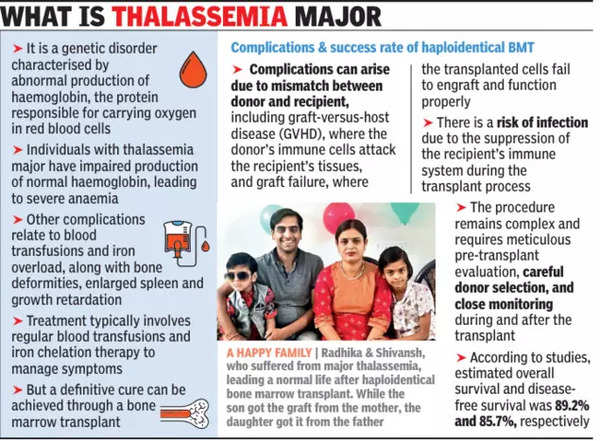
They were diagnosed with thalassemia major a few months after their birth.

According to doctors, the children underwent haploidentical bone marrow transplants (BMT) that involves using a donor who shares half of the necessary genetic markers with the recipient. Radhika's donor was her father, and Shivansh’s donor his mother.
"The first eight years after the birth of our first child in 2014 were the toughest period of our lives. In fact, we have started living and leading a normal life after my children underwent bone marrow transplantation in 2022," said Ashutosh Jha, a software engineer in Pune. He added that though the period was very tough, they didn't lose hope.
“We tried almost every possible option to find a cure for our daughter's condition, but without success. The only solutions were either a
bone marrow transplant (BMT) or a lifetime of blood transfusions. A doctor in Pune suggested having another baby to get a matching transplant without much complication. Without any delay, we planned our second child two years later. We went for a prenatal diagnosis at 8 weeks to a genetic counsellor, as we are both thalassemia minor carriers, a condition in which blood transfusion is not required.”
The doctor suggested doing the diagnosis at the 16th week, as it would have fewer complications and no harm to the baby. However, the result came after one month, by which time 20 weeks had passed. Unfortunately, the sample was also infected. "Though our family became complete, we were now parents to two thalassemia patients," Jha said.
They were devastated, he said. In August 2017, Ashutosh and Preeti arrived at Dharamshila Narayana Hospital, hoping to give their children a new life.
"After extensive tests, Ashutosh was finally chosen as a donor. On March 26, 2018, Radhika took the leap of faith into her new life, now free of thalassemia," said Dr Suparno Chakrabarti, consultant haematologist and BMT specialist, head & program director — haploidentical BMT and haematology.
After the success of the procedure, the parents wanted the same for Shivansh.
However, the covid-19 pandemic arrived.
Nevertheless, they persevered, and it was Shivansh's turn on Jan 30, 2022. The donor was Preeti.
Dr Sarita Jaiswal, consultant haematologist and BMT specialist, program director of haploidentical BMT, said that when both the parents carry the thalassemia trait, known as thalassemia minor, their offspring face varying probabilities of inheriting the condition.
"In such cases, there is a 25% chance of the child inheriting a normal haemoglobin genotype, free of thalassemia. Conversely, there is a 50% likelihood of the child becoming a thalassemia carrier, inheriting one thalassemia gene and manifesting as thalassemia minor. Typically, carriers of thalassemia minor experience mild symptoms or remain asymptomatic. However, the most severe outcome, thalassemia major, occurs in 25% of cases when the child inherits thalassemia genes from both parents," she said.
End of Article
FOLLOW US ON SOCIAL MEDIA







Photostories

Hot Picks
TOP TRENDING
Popular Categories
Hot on the Web
Top Trends
IND vs AUS Live ScoreBaba Siddique NewsVirat KohliRussell WilsonsSpacex StarshipRahul DravidWho was Baba SiddiqueBabar AzamNTA SWAYAM July RegistrationLawrence BishnoiAmazon LayoffsTaylor SwiftManagement Colleges of IndiaTop Medical Colleges of IndiaTop Engineering Colleges of IndiaTop Pharmacy Colleges of IndiaLive Cricket Score
Trending Topics
Diwali WishesDussehra 2024 QuotesDussehra WishesVettaiyan OTT ReleaseVettaiyan CollectionVettaiyan ReviewNatasa StankovicDevara CollectionBigg Boss 18Deepika PadukoneShraddha KapoorRatan Tata Passed AwayJigra Movie ReviewVettaiyan Movie ReviewSwatantrya Veer SavarkarDussehra 2024Star Health Hacker DemandedViral MemesUltimate Football Codes October 2024Wordle Answer
Living and entertainment
Latest News
How each zodiac sign handles emotional distance in relationshipsBook review: 'The Scientist Entrepreneur' by Dr Kalpana Sankar is a nuclear scientist’s inspiring journey of women’s empowermentDid BTS' V get promoted to corporal in the South Korean military? recent appearance at an orchestra event has fans speculatingParas Mhambrey joins Mumbai Indians as bowling coachSalman Khan’s security beefed up after Baba Siddiqui’s murder; ‘Sultan’ star looked uncomfortable after visiting the late politician’s family at 3 amRanji Trophy: Thriller in the making as Krunal Pandya fifty helps Baroda lead by 226 runs vs MumbaiOver 70 injured at Devaragattu Banni stick festival during Dussehra celebrationsBiker’s death ignites village fury in Odisha's Boudh, massive traffic jam on NH-57Women's T20 World Cup: Why India need Pakistan victory over New Zealand to secure semifinal berthSpaceX's fifth Starship test flight achieves historic booster catchKrushna Abhishek shares a heartwarming post for mama Govinda; says 'jab body mein adha blood supremely talented actor Govinda ka ho...'News brief: 'Who is listening? Modi?': Kapil Sibal takes a dig at RSS chief Mohan BhagwatKenya's Ruth Chepngetich breaks women's world record at Chicago MarathonZodiac signs likely to have soul connectionsAI’S Oppenheimer'Points towards failure of CM': Sanjay Raut slams Maharashtra govt over Baba Siddiqui's killingMahela Jayawardene returns as Mumbai Indians head coachMidnight queues, long waits, bad advice: It's not easy getting therapy in India
Copyright © 2024 Bennett, Coleman & Co. Ltd. All rights reserved. For reprint rights: Times Syndication Service